
AIX ! AIX ! AIX !
Aix-en-Provence Opera Festival: a logbook
It is always a joy, year after year, to set off once more for the beautiful city of Aix-en-Provence, to experience its traditional (it was founded in 1948) Opera Festival. It is a delight to once again enjoy open-air performances in the iconic setting of the Cour de l’Archevêché, in the almost new, so comfortable and pleasantly air-conditioned – which is important these days – Grand Théâtre de Provence, and in the charming, old-world setting of the Théâtre du Jeu de Paume.
Die Frau ohne Schatten – Richard Strauss
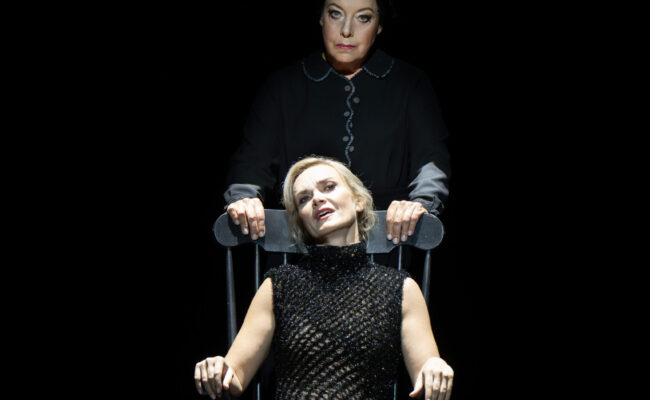
Let us begin with the production that will define this year’s Festival and remain its defining feature: ‘Die Frau ohne Schatten – The Woman without a Shadow’, as conducted by Klaus Mäkelä at the helm of the Orchestre de Paris, and magnificently staged by Barrie Kosky.
As we know, Strauss’s score is fabulous. As Klaus Mäkelä put it: ‘Extraordinarily rich, it draws on every possible resource’. It turns the orchestra into a character in its own right. What intensity, what contrasts, what a wonderful space it allows for the soloists within it, what surges, what outpourings, what subtleties.
But above all, this libretto offers an unrivalled playground for characters who are both highly distinctive and deeply nuanced. What a cast for these roles! Each and every one would warrant specific comments on their ‘portrayal of the role’: Vida Mikneviciute as the Empress, Ambur Braid as Barak’s wife, Nina Stemme as the nurse, Michael Spyres as the Emperor, Brian Mulligan as Barak, and, in various roles, Jean-Sébastien Bou, Tomasz Kumiega, Daniel Miroslaw, Robert Lewis, Gloria Tronel and Héloïse Mas.
Barrie Kosky, once again, has placed himself at the service of the work with creative modesty! What inventiveness, what freedom of imagination. What surprises he has in store for us. How perfectly it all comes together. There is the sudden appearance on stage of an immense three-tiered scaffold, which descends from the fly loft and rises back up again, serving as the Baraks’ incredible, hodgepodge home; there is a most peculiar rocking horse; there is a disjointed statue-like figure; there is the splendor of a fashion show featuring headless models; there is what looks like an enormous doll’s head. But none of this has been invented for the sake of invention: each of these unexpected elements serves a dramatic purpose.
This particular Frau ohne Schatten justifies the pleasure, the fondness, and the passion one can feel for opera; it is a magnificent defense and illustration of it.
Accabadora – Francesco Filidei
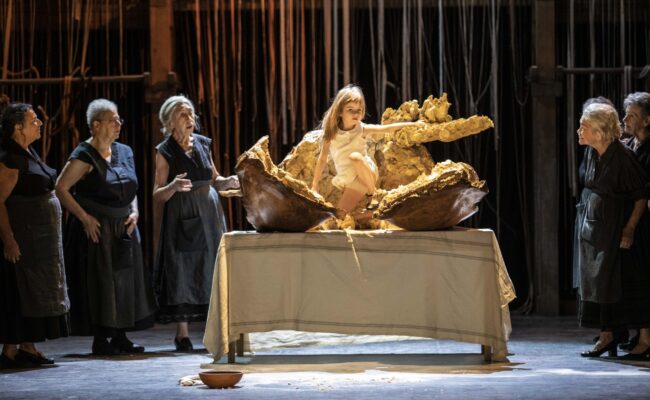
Another success is the premiere of Accabadora, the new opera by Francesco Filidei, who has already been acclaimed for his Giordano Bruno, The Name of the Rose and The Flood.
So, what does this strange title – which is difficult to pronounce at first – refer to? In rural areas of Sardinia, it refers to a woman, the ‘Lady of the Good Death’, the ‘last mother’, the one who, at the request of the family or loved ones, would come to put an end to the suffering of a dying person.
Little Maria is a child adopted by Tzia Bonaria Urrai, a seamstress, though one who seems to have another, mysterious occupation. Maria is to discover that she is the accabadora; she is to leave her region for northern Italy, far from these ways of living and dying. She will return there to be at the bedside of the dying Tzia Bonaria… and she will agree to take on her role from now on.
This opera is a work of delicate emotion. Filidei’s score can evoke the folk music and sounds of that region; it can also be seen as part of the operatic tradition; it is utterly convincing and fitting.
But what immediately draws us into this world is Valentina Carrasco’s direction, and in particular her set design: three gigantic looms standing vertically against the back wall of the stage, a reconstruction of a sewing workshop, and vines cascading down onto the stage. And so, little by little, moving beyond the initial realism of the portrayal, we are drawn into a world of human sensitivity, quiet reflection, and shared emotions.
Lucie Leguay brings the score to life, whilst Noa Frenkel-Tzia Bonaria and Rachel Masclet-Maria lead a cast whose talents complement one another.
Mozart
Mozart has always been at home at the Aix-en-Provence Festival, and this is particularly true this year, with The Magic Flute and a staged version of the Requiem.
The Magic Flute
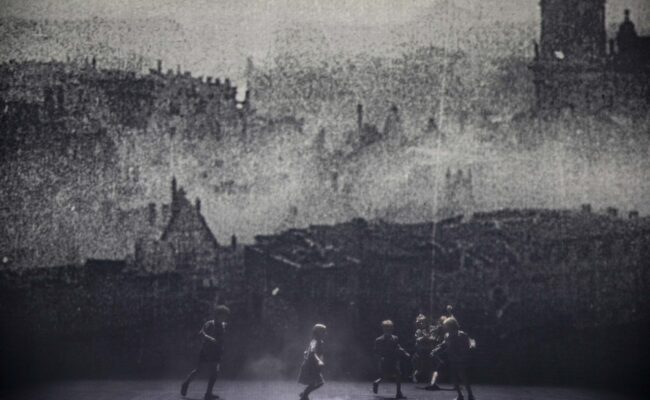
Unfortunately, The Magic Flute has lost its magic, falling victim to a concept that quickly runs out of steam. As is often the case in such situations, it starts well: Clément Cogitore plunges us into images of war – destroyed buildings, haggard and wandering crowds. And above all, images of children: in rags, barefoot, starving, or with a cigarette hanging from their lips.
On stage, young children appear. The focus is on two of them. The idea is immediately clear: whilst Mozart’s The Magic Flute usually depicts the journey of two young people towards adulthood, this time we go right back to the very beginning, to early childhood. Why not? Our television news programs are full of images of the traumatic reality faced by these little ones, plunged into a world that rejects them, crushes them, deprives them of the chance to flourish, or which, through imitation, could lead them to repeat the same cycles of conflict and destruction.
But you might ask, don’t these children sing? Well, no: in their shadow, we discover two soloists – the Pamina and Tamino of the story – who perform their arias.
Unfortunately, this good idea quickly reaches its limits. Carried on indefinitely, it fails to lead to any real developments; it merely tells a story rather than bringing it to life. At certain moments, indeed, one realizes that the director no longer knows how to bring the scene to life, nor how to break out of its confines.
Furthermore, the work’s multifaceted meaning – which is what gives Mozart’s work its richness and timeless appeal – is lost in this overly restrictive staging.
Poor soloists, relegated to the shadows and deprived of their stage presence. Nevertheless, they remain convincing. I was particularly moved by Ying Fang’s Pamina, whose singing (since there was no acting) – with its understated and nuanced expression – speaks volumes about her character.
Requiem
The Requiem is not a staged work; it is, in fact, a Missa da Requiem. And yet, Romeo Castellucci chose to stage it.
We are familiar with the radical nature of his approach, the way in which he neither repeats nor illustrates what is narrated and set to music. He offers visual equivalents; he no longer appeals to reason but demands that we surrender our senses to his provocations.
This brings us moments of wonder and just as many moments of extreme irritation.
This time, he shows us how this song of death is in fact a song of life. Some sequences are exceptionally beautiful, others more repetitive and less necessary. Typical Castellucci!
Stéphane Gilbart