Lucia di Lammermoor
Lucia di Lammermoor at La Scala

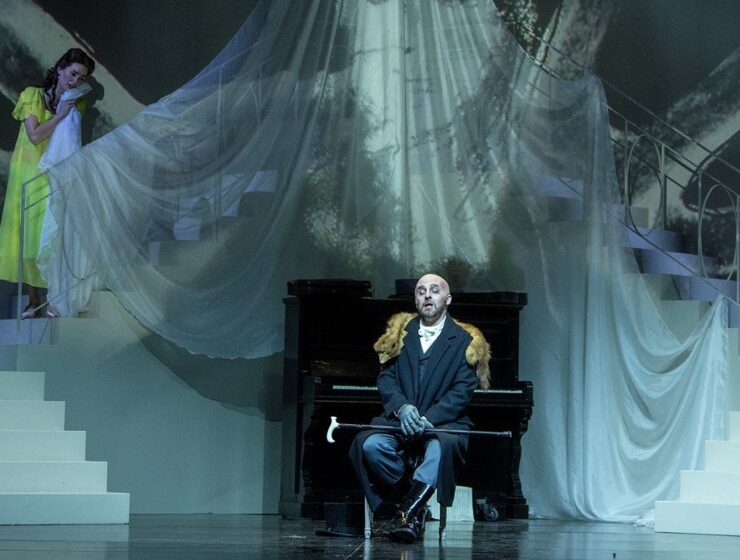
Lucia di Lammermoor. As Lucia, Rosa Feola lived fully through the gamut of emotions. She made use of every nuance in Kokkos’ staging, and every one of her appearances led logically to her sad demise. At every turn, vocally and theatrically, Feola’s Lucia remains a fragile figure, a victim of the manipulations of others causing her to doubt her lover’s fidelity. The Brünnhilde of Götterdämmerung comes to mind; both will sacrifice their lives through delusion. Observing Feola was a moving experience, made richer through the musical dissolution of her consciousness. The top notes were more than there, and delivered almost naturally, and in character with the crazed sad, desperate demise. An absolutely wonderful Lucia.

The Maestro
De Maestro

De Maestro. Een legendarisch voorbeeld van een akoestische en fysieke nachtmerrie is de \\\\\\\”Scena delle maschere\\\\\\\” (Don Giovanni): Donna Anna, Don Ottavio en Donna Elvira zingen het trio \\\\\\\”Protegga il giusto cielo\\\\\\\”. Voor deze balscène componeerde Mozart drie verschillende on-stage orkestjes die tegelijk met het orkest in de bak spelen. Elk groepje speelt in een andere maatsoort, resp. in 2/4, 3/4 en 3/8. Tegelijkertijd lopen de solisten zingend door de feestgangers. Lekker dan!

The Merry Widow
THE MERRY WIDOW

The Merry Widow. The secondary romantic coupling was, curiously, just that little bit more consistent, and thus endearing; Alexandra Flood was simultaneously dignified and coquettish as Valencienne, and John Longmuir gave us an ardently sung Camille de Rosillon. David Whitney as Baron Mirko Zeta and Benjamin Rasheed as Njegus were also a highlight… a funny and intelligently drawn double-act to rival the best of them. The remaining cast was faultless — the definition of a secure and mature ensemble.

Aix
Aix !

Aix! This brings us moments of wonder and just as many moments of extreme irritation. This time, he shows us how this song of death is in fact a song of life. Some sequences are exceptionally beautiful, others more repetitive and less necessary. Typical Castellucci!

La Scala’s Far West ‘Carmen’

La Scala’s Far West ‘Carmen’. Nearly every solution or off-the-mark innovation seemingly failed to captivate us as there was little sympathy for the personages as perceived, and they were surprisingly almost always projected through excessively old-fashioned stock mimic gesturing. This was especially so for the chorus who were never present in their prescribed roles, and were often asked to carry out bizarre, invented scenarios, unrelated to the main flow of action and with total regard to the words they were singing. In Carmen, they are essential characters inserted within the plot and must remain so.

“Gelijk Ik hoor, oordeel Ik'
“Gelijk Ik hoor, oordeel Ik, en Mijn oordeel is rechtvaardig.” Baruch 6:30.

“Gelijk Ik hoor, oordeel Ik\\\\\\\\\\\\\\\\\\\\\\\\\\\\\\\”. Een hoofdredacteur die bijklust bij een operagezelschap dat hij moet evalueren, dat is wel schokkend, maar niet in de juiste zin. Dat is een typisch kenmerk van de ons-kent-ons snobistische operakliek die kritische recensenten tegenwerkt en financieel benadeelt, maar een site minzaam tegemoet treedt die de lezersforumfunctie uitschakelt vanwege de nadeligheid voor banden met zangers en operahuizen.

Tannhäuser
Tannhäuser – Musically Strong, Scenically Unconvincing

Tannhäuser. Vocally, the performance did not consistently rise to the level one had hoped for. Eric Cutler, in the title role, struck us as somewhat one-dimensional over long stretches. He sang with considerable commitment and sustained the part with stamina, but his Tannhäuser lacked real interpretative differentiation. This was already evident in the Venusberg scene of Act I. In “Dir töne Lob!”, in particular, the contrast was striking: the harp played its introduction and accompanying figures with extraordinary delicacy and beauty, shaping the music with a refinement that seemed to open up precisely the sensuous and inward expressive world the passage requires. All the more disappointing, then, was the tenor’s entry, which seemed comparatively blunt and effortful, as though little had been taken from the atmosphere the orchestra had so carefully prepared. Sheer effort and volume often appeared to count for more here than tonal nuance, verbal inflection or any real shaping of the musical line.

The Conceptual Cabinet of Curiosities
Het conceptuele rariteitenkabinet van het Regietheater

Het Conceptuele Rariteitenkabinet van het Regietheater. Ironie is het duizenddingendoekje van de hedendaagse regie. Handig, veelzijdig en vooral populair bij mensen die hun Morgenmuffeligkeit tot levensmotto hebben gemaakt en niet meer geloven dat schoonheid zonder aanhalingstekens kan bestaan.

The Conceptual Cabinet of Curiosities

The Conceptual Cabinet of Curiosities. Irony: the favorite Swiss Army knife. Contemporary directing harbors, likely out of incompetence, an almost pathological fear of sincerity. You see it time and again: comical extras during tragic music, sexually charged actions in formal scenes, ugly sets to strip the music of its noble aura.

Simone Boccanegra (English)

Simone Boccanegra. And then there’s Jetske Mijnssen’s direction. We have to admit: we’ve seen worse. The director “transposed” the opera to 1871, the year the revised version premiered. Two questions arise: 1) Why relocate? 2) Why 1871? The idea that the nineteenth-century costumes and sets place the characters in a world closer to Verdi himself than to medieval Genoa is utter nonsense. What is closest to Verdi is his own opera, and that is set in Genoa in the 13th (or 14th?) century.