FAUST
Bayerische Staatsoper, Munich: Faust
Conductor: Daniele Rustioni
Production: Lotte de Beer
Set design: Christoph Hetzer
Costume Design: Jorine van Beek
Chorus: Bavarian State Opera Chorus
Chorus Master: Christoph Heil
Faust: Piotr Beczała
Marguerite: Nicole Car
Méphistophélès: Kyle Ketelsen
Siebel: Emily Sierra
Marthe: Dshamilja Kaiser
Valentin: Boris Pinkhasovich
Szene: 3*
Musik: 3*
The previous Munich production of Gounod’s Faust, which premiered in 2000, remains one of the most unfortunate excesses of “Regietheater” ever seen at the Bayerische Staatsoper. David Pountney cluttered the stage with railway tracks, train carriages, and washing machines. He had Marguerite murder her child by placing it in a refrigerator and later confined her inside a gigantic refrigerator during the church scene, while Méphistophélès sat enthroned above her. As if this torrent of imagery were not alienating enough, the production rejected the most commonly performed version with recitatives and adopted a lesser-known version with spoken dialogue. These dialogues were played from a tape in colloquial German, repeatedly interrupting the flow of the otherwise French-sung score. The staging was so intrusive and unsettling that not even the splendid musical performances — first by Marcelo Álvarez and later by Rolando Villazón in the title role — could redeem the overall impression.
“Faust” disappeared for more than two decades
The consequence was remarkable: Gounod’s “Faust” disappeared from the Bavarian State Opera’s repertoire for more than two decades. In February of this year, Lotte de Beer, director of the Vienna Volksoper, unveiled a new production that has now been revived with a new cast to conclude the Munich Opera Festival. De Beer has not always demonstrated infallible instinct, either in her programming choices or in her own productions. Therefore, her markedly different approach to that of her predecessor is all the more welcome.
Provocative directorial gestures absent
Her production clearly and focusedly tells the story, showing evident respect for the work’s dramatic structure. Above all, she resists the temptation to impose fashionable contemporary interpretations on Gounod’s lyrical masterpiece. The narrative poise required for Faust to unfold its emotional and musical power is thereby recovered. The stage direction is restrained and unobtrusive. Thankfully, provocative directorial gestures and demonstrative deconstructions are almost entirely absent.
Yet this restraint comes at a price. Truly compelling dramatic climaxes arise only intermittently, and for long periods, the performance relies more on the music than the stage action for momentum. A striking exception is the Walpurgis Night scene. Here, the production suddenly opens up and transforms the stage into a flower-decked hall of antiquity filled with Bacchic exuberance. This abrupt change in atmosphere unleashes a burst of theatrical energy, creating one of the most vivid moments of the evening.
Christoph Hetzer’s set design features a simple revolving stage reminiscent of Shakespearean productions. This design allows for swift scene changes while maintaining an unbroken dramatic flow. This proves to be both practical and effective. Jorine van Beek’s costumes, however, are inconsistent. While the main characters’ costumes convincingly evoke the late Middle Ages and provide them with a coherent visual identity, the chorus costumes are occasionally stylistically inconsistent and arbitrary.
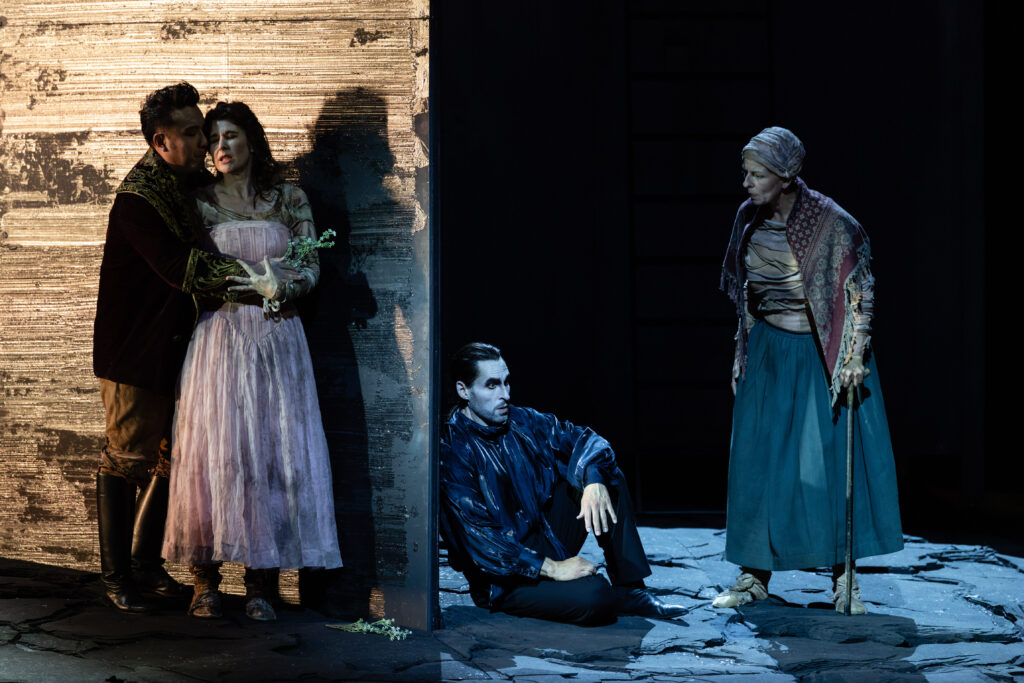
The result is a solid, carefully crafted production that, while not quite reaching the artistic heights of an exceptional Faust, is undoubtedly an improvement on the earlier Munich staging.
Piotr Beczała sang the title role with audible caution following a recent cold. At times, his voice sounded slightly congested and less free than usual. In the more dramatic passages, it lacked some of its customary brilliance. All the more impressive, therefore, was his performance of “Salut! demeures chaste et pure,” characterized by refined phrasing, stylistic elegance, and admirable restraint.
Nicole Car offered a mixed but often touching performance as Marguerite. While her upper register sounded somewhat sharp and strained, her lyrical passages revealed far greater ease and musical sensitivity. Her “Jewel Song,” “Ah! je ris de me voir si belle en ce miroir,” charmed with its lightness, elegance, and finely sustained legato. In the intimate scenes, especially the final prayer, she achieved a genuinely moving intensity of expression.
However, the true center of the evening was Kyle Ketelsen’s Méphistophélès. He sang with remarkable elegance, secure phrasing, and a commanding stage presence, delivering a consistently compelling performance. Together with Nicole Car, he performed the church scene with exceptional dramatic force, making it one of the performance’s highlights.
Emily Sierra was deeply affecting as Siebel, both dramatically and vocally. With her warm, clear tone and unaffected sincerity, she provided one of the most humane moments of the evening. Dshamilja Kaiser brought a lively presence and vocal focus to the role of Marthe, adding a welcome touch of color to the ensemble.
Less successful was Boris Pinkhasovich as Valentin. Notable intonational insecurity emerged in “Avant de quitter ces lieux,” which weakened the impact of the aria and continued into the duel scene.
The Bavarian State Opera Chorus, prepared by Christoph Heil, sang with evident commitment, particularly in the fairground waltz, the soldiers’ scenes, and Walpurgis Night. However, not every entry was perfectly precise, which occasionally diminished the musical polish.
Cleanly and reliably conducted
Daniele Rustioni conducted cleanly and reliably with appropriate stylistic awareness. However, his interpretation often seemed too routine and insufficiently distinctive. The delicate elegance and dramatic ardor of Gounod’s score were only partially realized; many climaxes were carefully controlled rather than genuinely electrifying. Unfortunately, the conductor of the premiere was absent from these final festival performances due to commitments at Bayreuth.
Thus, the penultimate evening of the Munich Opera Festival concluded with a well-executed, musically respectable production of Faust featuring several notable performances. Ultimately, however, it failed to achieve true festival triumph. Nevertheless, the warm, prolonged applause from the audience suggested that, after its long absence from the Munich stage, Gounod’s masterpiece had returned as a welcome guest.
Marco Aranowicz