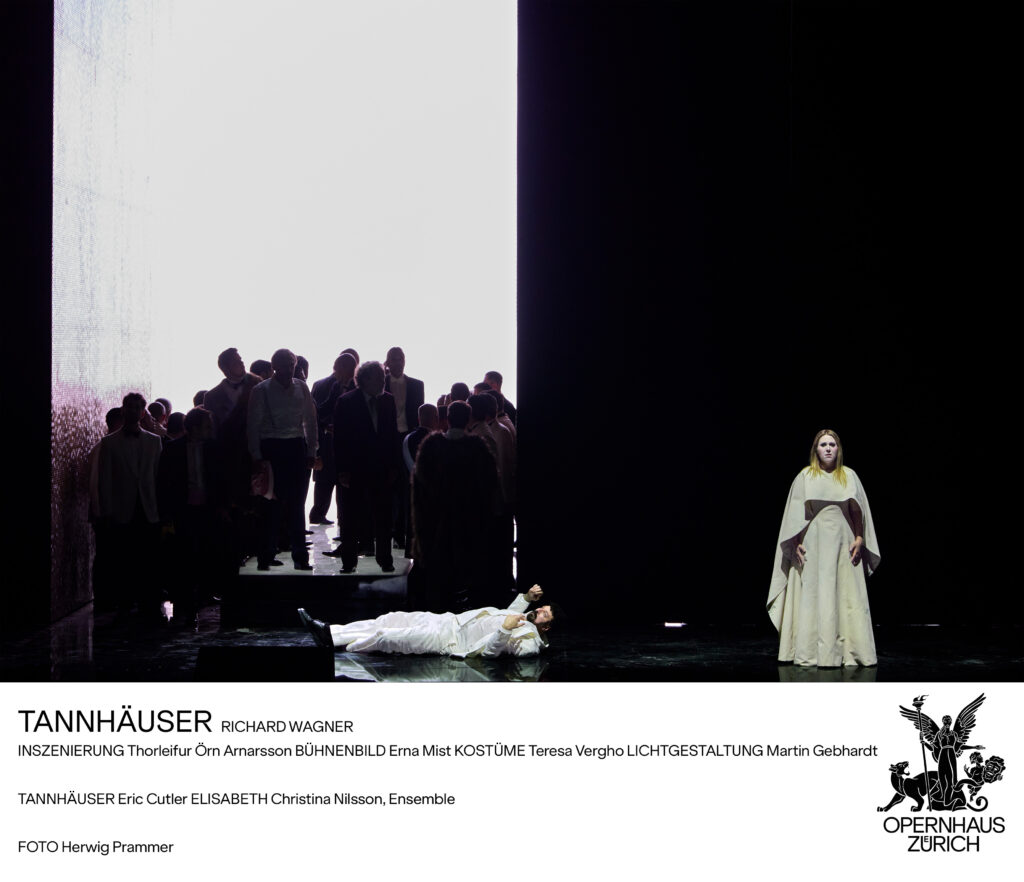
Tannhäuser
Tannhäuser und der Sängerkrieg auf der Wartburg
Drama in three acts. Music and text by Richard Wagner.
Conductor: Tugan Sokhiev
Production: Thorleifur Örn Arnarsson
Chorus master: Klaas-Jan de Groot
Hermann, Landgrave of Thuringia: Christof Fischesser
Tannhäuser: Eric Cutler
Elisabeth: Christina Nilsson
Venus: Rachael Wilson
Wolfram von Eschenbach: Christian Gerhaher
Biterolf: Andrew Moore
Walther von der Vogelweide: Johan Krogius
Heinrich the Scribe: Nathan Haller
Reinmar von Zweter: Brent Michael Smith
A Young Shepherd: Yewon Han
Chorus of Zurich Opera
SoprAlti of Zurich Opera
Orchestra of Zurich Opera
Statistenverein of Zurich Opera
Performance attended: 21 June 2026, Zurich Opera House
Music: 4****
Staging: 2**
Tannhäuser
Quite apart from the enduring fascination of Wagner’s Tannhäuser, this Zurich Opera premiere promised a great deal musically. Expectations were high, not least because it offered a first opportunity to hear Tugan Sokhiev conduct Wagner in this house.
It was striking, however, that the house was not sold out – perhaps the weather had something to do with it, and some may have preferred a swim in the lake to an evening at the opera. Sokhiev, at any rate, did not disappoint – quite the reverse. The overture immediately commanded attention: the strings played with tremendous impetus, the violins and cellos with an almost electric presence, and the overall tension was genuinely exhilarating. More importantly, Sokhiev sustained this energy throughout the evening, maintaining momentum from first bar to last. Even in the more declamatory passages, the orchestra remained alert, precise and fully engaged. The great climaxes, the choral scenes and, above all, the long build towards the close were magnificently judged – perfectly paced and shaped with a compelling sense of direction.
Under Sokhiev, the Orchestra of Zurich Opera played with exceptional unanimity, finely graded color and an impressively organic grasp of the work’s dramatic architecture. The strings combined warmth with precision, the wind playing was characterful and distinguished, and even at moments of full orchestral surge the texture retained its clarity. It was precisely this combination of transparency and dramatic drive that made the evening so musically persuasive. Sokhiev treated Wagner’s score not as a wall of sound, nor as an excuse for mere symphonic weight, but as a living, breathing, many-layered fabric. Where urgency was needed, he tightened the line decisively; where the music opened out into the visionary, the lyrical or the transcendent, he gave it room without ever allowing the structure to slacken. The result was a sound world that did equal justice to the score’s romantic glow and its metaphysical unease.
Particular mention must be made of the close of Act III with the Pilgrims’ Chorus. Rarely does one hear this passage shaped with such inevitability and, at the same time, unfolded with such beauty of sound. From its hushed beginning to its great choral release, Sokhiev achieved a moment of rare intensity. One had the impression that the auditorium itself was holding its breath, granting the music the silence it required. These are the moments in which opera reveals its true power: when music does not merely accompany or illustrate but renders both anguish and exaltation directly palpable.
After the performance, we returned to the overture in Solti’s famous recording and found ourselves preferring what Zurich Opera had offered on premiere night. This was conducting of real distinction. With an unerring instinct for tension, orchestral balance and dramatic culmination, Sokhiev forged an interpretation of unusual cohesion and conviction. That Tannhäuser emerged here not as a cumbersome monument but as a living music drama was due in no small part to him. One would gladly hear him conduct Wagner here again.
The eternal “psychological journey”
The staging, however, invited much greater reservation. We had not previously encountered Thorleifur Örn Arnarsson’s work, but once it became clear that he intended to present Tannhäuser as an inward psychological journey, skepticism set in. One has become wary of a certain kind of directorial theatre that lays claim to psychological depth without demonstrating the dramatic insight required to sustain it. Such ambitions are all too often asserted rather than earned, reductive rather than illuminating. Genuine psychological insight in the theatre is hard won: it must arise from a deep and exacting engagement with character, drama and music, not simply be overlaid upon the work as a conceptual scheme. Here, too often, one had the impression that large interpretative claims were being made without sufficient dramatic substance to bear their weight.
Reading the relevant passages in the programme booklet only deepened that unease. They seemed at times superficial, internally inconsistent and insufficiently thought through. Much felt less drawn from the work itself than imposed upon it, without any persuasive organic connection to Wagner’s drama. Nor did the language of the programme notes help matters. Its conspicuously short sentences gave an impression of simplification at the expense of nuance and precision. It was therefore hardly surprising that the staging itself, despite a few atmospherically effective moments, often lacked the dramatic necessity and precision that lift an interpretation above the level of mere concept. What was evidently intended as serious psychological enquiry remained, over long stretches, more asserted than convincingly realized.
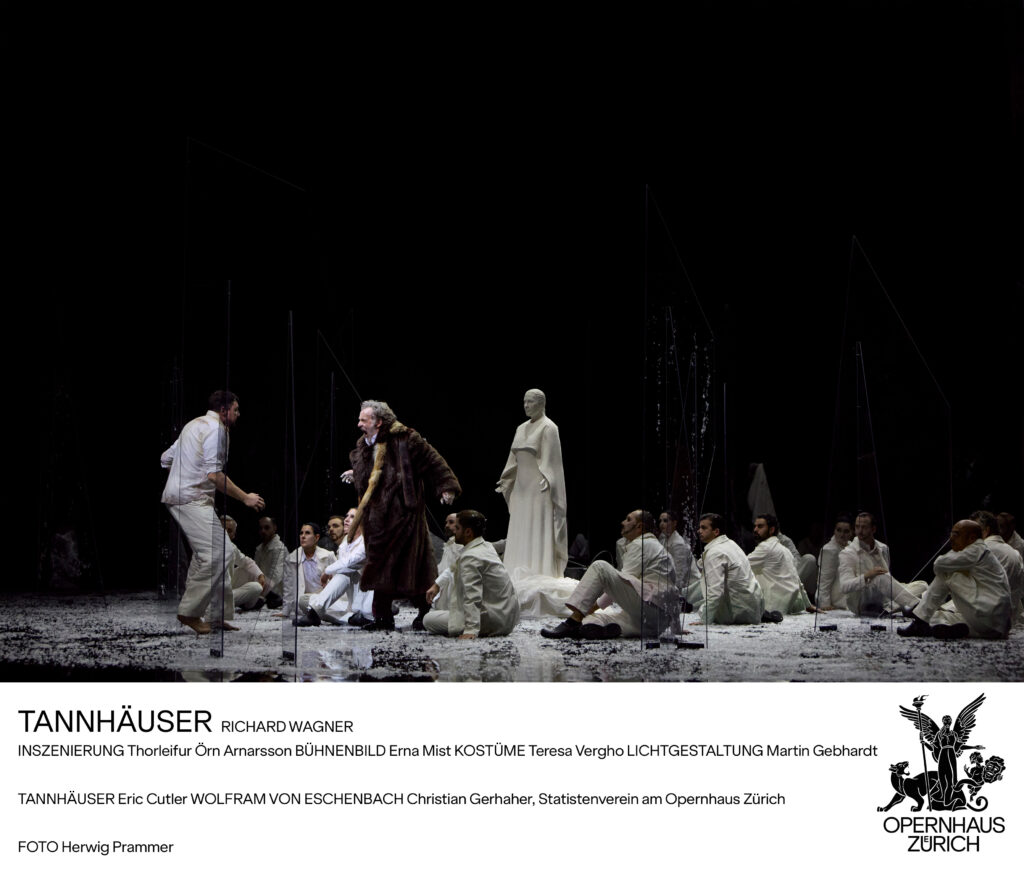
Erna Mist’s set, too, left us unconvinced for much of the evening. During the overture, the curtain rose after only the first few bars. Men dressed in white were lowered from the ceiling, lay on the floor and began to twitch as dense smoke filled the stage. The image was alienating and distinctly unpleasant, evoking associations more disturbing than theatrically illuminating. Whatever precise meaning was intended remained unclear. Instead of an evocative opening into Wagner’s sound world, one was confronted with an image that jarred rather than drew the audience in.
Fluorescent tubes !
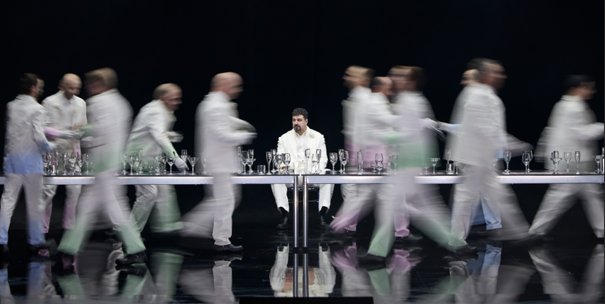
Later in Act I, long USM office desks appeared on stage beneath fluorescent tubes, with rows of wine and champagne glasses lined up upon them. When Tannhäuser swept them to the floor, it was immediately obvious from the sound that they were plastic – an effect as visually unappealing as it was atmospherically damaging. Such details may seem trivial, but in the theatre they are not. In a work such as Tannhäuser, which depends so heavily on sensual intensity and inner tension, banal ideas of this kind can very quickly undermine any sense of poetic credibility.
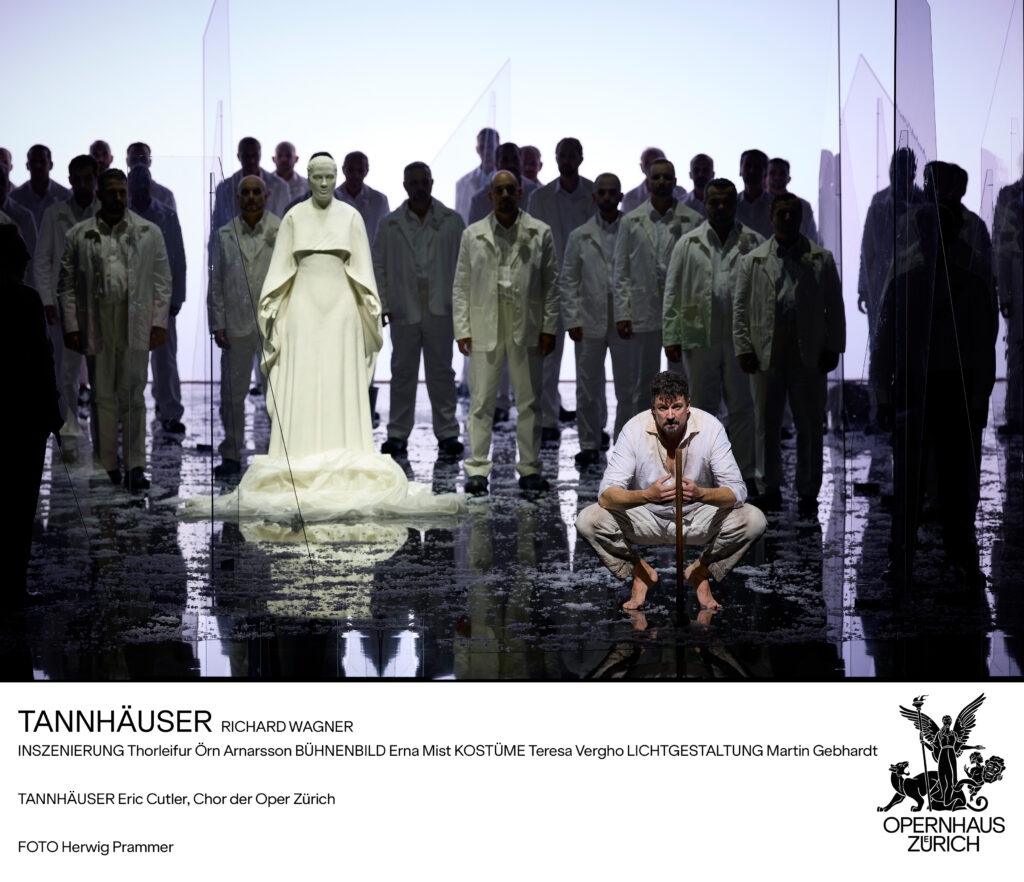
In the third scene, the Young Shepherd appeared in a glittering costume that relied more on outward effect than on genuine suggestive force. The pilgrims, meanwhile, wore white service-style uniforms with an air less of penitential travelers than of breakfast staff at the Hotel Waldhaus in Sils. The association may have been unintended, but it did little for the coherence of the costume concept. In the fourth scene of Act I, the singers and the Landgrave arrived in an estate car, driving straight into the desks and sending yet more plastic glasses crashing to the floor. At the same time, the screen behind the stage showed a close-up of the car’s interior. The enlarged projection felt rather too literal and left little doubt that the singers and the Landgrave were shown snorting cocaine. The film sequence, while live stage action unfolded simultaneously in front of the screen, proved distracting. At times the eye scarcely knew where to settle; the scene dissolved into competing stimuli rather than cohering as a dramatic whole.
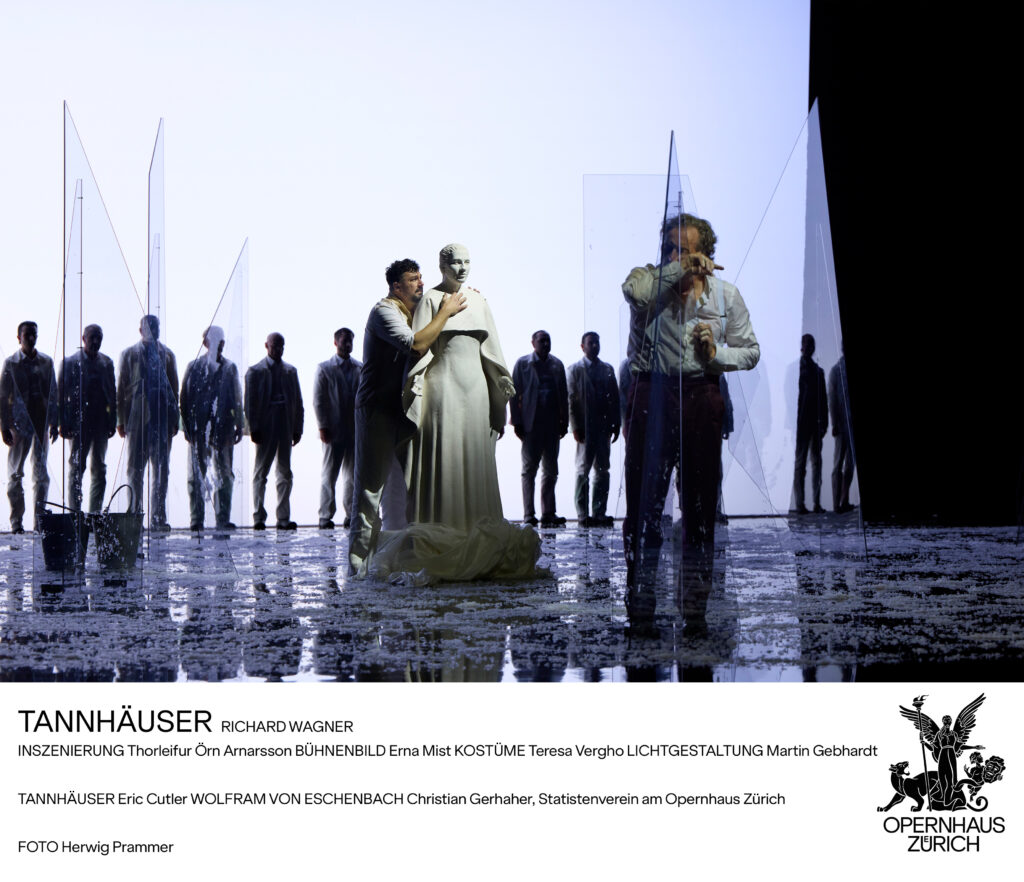
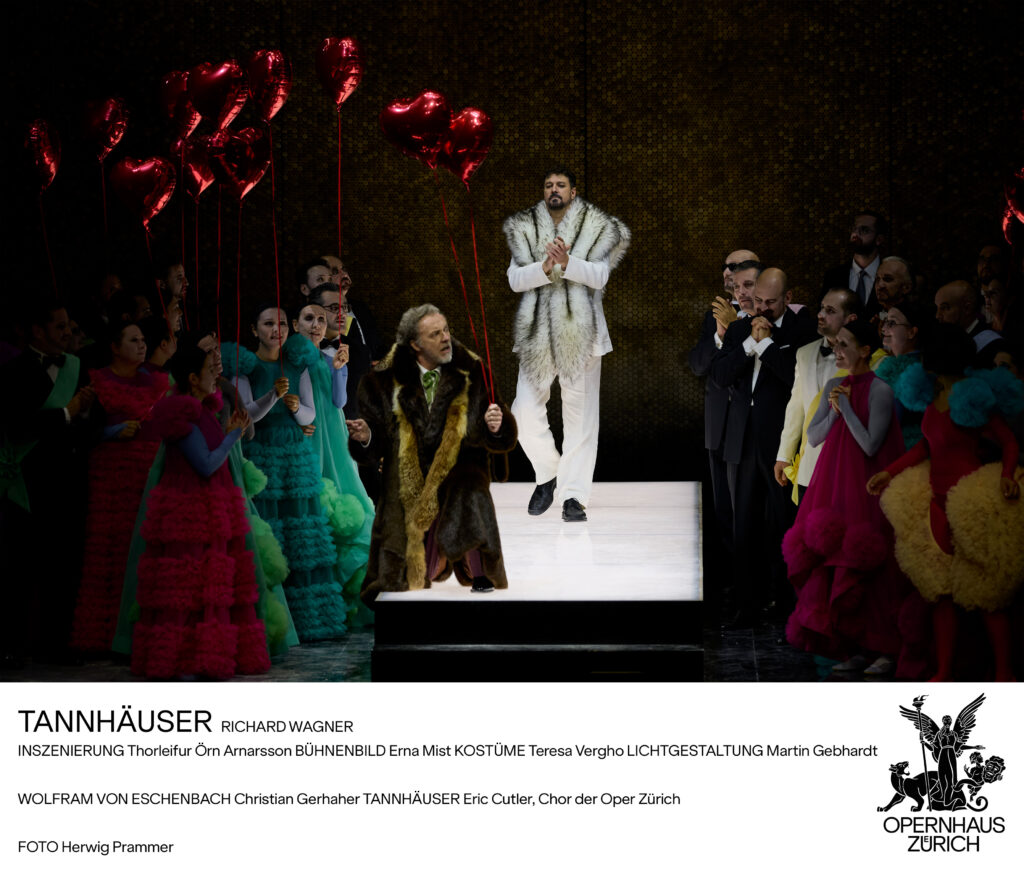
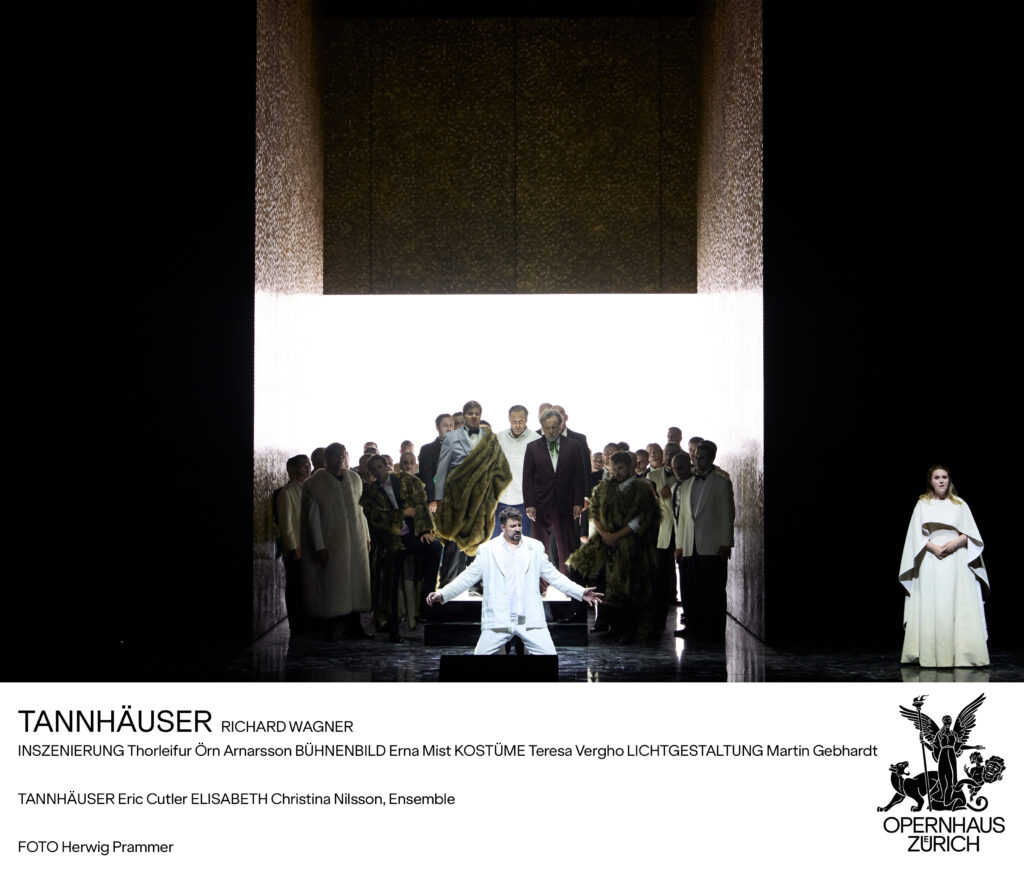
Act II began somewhat more promisingly, if only because one could at least discern a stronger sense of space and a clearer visual idea. The singers’ hall at the Wartburg had been conceived as a large, lofty chamber. Elisabeth appeared in white costume and white make-up, recalling a vestal: severe, remote and almost statuesque. This initially had a certain force. Yet with the entrance of the guests, the production’s tendency towards superficial whimsy soon reasserted itself. The women wore pink and lilac dresses with large pom-poms, immediately suggesting the playful visual world of Saltimbanco. The stocking-like headpieces, too, were aesthetically unconvincing. During the Song Contest itself, the production sought further differentiation by dressing the singers in a variety of fur coats. Landgrave Hermann wore a suit with gold embroidery – a conspicuous gesture, certainly, but one that did little to lend the scene either greater coherence or greater dignity.
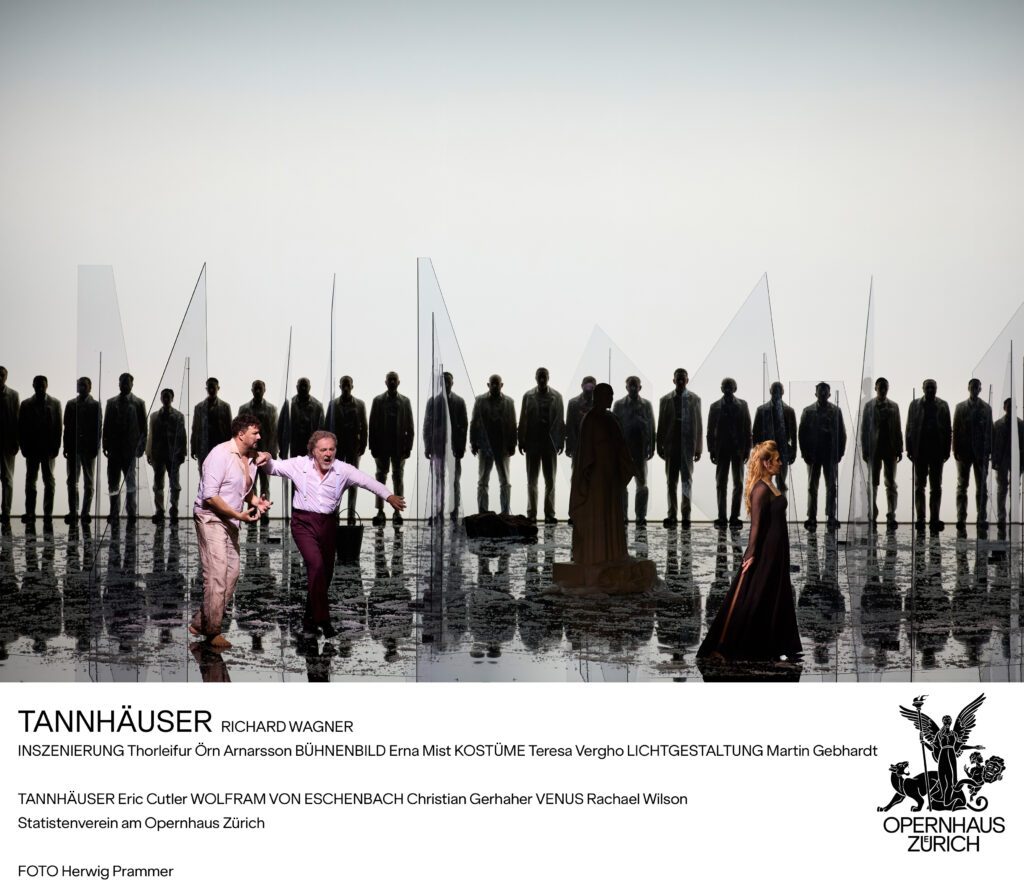
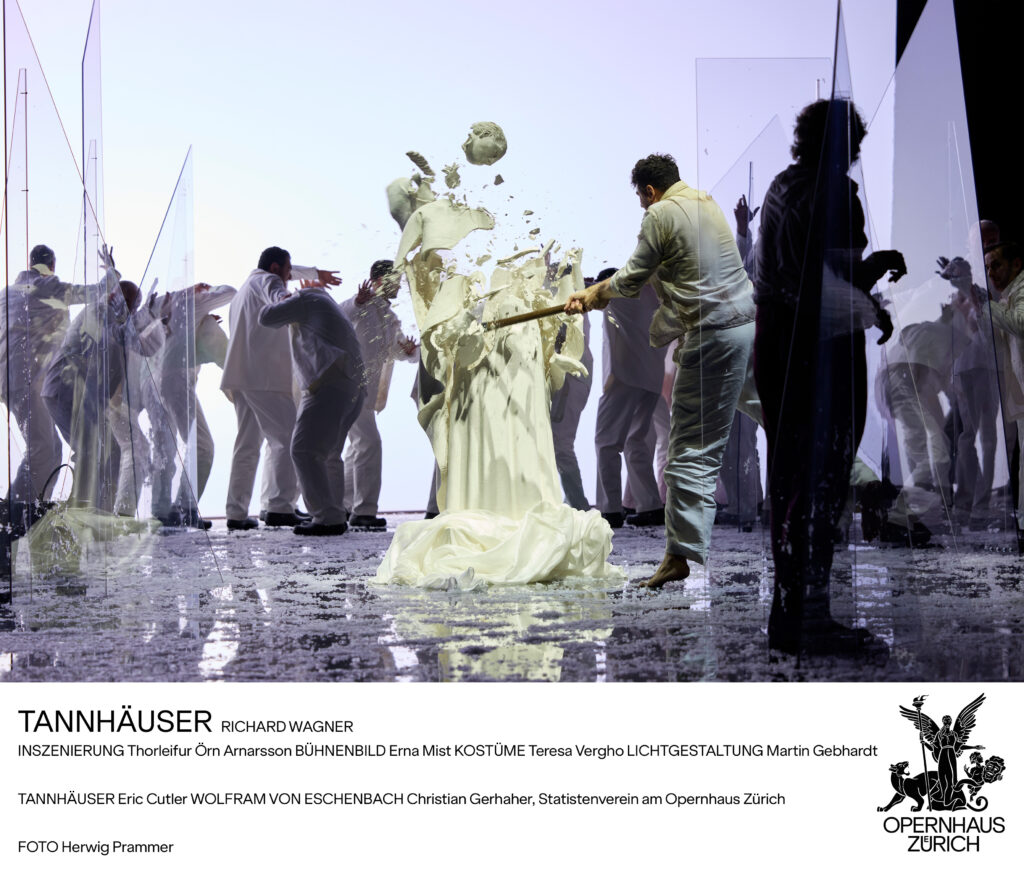
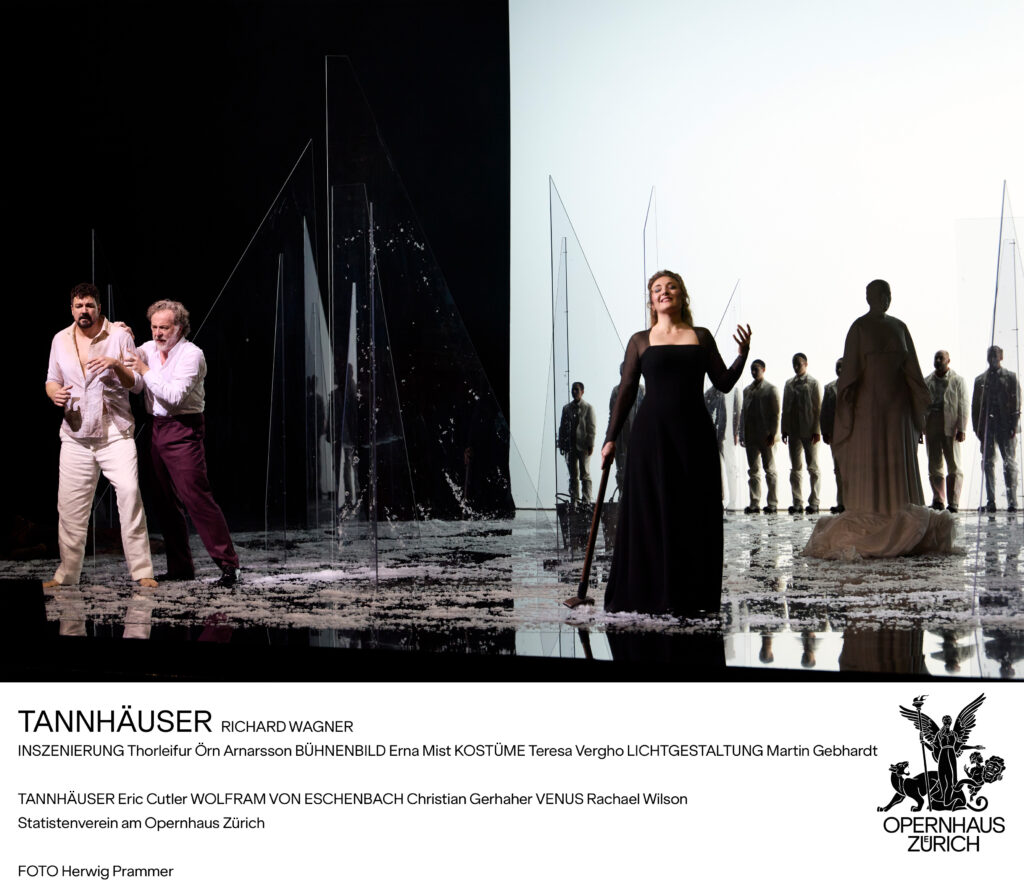
Act III opened with ice-like formations. One briefly wondered whether this might be an allusion to the director’s Icelandic origins; Jökulsárlón, the glacial lagoon with its drifting ice, came involuntarily to mind. In fact, this imagery, especially in combination with the falling snow on stage, possessed a certain atmospheric plausibility and suited the music far better than much that had preceded it. Yet even this idea could not resolve the underlying problem. Taken as a whole, there was little in either set or costumes to admire without qualification. They seemed neither fully coherent in themselves nor truly attuned to the work, and in the end felt largely arbitrary.
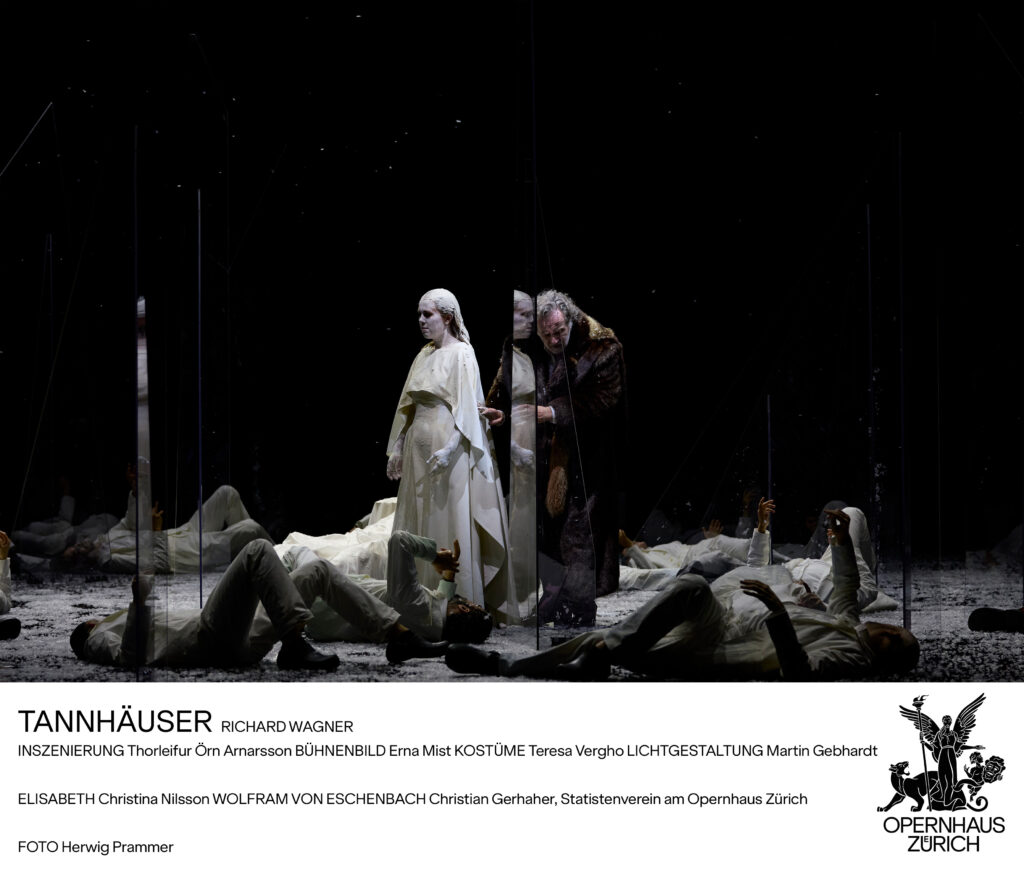
Martin Gebhardt’s lighting, by contrast, contributed greatly to the evening’s atmosphere and was generally persuasive within the production’s visual framework. Wherever the stage picture drifted into vagueness or arbitrariness, the lighting at least intermittently supplied contour, space and mood. Even so, especially in Act I, one might have welcomed warmer, more sensual colors and, overall, a less chilly palette. The announced choreography by Sebastian Zuber, on the other hand, scarcely registered as an independent element. There was no ballet in any meaningful sense; perhaps the term referred chiefly to the movement of the chorus on stage, particularly in Act II.
The Title Role: Eric Cutler
Vocally, the performance did not consistently rise to the level one had hoped for. Eric Cutler, in the title role, struck us as somewhat one-dimensional over long stretches. He sang with considerable commitment and sustained the part with stamina, but his Tannhäuser lacked real interpretative differentiation. This was already evident in the Venusberg scene of Act I. In “Dir töne Lob!”, in particular, the contrast was striking: the harp played its introduction and accompanying figures with extraordinary delicacy and beauty, shaping the music with a refinement that seemed to open up precisely the sensuous and inward expressive world the passage requires. All the more disappointing, then, was the tenor’s entry, which seemed comparatively blunt and effortful, as though little had been taken from the atmosphere the orchestra had so carefully prepared. Sheer effort and volume often appeared to count for more here than tonal nuance, verbal inflection or any real shaping of the musical line. Added to this was a vibrato that was often intrusive, disrupting rather than supporting the melodic contour, so that tension, line and cantabile continuity could emerge only imperfectly. Precisely where Wagner offers the voice its finest expressive possibilities in dialogue with the orchestra, Cutler left much unrealized. It was particularly noticeable that he responded only intermittently to the beautifully played introductions and accompaniments to his phrases, often pressing ahead rather than drawing on what the orchestra had already prepared. More than once, one felt that a closer musical exchange with the pit might have yielded greater expressive nuance. Genuine verbal coloring, conscious shaping and inflection of phrase were only intermittently in evidence. The Rom Narrative in Act III fared somewhat better and certainly had dramatic weight, yet even there one felt that more inward shading, greater verbal imagination and a subtler responsiveness to the orchestral line might have deepened the portrayal. Thus, Tannhäuser appeared less as an inwardly riven figure than as a rather broadly outlined dramatic character. Not even the impressively secure top notes could entirely dispel that impression.
Christina Nilsson made an excellent impression as Elisabeth from her first entrance. With a radiant, noble soprano, secure top notes and a beautifully sustained line, she lent the role dignity, warmth and inner firmness. In “Dich, teure Halle”, she was compelling in both brilliance and poise. She also traced Elisabeth’s spiritual deepening in the prayer “Allmächt’ge Jungfrau, hör mein Flehen!” with considerable expressive power. Added to this were her weighty contributions to the major ensemble and choral scenes of Act II, above all during the Song Contest, where Elisabeth is not merely the object of conflict but also the moral center of the action. Nilsson brought great credibility and musical completeness to all this; her portrayal felt fully rounded and musically compelling throughout.
Rachael Wilson proved, both scenically and vocally, one of the evening’s most welcome presences. She looked splendid in her evening dress and inhabited the role with complete ease, thanks to her commanding stage presence. Whenever she appeared, her charisma and theatrical assurance made one almost forget, if only briefly, the surrounding scenic irritations, allowing the audience to yield to her performance with genuine pleasure. Vocally, too, she made an excellent impression. The voice sounded notably healthy, technically secure and remarkably integrated throughout. Wilson phrased with ample breath, placed her accents exactly where they belonged, and knew how to give the role not only sensual richness but also dramatic tension. Above all, one heard at once that she must make a formidable, full-blooded Amneris. Her chest register lent Venus additional weight and color; at moments, the opulent dramatic coloring brought to mind singers such as Elena Obraztsova. This gave her portrayal, especially in the great Venusberg scene of Act I, unusual profile. Particularly striking was her outburst at the end of the opera on “Weh mir, verloren!”, perfectly timed and delivered with complete assurance.
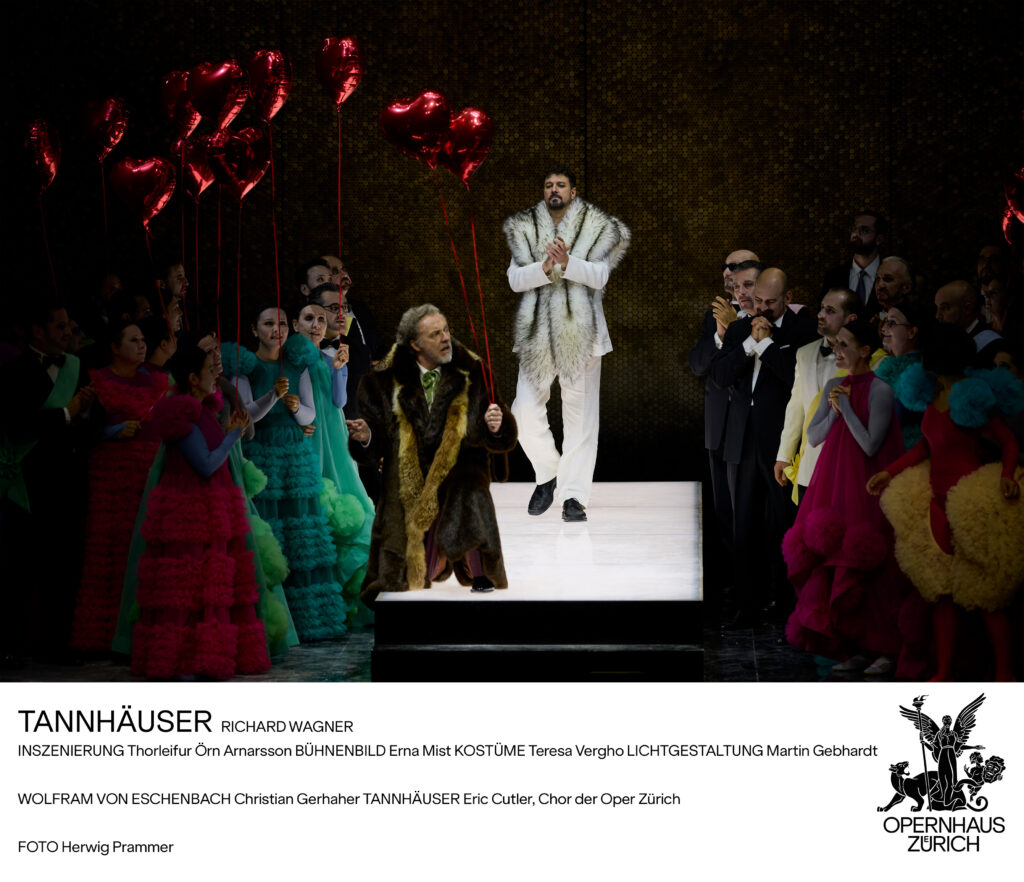
The vocal honors of the evening – and the warmest applause – belonged, in our view, to Christian Gerhaher as Wolfram von Eschenbach. With his unmistakable clarity of text, the nobility of his utterance and a musical intelligence carried through to the smallest detail, he lent the role extraordinary stature. Each syllable seemed to generate its own timbre, mood and inner nuance. It was singing of rare distinction. All the more marked, by contrast, was the relative one-dimensionality of Tannhäuser noted above – a disparity that could scarcely have been greater. This was already apparent in Gerhaher’s contributions to the Song Contest in Act II, but above all in his great Act III scene, the “Lied an den Abendstern”. Precisely because Gerhaher never aimed for mere effect, but drew everything from the word and the line, the scene attained that quiet intensity which lingers long afterwards, giving the audience the space needed to absorb the full intimacy of his singing. His contribution to the final ensembles of Act III likewise carried rare distinction.
Christof Fischesser brought vocal solidity and dependable stage presence to Landgrave Hermann. Even so, his performance at times lacked the authority and gravitas that ought to define the character. This cannot be laid entirely at his door; it was at least partly the result of a directorial conception that did not consistently present the Landgrave as a genuinely sovereign figure. At times the role seemed curiously lightweight, rather than embodying the ceremonial dignity and political order it represents in the work. That he was also made to perform a floss dance naturally did little to enhance his authority – though one must note, with a certain admiration, how gamely Fischesser handled even this conceit. Still, in the large public ensemble and choral scenes of Act II, especially the guests’ entrance and the framing sections of the Song Contest, one would have wished for greater authority and inner weight.
The Supporting Cast
The smaller roles, too, were solidly to well cast throughout. Andrew Moore as Biterolf stood out in his forceful contributions to the Song Contest and related ensemble passages, singing with firm commitment and a virile, well-focused voice. Johan Krogius as Walther von der Vogelweide delivered his solo passages cleanly, stylishly and with fine phrasing, while also integrating convincingly into the festive and choral scenes. His singing possessed an immediately appealing bel canto quality, and one could not help wondering whether his vocal and interpretative gifts might not have come closer to the kind of Tannhäuser one would ideally have wished to hear that evening. Nathan Haller as Heinrich der Schreiber and Brent Michael Smith as Reinmar von Zweter fulfilled their duties with reliability and a sound sense of ensemble.
Yewon Han made a pleasing impression as the Young Shepherd, her tone clear and agreeably produced. The Shepherd’s Song in Act I – that simple, luminous episode so strikingly set against Tannhäuser’s despair – was delivered with charm and musical assurance, providing a fine and effective touch. Even so, one felt that this brief but important scene might have offered greater interpretative scope.
The Chorus of Zurich Opera was beyond reproach throughout. Precision, tonal richness and ensemble unity were consistently of a high order, exactly what one hopes for in this work. Klaas-Jan de Groot’s chorus preparation ensured the necessary discipline and cohesion in the great crowd scenes. In Tannhäuser, where the chorus does not merely decorate but plays a central dramaturgical role, such assurance is essential. It was above all in the opera’s major choral passages – the Pilgrims’ Chorus, the festive “Freudig begrüssen wir die edle Halle”, and the expansive chorus and ensemble scenes of the Song Contest – that the chorus unfolded the collective power and solemnity without which Tannhäuser is scarcely conceivable. The SoprAlti of Zurich Opera, the Orchestra of Zurich Opera and the Statistenverein also contributed substantially to the artistic substance that sustained the evening.
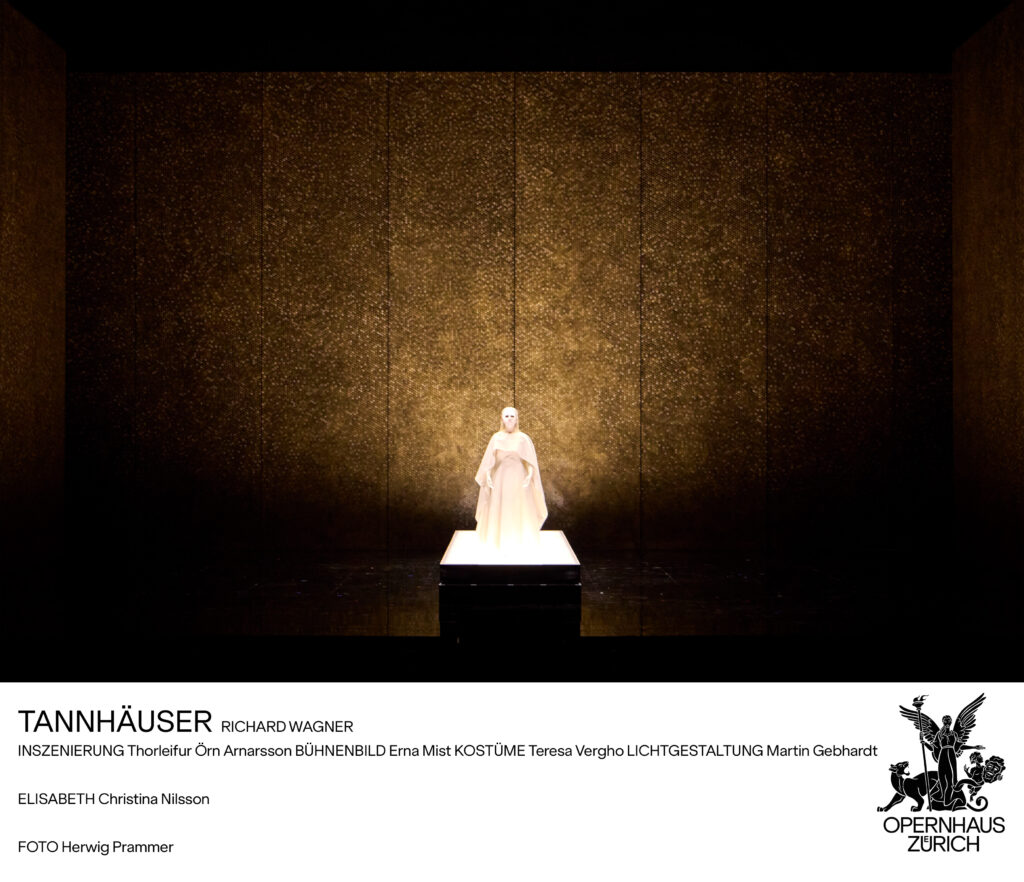
Musically, then, this was an evening of a high – at times very high – standard. Above all, Sokhiev’s conducting and the magnificently prepared Orchestra of Zurich Opera carried the performance in decisive fashion. Vocally, too, there was much to admire, even if the title role itself never fully convinced. The audience responded with warm enthusiasm, especially towards the singers, chorus and conductor. The production team, too, received applause, though it was mingled with clearly audible expressions of disapproval. From the second tier of the auditorium came several particularly loud boos directed at the staging.
That confirmed the overall impression of the evening: musically, the performance was impressive in many respects; scenically, it was far less persuasive. One could readily have done without this production and its visual world altogether. In this case, a concert performance would arguably have appealed more; indeed, even a restrained visual accompaniment might have proved less distracting than this directorial concept. It is difficult to imagine this staging establishing itself as a durable repertory success.
More broadly, however, a deeper unease suggests itself. In the long term, it is difficult to find wholly convincing the extent to which so many opera houses across Europe continue to rely on the same directorial names, similar scenic signatures and the same psychologizing interpretative habits. Much of it has become interchangeable. One is often left with the impression that many houses have relinquished the ambition to develop a scenic language of their own – one that grows organically out of the work, the local theatrical culture and the relationship with their audience. In its place, one increasingly encounters a certain international uniformity of directorial style, whose aesthetic reflexes, interpretative routines and insistence on profundity can look remarkably similar from one house to the next.
Zurich, in particular, would do well not to follow this trend too uncritically. There is no reason for Zurich Opera to adopt aesthetic routines that elsewhere have long since hardened into convention. Far more desirable would be the courage to cultivate a profile of its own – one rooted in Zurich’s cultural position, its audience and its distinctive tradition.
Imported theatrical mannerisms
For Switzerland does not look culturally only to the north, but equally to the south. Zurich, in particular, belongs not only to the German-speaking cultural world; it has also long stood in a significant relationship to Italy and to the major operatic centers south of the Alps. That orientation has left a lasting mark on musical sensibility and on the understanding of opera itself. It is therefore all the more regrettable when Zurich Opera adopts forms of Regietheater that can seem imported rather than organically grounded in its own cultural and operatic environment. For the new artistic leadership, it would be highly desirable to recognize this cultural constellation and to take it more seriously in future. Zurich would do well not to emulate imported theatrical mannerisms, but to cultivate more consciously that native cultural measure which corresponds so closely to its position between the German and Italian cultural spheres.
Productions of this kind also raise broader questions about artistic priorities in the use of public funding. One may reasonably ask what wider cultural value this particular staging is intended to provide.