Lucia di Lammermoor
Many years ago, reading British music journals, I was jealous that America barely had any second-rank but excellent opera companies. While the Brits seem to have no end of fascinating, plucky little groups who were brave and managed to put on modest but very worthy performances of repertory and non-rep operas – scaled back Ring Cycles and little-known bel canto operas – local companies here in the US were stuck with endless Traviatas, Bohemes, and weirdly, Gilbert & Sullivan operettas with altered libretti to mirror the current political climate.
About six years ago, I discovered the Berkshire Opera Festival, an innovative, clever, and thoroughly professional company that operates out of the restored 123-year-old Mahaiwe Performing Arts Center in Great Barrington, Massachusetts. The charming theater seats 680; there is no orchestra pit. The opera was Donizetti’s Don Pasquale, and the 30-or-so musicians were in an upper corner of the stage, barely visible, but audibly well-balanced with the singers. The production was updated to the 20th century with no outrages: Norina, by the time she had taken over Pasquale’s household, was dressed as a dominatrix – not all that far from the text. Slapstick was held to a minimum, but it was very funny and the singing was a knockout. The festival’s co-founders, Brian Garman and Jonathan Loy conducted and directed, respectively. I have since seen their Don Giovanni, Falstaff and Faust and they all have been impressive. There is the occasional “name” star, but the singers are invariably young, with plenty of experience in opera companies across the United States.
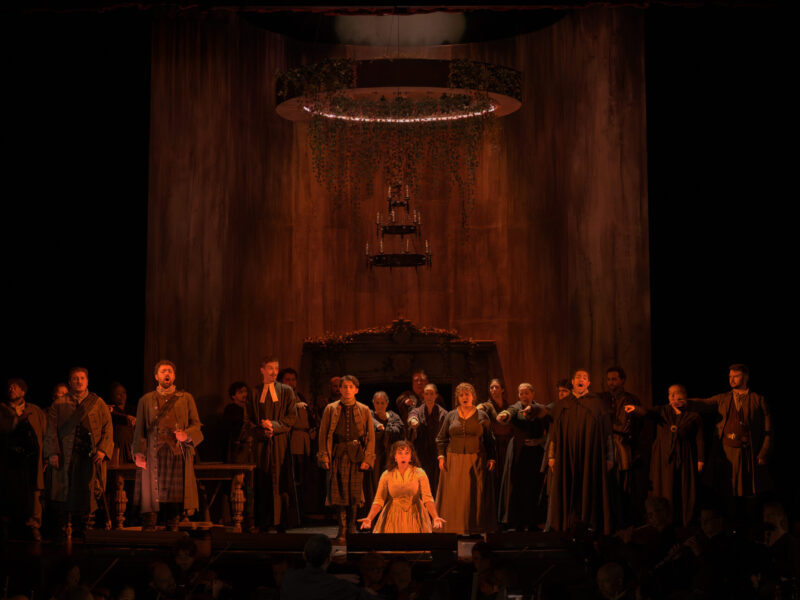
Their presentations this year were Lucia di Lammermoor and Gretry’s Zemire et Azor; I saw the former and it was revelatory. Many years ago, the Met presented a Lucia in which our heroine was crazy from the start and under the influence of her witch-maid, Alisa; the Mad Scene found Lucia climbing over dozens of half-opened coffins. Dreadful. Loy, here, also, goes for the supernatural, but it makes more sense and has a fierce point of view.
Lucia sees things
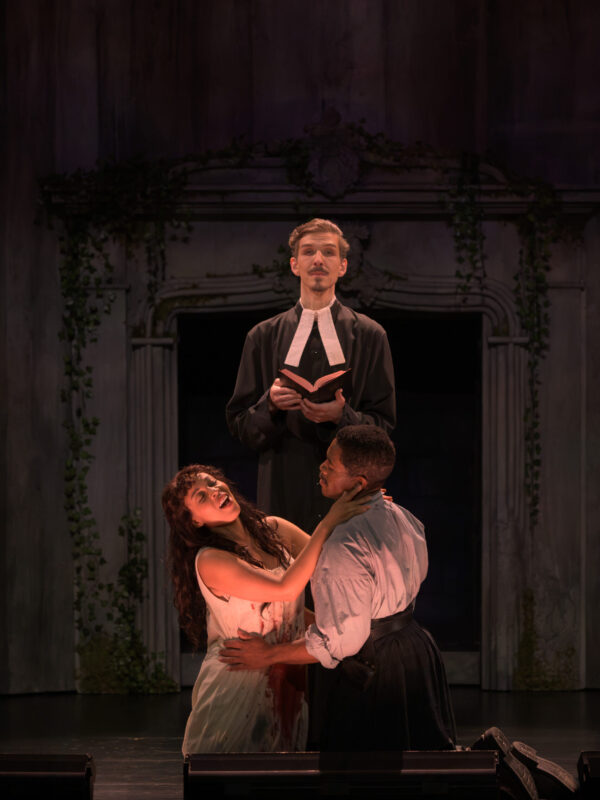
Lucia sees things – that is always clear. Her perceptions here are not simply signs of looniness, rather, they give her reason to act as she does. The fountain at the start is just that – a start. She believes in ghosts; it may be flighty, but she believes it. In her duet with Enrico, his great threat is that his ghost will haunt her. The Mad Scene is therefore a means to an end – maybe she can be forced into a wedding, but not a marriage. The frightening, black-hooded wedding guests (costumes by Brooke Stanton) seemed like witches and warlocks. Arturo’s bloodied body, brought out on a bed during the Mad Scene, is a centerpiece, but when Enrico shows up near the end, she stabs him and he dies. She may be mad but in this feminist view of the opera, she gets her revenge.
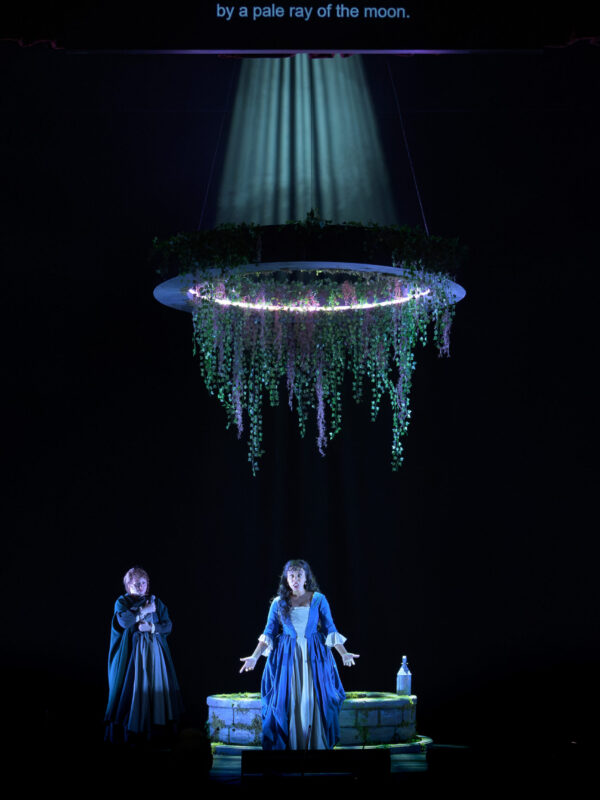
Musically, Maestro Garman came close to presenting the opera come scritto – no cadential high notes, essentially only Donizetti’s written coloratura. The lack of added filigree tended to make Lucia a more solid character, and Christine Lyons, who clearly had all the notes, played Lucia with urgency. Her first act narrative was anything but a flight of fancy, she defied Enrico, and instead of a high E flat, she ended the Mad Scene with a knife to her brother’s stomach. The voice is liquid clear and even from top to bottom and her Lucia begged the question as to whether, like Hamlet, she is truly mad or acting to suit her purpose. Very interesting.
Ferocious, tragic, and dangerous
As only occasionally happens, Edgardo walked away with the show. Tall and handsome and an active, agile actor, Terrence Chin-Loy began an understated Act One love duet, but his interruption in the Wedding Scene was ferocious, tragic, and dangerous. But the beauty of his legato and bright high notes in his final double aria brought the house down. Baritone Dean Murphy exhibited a type of American baritone we have learned to admire – Robert Merrill, Leonard Warren, Sherrill Milnes – and he was properly despicable as Enrico. The imposing bass Stefan Egerstrom began cloudily as Raimondo, but the voice gained warmth and power as the opera progressed. A surprise came with the usually thankless role of the poor bridegroom, Arturo. Tenor Luke Norville sang his annoying little pre-wedding/death with great tonal beauty and warmth. And the same might be said about the Normanno, a role that rarely even registers, as sung by Scott Ruben La Marca.
The glass harmonica !
The orchestra, now on the same level as the Parterre and 40-strong, played with dark intensity under Brian Garman and never drowned out the singers. The use of a glass harmonica always adds a wonderful sense of eeriness; player Dennis James was placed in a box adjacent to stage right. I do wish that Garman had not cut repeats in the solos of Enrico, the Lucia/Enrico duet and Raimondo’s narrative – I thought that sort of paring down had gone out with the 1950s. But the play’s the thing, and it was a great success.
Robert Levine

Have a comment to make? You can post it in the space below.
Facebook comments are NOT read by most of our reviewers.