
The Conceptual Cabinet of Curiosities
The Intellectual Laziness of Modern Regietheater
A soprano sings of honor, suicide, or passionate love. Behind her, the director places a refrigerator, a security camera, or a troupe of clowns. The music remains unchanged, the libretto is still printed verbatim in the program, but the trinity of stage design, libretto, and score has now degenerated into an artistic monstrosity pulling the wool over the public’s eyes. This is how directors abuse the meaning of an opera: not by mutilating the score itself, but by changing the framework within which the audience must take in the resulting freak show.
This is not a matter of taste, and certainly not a matter of “modern” (“daring concept”) vs. “old-fashioned,” or, even worse, of “contemporary” vs. “conservative.” In opera, meaning is never conveyed by music alone, and certainly not by the text alone or by the stage imagery alone. Opera arises from a close, attentive interplay between score and libretto, and a faithful performance thereof. It’s the Mutual Relationship, stupid! Remove one building block and it’s 9/11 all over again. Certainly, a staging can, based purely on the libretto, sharpen the inner logic of a work, expose latent tensions, and clarify characters. But the so-called “contemporary staging” often serves a different (ideological) master. Matthieu 6:24 doesn’t say this for no reason: “No one can serve two masters; for either he will hate the one and love the other, or else he will be loyal to the one and despise the other. You cannot serve God and mammon.” Verdi, Mozart, Wagner, and Puccini, ground to dust, spew vanity and delusions from the director’s dung cart.
How directors change the essence of an opera
The easiest, most obvious method for mutilation is the setting. Move Rigoletto to an executive boardroom, Tosca to Allende’s Chile, and you’re doing more than just giving Scarpia’s room a fresh coat of wallpaper: you’re replacing a network of social and historical facts with your own petty ideas. Rank, religion, patriarchy, court rituals, and codes of public shame are not the same in every era. The new setting offers no dramatic equivalents, because there aren’t any, unless you fall for the convoluted reasoning in gibberish-filled program booklets and abracadabra interviews with directors. That is why so-called “refreshing” transpositions are so often exposed: a “modernized” Il trovatore is doomed to fail, because the plot relies on a medieval world of dynastic violence, superstition, and tribal revenge. Directors who ignore these foundations do not “reinterpret” the work, but demolish it and ask the audience to admire the demolition.
A second method concerns gestures and movements on stage. Opera frequently repeats musical patterns: cabalettas, ensembles, ritualistic confrontations, pauses that provide orchestral commentary. The way in which these moments, with the libretto in hand, should be staged stems from the (well-understood) music of the composer. But when it is the director who decides whether those moments should be serious, subversive, eroticized, mocked, or personalized, the character of the opera is at risk of being undermined. Take a heroine’s prayer: when she sings in silence and alone, it feels like sincere spiritual concentration. If the director surrounds her with ironic visual counterpoint, or has her make gestures of indifference or stealthy mockery while she sings, then the prayer becomes self-deception, hysteria, or even parody. The music conveys one emotional level, while the staging undermines it. That gap is often presented as “poignant,” “jarring,” “urgent,” or some other term from the slang of directors and parvenus. More often than not, it is sabotage, because by sabotaging a production faithful to the libretto, you’re always in good standing with People of Today…
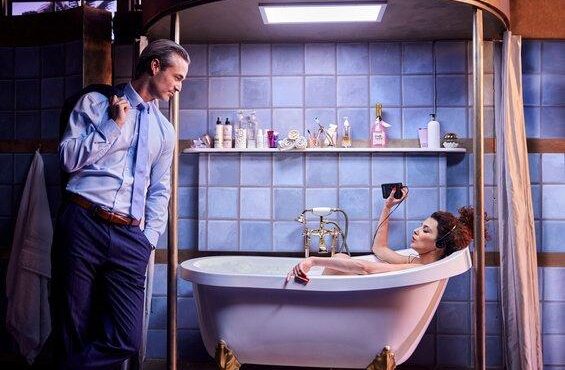
Irony: the favorite Swiss Army knife
Contemporary directing harbors, likely out of incompetence, an almost pathological fear of sincerity. You see it time and again: comical extras during tragic music, sexually charged actions in formal scenes, ugly sets to strip the music of its aura. They are unable to bring the emotion of the original work to the fore and resort to a cynical wink. Irony, frequently used in Baroque operas, thus acts like a shotgun blast against the original libretto on which the composer based his work. But the laboratory of irony offers no one-size-fits-all solution. The audience is kept in the dark about what the opera says about love, faith, duty, or transcendence. Essential meaning becomes a nasty, superior smirk. As soon as that happens, characters are no longer dramatic protagonists, but victims of the directorial concept. The concept of “direction” increasingly becomes “interpretation” and “concept.” The work gets stuck in a shabby, shadowy mirror.
Directorial Freedom
The question is not whether a production is “traditional” or “modern” (nonsense terms, by the way) but whether the staging serves the opera’s internal truth. You find that in the libretto. A director may, for example, simplify a set or abstract the location (Strauss, Berg – more on that next time). That can be legitimate when the music, text, and plot continue to point in the same direction. However, directorial freedom is not an exemption from the original dramatic content.
The score is not a suggestion
One of the most tiresome evasions in contemporary opera discourse is the claim that every work must be made “relevant.” Relevant to whom? Opera remains relevant as long as human motives remain recognizable as intended and under circumstances as intended. First and foremost, the score contains the relevant dramatic information: tempo, orchestration, vocal lines, etc., indicate the center of gravity. Stagings that go against that current do a disservice to the artwork. Comical commotion accompanying serious/solemn music is a typical example of the director thinking they know better than the composer.
Wandering spirits would have us believe that they are ridding canonical operas of sexism, aristocratic supremacy, religious hypersentiment, or romantic idealism. Instead of delving into the episodic elements, they place the work in corrective quarantine – and pay visual homage to their moral superiority. The result, the clash between stage design and libretto/score, is usually cringe-worthy.
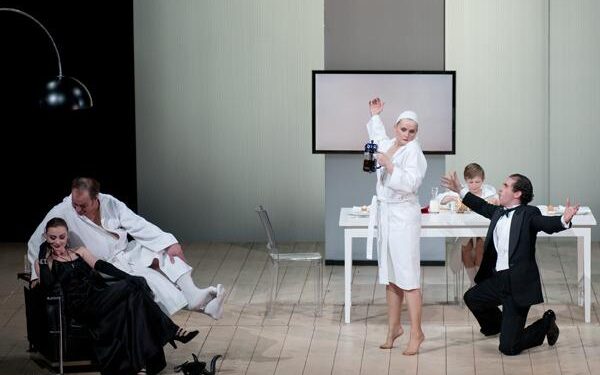
Rewriting a character while retaining the libretto text
How directors shape the meaning of an opera is most evident in the characterization. Is Carmen free and reckless, doomed or manipulative? Is Butterfly naive, heroic, humiliated, self-assured? Is Parsifal holy, traumatized, or absurd? The score sets boundaries, but the staging sets the emphasis. All well and good, except when the director makes his or her own ideology the primary angle. When every person in power is portrayed as a crude monster, and every woman as a pure victim (or, conversely, as a “strong woman”), every religious act as a cynical charade, and every devotion as pathological, nuance disappears. The opera then becomes a contemporary sermon that renders Bizet, Wagner, or Bellini inaccessible.
And then there is the physical environment. Space creates metaphysics on stage: a cathedral, a fortress, a bedroom, a wasteland, a bureaucratic office – replace them, and the moral tone changes. A historical conflict becomes institutional critique, and human tragedy becomes a sociological reflection. Regietheater is obsessed with “hidden meanings” that aren’t there at all or are simply imported from elsewhere. Or it involves meanings that aren’t “hidden” at all.
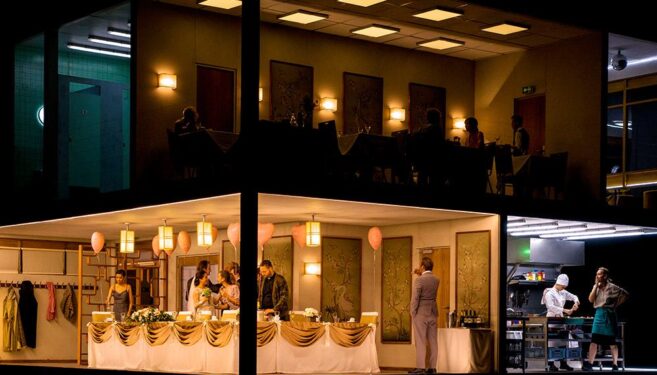
Conservative versus progressive
Logical and valid criticism of Regietheater is rarely countered with valid arguments; for the sake of convenience, people resort to the conservative-versus-progressive frame. There is no mention of artistic responsibility. But opera is an episodic art form in which music, text, and drama must fit together seamlessly – or at least fit together as the composer and librettist intended. When a director breaks that contract, the audience is presented with a fragmented work, a hodgepodge of what one sees, what one hears, what one reads, and what one feels. Interpretive noise paralyzes the emotional core. For a serious opera audience, this is not a minor annoyance, but a major issue. Opera Gazet derives its raison d’être in large part from its readers who understand that this issue is not “old-fashioned” but essential.
A strong production requires discipline, style, musical knowledge, and respect for the dramatic structure of the work. If that discipline is lacking, there is no “compelling concept” behind it; instead, the direction ends up overshadowing itself. Direct meaning degenerates into mere substitutions. And as soon as substitution becomes the norm, a healthy reaction from the audience and critics follows: not passive tolerance, but sharp discernment. ‘Old-fashioned,’ and not falling into the trap.
Olivier Keegel

Great article! In addition to all that you have said, I feel that it is patronising on the part of directors to assume that it is their job to make things “relevant”. Also, if I go to see Norma I want to be transported back to Gaul under Roman occupation.
I completely agree