Die Zauberflöte (The Magic Flute)
20 September 2026 (premiere), Zurich Opera House
Deutsche Oper in zwei Aufzügen (German opera in two acts)
Music by Wolfgang Amadeus Mozart (1756–1791)
Libretto by Emanuel Schikaneder (1751–1812)
Conductor: Tarmo Peltokoski
Director: Daniele Finzi Pasca
Tamino: Magnus Dietrich
Sarastro: Tobias Kehrer
Pamina: Regula Mühlemann
Queen of the Night: Jasmin Delfs
Papageno: Yannick Debus
Papagena: Mariam Suleiman
First Lady: Hannah McKay
Second Lady: Karima El Demerdasch
Third Lady: Dominika Stefańska
Monostatos: Nathan Haller
Chorus of Zurich Opera
Orchestra of Zurich Opera
Statistenverein am Opernhaus Zürich
Music: 5*
Production: 5*
Die Zauberflöte
Mounting a new Zurich production of this work carries a particular responsibility. Few operas occupy so central a place in the cultural imagination as The Magic Flute. For countless people, it is the first opera they ever encounter – whether in the theatre, in school, or through recordings. It is often with this work that one’s future relationship to opera is formed: whether one goes on to approach the art form with curiosity, pleasure and interest, or turns away from it again. All the more reason, then, for a production to do justice to the piece. That matters all the more because The Magic Flute so often plays a special role in educational contexts. The disappointment is correspondingly greater when a stage performance has little to do with what one has come to understand in the work musically, dramatically and poetically. For us, the earlier Zurich Magic Flute productions by Martin Kušej and Tatjana Gürbaca belonged to that type of Regietheater which obscures a work rather than clarifying it. All the greater, then, was our pleasure that Zurich Opera, with Daniele Finzi Pasca’s new production, chose a wholly different course. For us, this new Magic Flute was an unqualified success – musically and scenically, imaginative and coherent, and remarkable for its sense of overall unity.
Daniele Finzi Pasca’s production proved a genuine stroke of luck because it neither let Mozart’s Magic Flute ossify into something museum-like nor smothered it beneath the strained will to reinterpret from which so many current productions suffer. This work, more than most, demands an exact sense of measure: it must preserve its fairy-tale quality and enchantment without slipping into mere prettiness or whimsy. Finzi Pasca found a thoroughly convincing way through. He took the symbolism and peculiar nature of the piece seriously without burdening them with ponderous significance, relying instead on poetic imagery, theatrical imagination and a direction that seemed to grow organically out of the music itself.
Outstanding stage direction
One of the production’s great strengths was that it never set the work against itself. Papageno’s comic scenes were allowed to be genuinely comic, the more mysterious passages involving the Speaker and Sarastro retained their weight, and the fairy-tale dimension was never damaged by irony. The production was also marked by outstanding stage direction, with playfulness, precision and a very sure sense of timing evident across the cast. Particularly pleasing was the fact that the humor did not depend on clumsy jokes, but arose out of situation, movement and musical context. The spoken dialogue, too, was one of the evening’s real strengths. It was especially gratifying that it remained so close to the original text and had not been aggressively modernized, updated or rewritten. That turned out to be a very intelligent choice since the dialogue felt anything but dusty. On the contrary, it came across as fresh, natural and genuinely entertaining. The audience seemed honestly amused by it – clear proof that no forced linguistic contemporizing is needed when the direction, timing and delivery are right.
The lighting, likewise, was of exceptional quality. Finely modulated shades of blue, red, yellow and orange created spaces of great atmospheric richness. The lighting did not merely illustrate: it supported the dramatic action, deepened the prevailing moods, clarified transitions and gave the performance a striking poetic coherence.
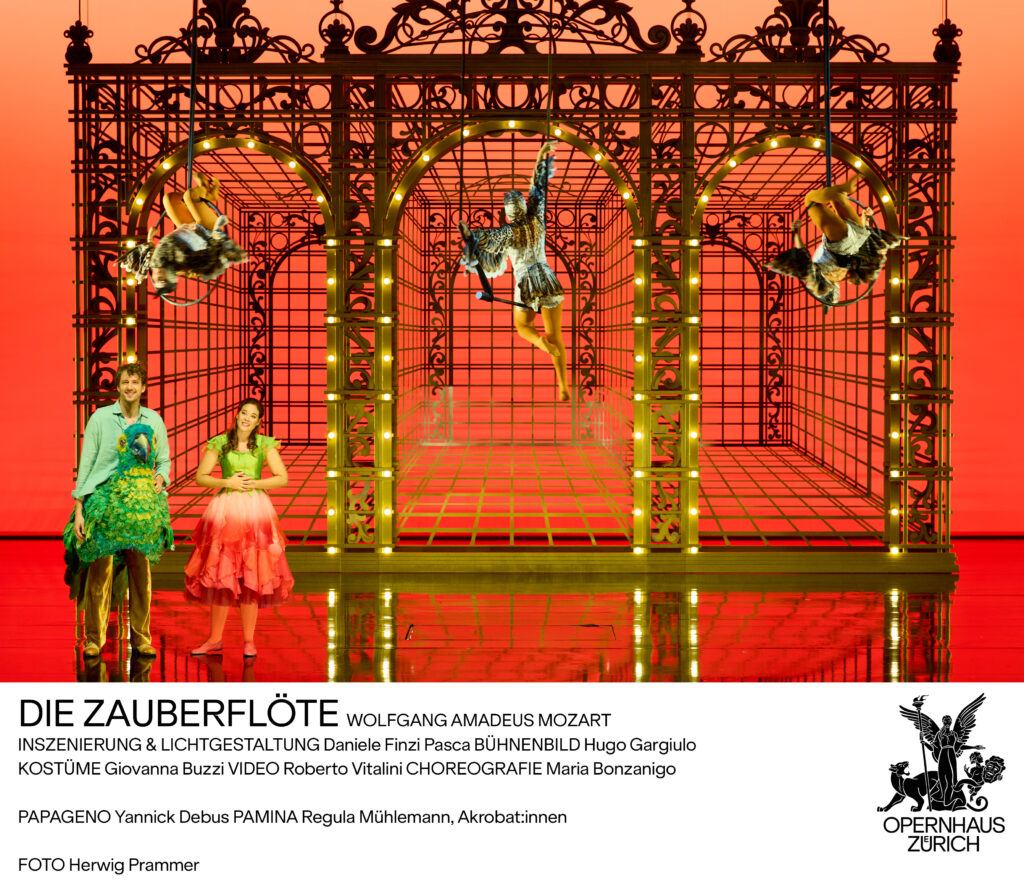
Among the evening’s most notable virtues was Hugo Gargiulo’s set, created with the collaboration of Matteo Verlicchi. It did not merely provide decorative background but opened up a theatrical space of its own for the work to inhabit. The majorelle-blue backdrop of the first act already possessed a depth and luminosity that gave the action something at once fairy-like and expansive. Particularly effective was the fact that these images did not lapse into crude naturalism but remained deliberately artificial. This was evident, for instance, in the serpent, which appeared as an artfully manipulated stage creature whose movements recalled a Chinese dragon dance. The Queen of the Night’s emergence from below was equally successful. In one of the Papageno scenes, one saw a golden, palace-like structure with three gates, which almost involuntarily suggested some oversized and curious aviary. Later, in Act II, the visual world shifted towards something sterner, recalling a Carrara marble quarry and lending Sarastro’s realm dignity, brightness and architectural clarity. That was the real achievement of the set: it avoided both banal naturalism and abstract conceptual chill, arriving instead at images that were artificial, theatrical and poetic all at once.
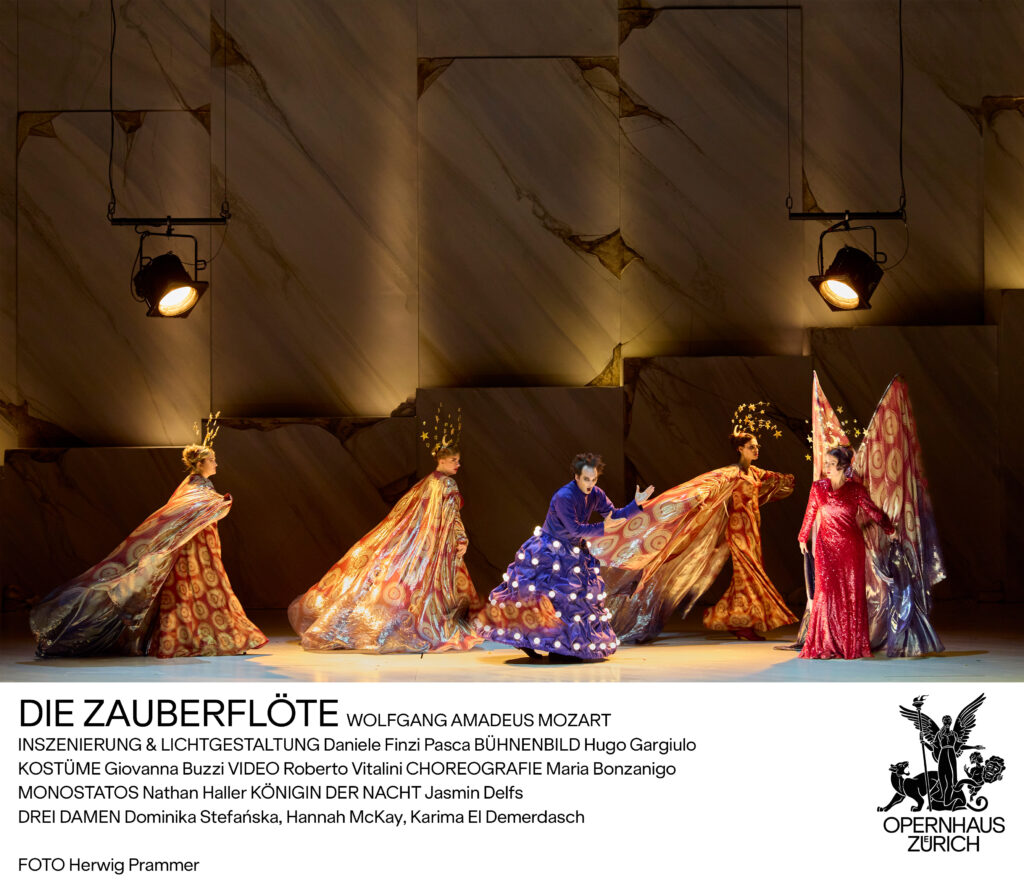
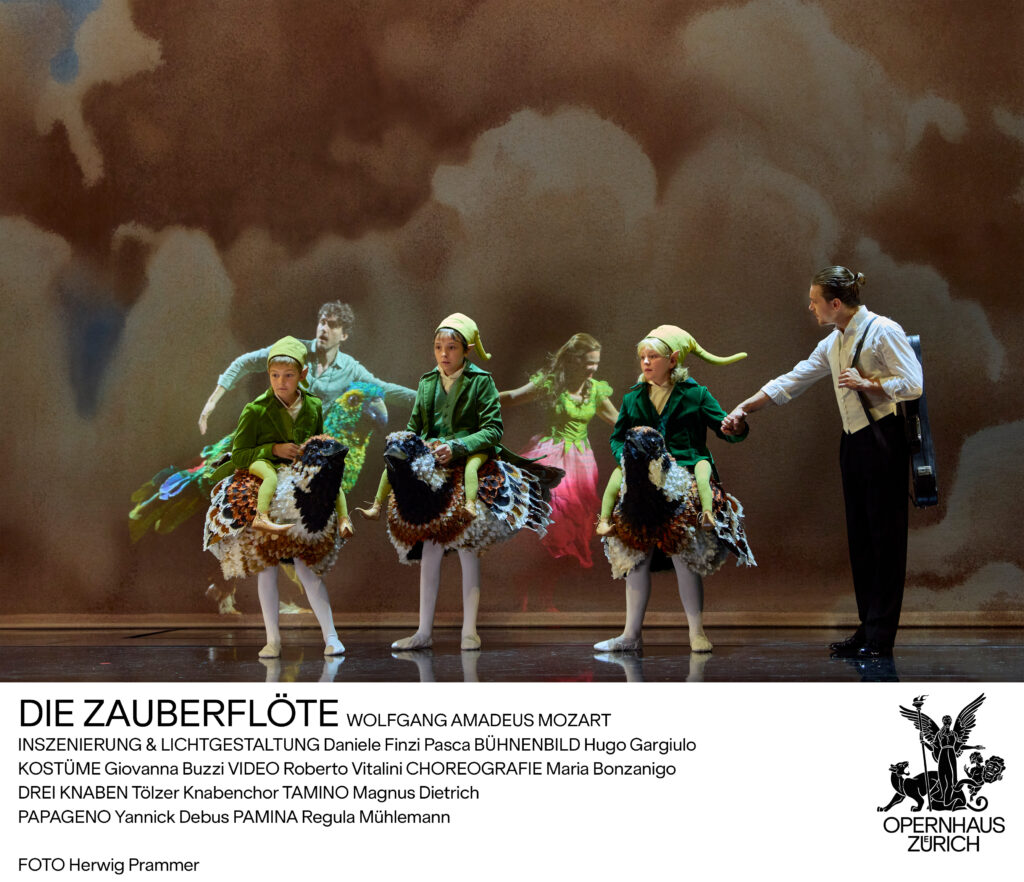
Giovanna Buzzi’s costumes made a major contribution to the evening’s effect because they clearly articulated the work’s different spheres while also placing them within a shared poetic world. The bird costumes, in particular, gave Papageno’s realm lightness, wit and fairy-tale mobility. The Three Boys, too, were beautifully conceived: riding on doves and dressed in costumes suggestive of a cross between goblins and leprechauns. Pamina’s costume was especially effective in its softer, more sensitive coloring, which gave the figure inwardness and lightness. The Three Ladies and the Queen of the Night were dressed in flowing, wind-swept robes, while Sarastro’s world – he himself and the chorus alike – was marked by priestly severity and ritual cohesion; the effect spontaneously called to mind the Priest of Baal in Nabucco.
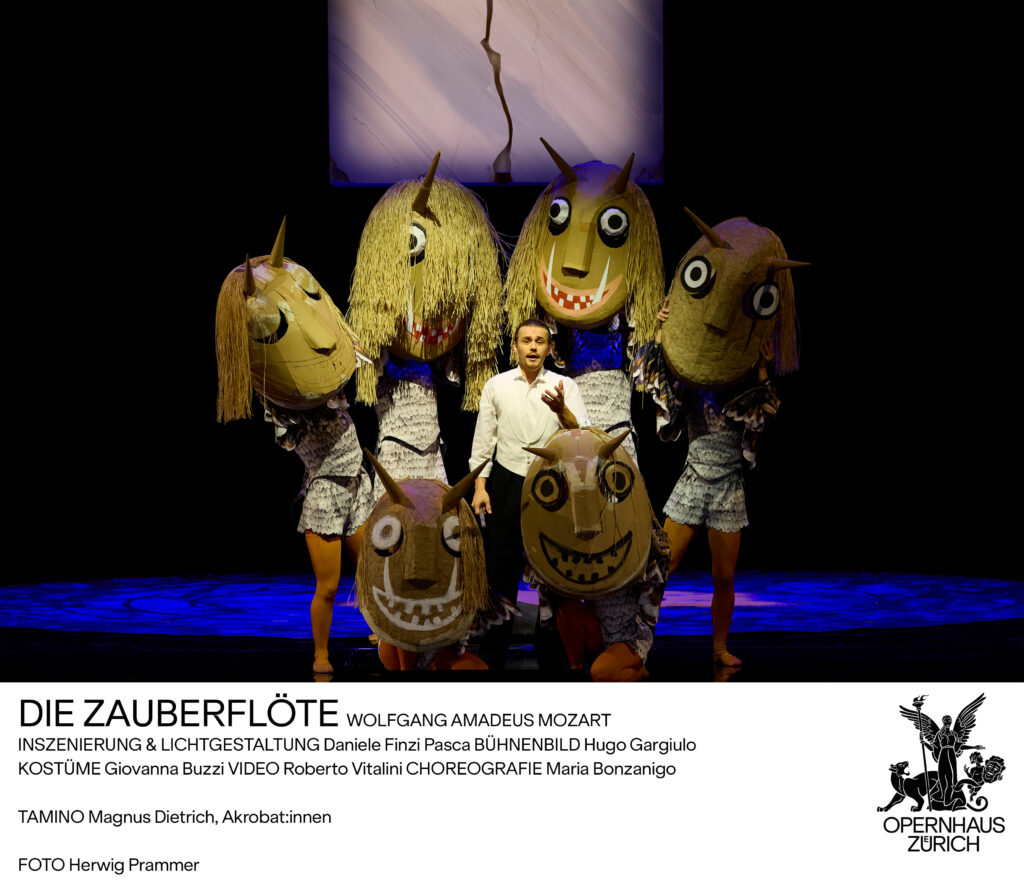
Roberto Vitalini’s video projections likewise belonged to those rare instances in which this device is used in the opera house with real intelligence and restraint. Unlike so many projections, which merely create restlessness or conceal scenic lack of invention, these served to intensify the atmosphere and extend the visual world. Particularly striking were the oversized lions’ heads and the projections used during the trials by fire and water. The crucial point was that the projections never competed with the stage action but supported it.
Maria Bonzanigo’s choreography, too, proved an essential part of the evening’s success. This was most apparent in the movements of the bird-creatures to Papageno’s glockenspiel – delightfully witty, for instance, in “Ein Mädchen oder Weibchen” – and in the dance of the animals with masks suggestive of West African forms.
For all our enthusiasm, there were a very few moments when less might perhaps have been more. In Tamino’s great aria “Dies Bildnis ist bezaubernd schön”, one might well have done without the bird movements in the background. Charming as they were in themselves, they distracted somewhat from the nobility of the moment – rather as if, during a wedding ceremony, a small child were suddenly to stray into the middle of the proceedings. In Pamina’s aria “Ach, ich fühl’s”, moreover, the lighting struck us as somewhat too bright. A darker, more subdued light would, in our view, have supported the aria’s melancholy coloring more fully. There was also a small acoustic blemish in the Speaker’s scene: during an intimate musical passage, the smoke machine made a noise that sounded almost as though someone backstage were blow-drying their hair. In the overall scheme of things, however, this barely mattered.
Magnificent playing of the Orchestra of Zurich Opera
Tarmo Peltokoski’s conducting pleased us enormously. The orchestra seemed to us to be playing with a mixture of historical and modern instruments, giving the sound at moments an appealingly astringent edge. Taken as a whole, the interpretation impressed us deeply: wonderfully nuanced, with unexpected shifts in tempo and dynamics, surprising and compelling in equal measure. One came away with the feeling of having encountered this work afresh. Particular praise must go to the magnificent playing of the Orchestra of Zurich Opera. The flute solos were especially beautiful, marked by great tonal beauty and finely shaped line. What playing, what delight in music-making – technically of the highest precision and animated by an enthusiasm that readily communicated itself to the audience. The Chorus of Zurich Opera, prepared by Klaas-Jan de Groot, also made a strong impression. At the end of Act I, we might perhaps have wished for a little more sheer vocal weight; the slightly reduced impact may have been due in part to the fabric masks. By the close of Act II, however, the chorus was singing with its customary fullness and power.
As Tamino, Magnus Dietrich came very close indeed to being sensational. His performance recalled those rare evenings when one has the feeling of hearing a major career in the making. Tamino is generally associated with lighter lyric tenors; all the more, then, did the role gain here from Dietrich’s marked, virile and yet clear timbre. Tamino’s portrait aria in particular pleased us enormously: excellent vocal control, precision, a gleaming top and, at the same time, the ability to spin the most delicate pianissimo. One felt one could already hear in this voice material that might one day be suited to spinto roles and, in the longer term, perhaps even point towards the heroic repertory. Tobias Kehrer, too, impressed us greatly as Sarastro; his bass is richly colored and firm-grained, yet by no means heavy or cumbersome in production.
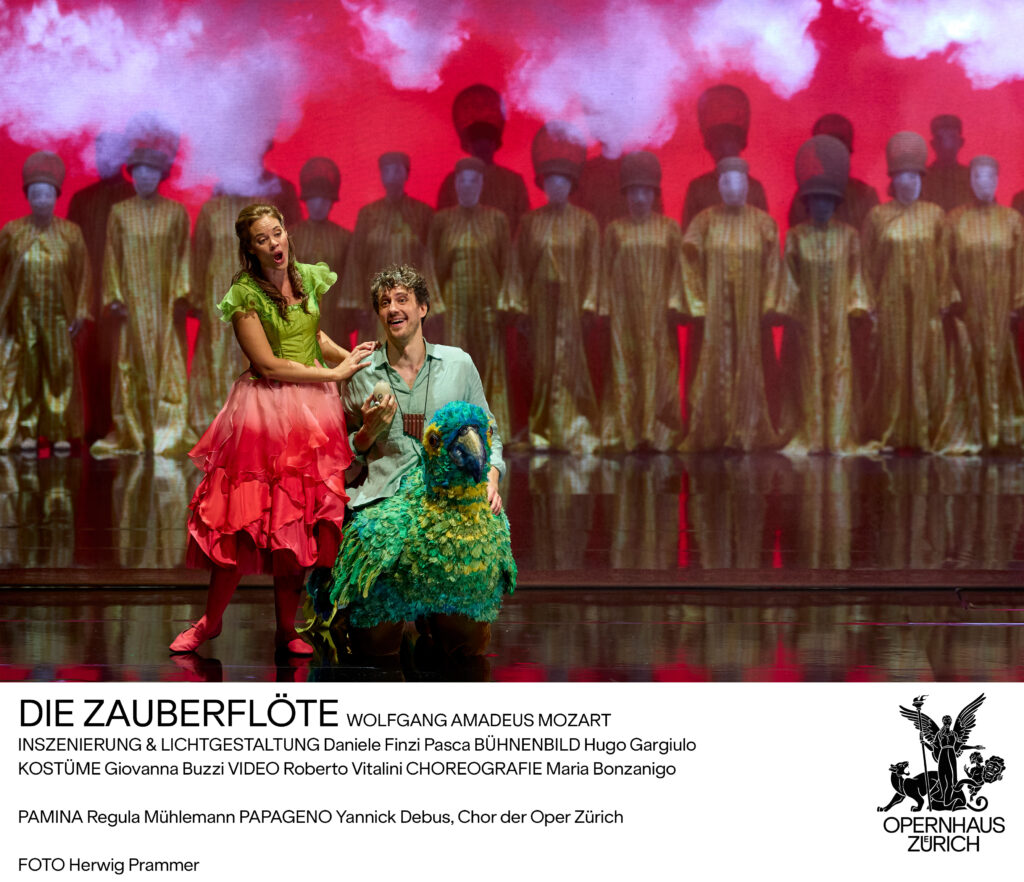
Regula Mühlemann was a splendid Pamina. Her voice sounds radiant, freely produced and secure into the upper register, while the middle and lower ranges are integrated with notable evenness. Particularly striking is the way she shapes the small pauses in her singing, moments in which the audience seems almost to hold its breath, so that the return of the voice becomes all the more moving. Jasmin Delfs mastered the Queen of the Night with striking assurance, precise coloratura and impeccably placed top notes. Yannick Debus fashioned Papageno with great comic flair, abundant humor and impressive stage agility; he also enjoyed excellent chemistry with Mariam Suleiman as Papagena. Hannah McKay, Karima El Demerdasch and Dominika Stefańska as the Three Ladies likewise made a very strong impression – theatrically engaging, individually characterized and yet beautifully blended.
Nathan Haller, too, left a particularly vivid impression as Monostatos. The role so often feels labored; here, however, Haller turned his scenes into little set-pieces, with outstanding stage presence, vocal agility and precise comic timing. One could readily imagine him as a magnificent Mime. Andrew Moore as the Speaker, as well as Salvador Villanueva, Rafael Rojas and Theodore McAlindon in the smaller roles, also acquitted themselves very well. We were equally taken with Leo Eisenreich, Nicolas Bader and Benedikt Eberl of the Tölzer Knabenchor as the Three Boys, who not only sang with exceptional musicality, beauty of tone and secure intonation, but also played their roles with great spirit.
A happy evening at the opera
For us, this Zurich Magic Flute made for an exceptionally happy evening at the opera. Daniele Finzi Pasca has created a production that preserves the work’s poetry, enchantment and theatrical distinctiveness without lapsing into museum-like harmlessness or forcing it into some willful reinterpretation. At the same time, Tarmo Peltokoski in the pit provided a musical reading of rare freshness, tension and refinement. The presence, moreover, of an excellent and superbly prepared ensemble of soloists only deepened that impression. The result was an evening that did more than merely please: it reminded one why The Magic Flute remains, for so many people, a cornerstone of the operatic repertory – because, when it is taken seriously and shaped with imagination, style and musical intelligence, it can still cast its spell. The response at the final curtain spoke volumes. All involved, including the production team, were met with unanimous applause and repeated cries of “bravo”. There were also scattered standing ovations, if not throughout – something that, at least in the stalls, may well have had more to do with mobility than with any lack of enthusiasm. It has been a very long time since a production team at Zurich Opera escaped without a single boo and was instead greeted with enthusiastic cries of “bravo”. A performance not to be missed.