Saint François d’Assise
Olivier Messiaen
Director, Designs, Lighting – Romeo Castellucci; The Angel – Lauranne Oliva; Saint François – Philippe Sly; The Leper – Sean Panikkar; Brother Léon – Russell Braun; Brother Massée – Léo Vermot-Desroches; Brother Élie – Aaron-Casey Gould; Brother Bernard – Willard White; Brother Sylvestre – Marius Aron; Brother Rufin – Ivan Lyvch; Saint François ’s father – Ingo Arbeiter; Saint François ’s mother – Ingeborg Haidinger; Leper (actor) – Georg Schwamberger
Saint François d’Assise in Salzburg by Olivier Eugène Prosper Charles Messiaen
Images from A Distorted World
“Though this be madness, yet there is method in it.”
William Shakepeare, Hamlet
“For one who believes in the essence of Angels,
any attempts at explaining a life-time’s expectancy is futile.”
Anonymous, Aphorism
Saint François d’Assise
A Spirit at Large
The Roving Legend
Provocative metaphors
Prisoners of A Visual World
AI itself tells us that the human race is absorbing a staggering five billion images a day, with high-resolution smartphone cameras and endless cloud storage capturing over two trillion photos globally each year. By nature, we resort to engine searchers on the Web as a short-cut to satisfy human curiosity, admirably wishing to know a bit of everything, and at all times. When brought to the opera house, that breeding ground wherein today’s stage directors resolve, reinterpret or even invent the essence of a piece seemingly as a game, we are asked to accept what may at times no longer appear to represent an original creation. This is Regietheater, not a new discourse, wherein those responsible for all we are to witness upon the stage have somehow been misguided into repeating themselves through identical acts of subterfuge, wherein the new norms are all lawful until all wears thin. What is shameful is that it seems these interpretations are made to capture our attention, to put a stamp of approval upon today’s world and its realities as representing all that is of the past. Hyper-technology, stage machinery, sophisticated computer projections, as well as deconstructionist re-dimensioning inhabit the theatrical ambiance, attempting to ever uphold these modifications. The tragedy here is that nothing can be built upon these castles in the sand. And yet, somehow, the absurd is saved through the use of images as a solution. Retouching through originality, discovering diverse aspects as related to our modern times, or perhaps facing a radical belief that all proposed was what we were waiting for to utterly understand such tangible milestones of civilization as Sophocles’ Oedipus Rex, Goethe’s Faust or Shakespeare’s Hamlet.
And Castellucci, whom we may absolve from attempting to repossess, to bend a well-known work of art as an opera into an offering for today’s public? He has been consistently diverse, yet has attempted to create his own esoteric, personal world, interpreting the core of any opera in a picturesque manner distant from his provocative ‘theatre of cruelty’ origins. Too often, all is hermetic, removed, requiring much energy to join in a semiotic game of decodifying what is presented. His multi-sensory experiences lead us into a labyrinth of haunting stage tableaux paved with his trademark aesthetics of at times purposely shocking a complacent audience, eliciting emotional responses. Judge him as you will for this staging of Saint François d’Assise, as for various other recent productions in his style, yet you may come to admit that his vision of a theatrical work almost always comes through a re-routing, through the ‘images’ of a visual artist. Original? Perhaps not, especially within those superficial attempts to relate much of the stage action to today’s world at every turn. All images turned into stage action may aim to penetrate the spectator’s Third Eye, often asking one to do no less than habitually recognize that portrait of a distorted world reflecting a protagonist’s supposed interior strife while harboring madness through the profound anxieties of our Age. Either one likes this manner of framing a work of art or not, while it is true that there are those of us awaiting new saviors to bring us a classic untarnished, so vitally invigorating in its own true originality that we are seeing it as never before yet totally connect to all that we understood the work to be. Nothing else matters; not reviews, mass success, news grabbing attention, nor our own personal reactions even. Use your five fingers and count those stagings that you feel brought one closer to the essence of his idea of the original. Some may cite Robert Wilson’s unforgettable 1995 solo performance of a masterpiece that ever-captures the universal experiences of human doubt: Hamlet, A Monologue.
Prisoners of A Visual Existence
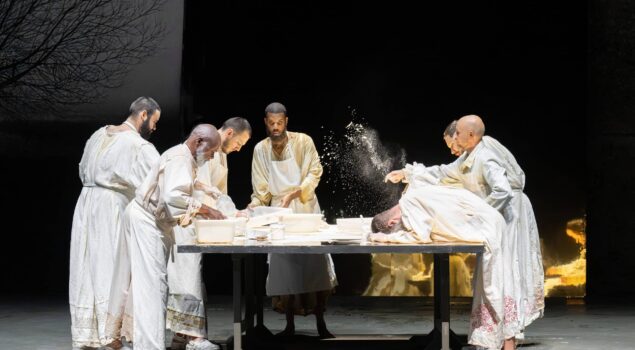
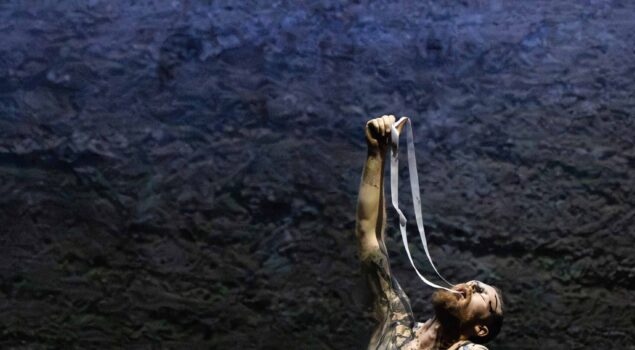
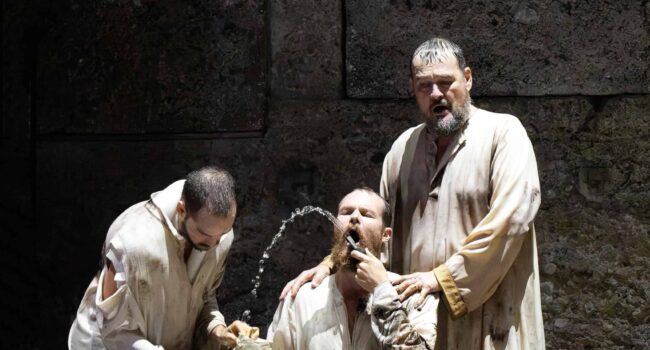
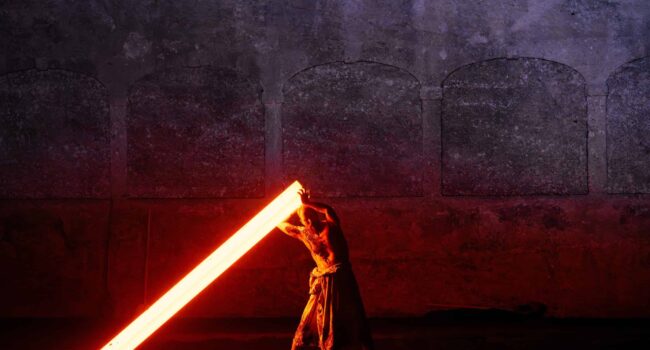
Well then, six and ½ hours in the ‘Felsenreitschule’ to experience this rarely performed, soul-scorching testament to the human and the divine. Messiaen’s insistent bird calls abound, ingrained in his past traumatic experiences in a WWII French lager, as also simply by long solitary walks through perhaps untrodden forests chirping incessantly, and so violently through the score. Visually, we are confronted with the characteristic physicality of a Castellucci staging to bear the essence of the work’s interwoven structures. In its sparseness, much physical space is left for our mind to interpret the meanings, or even to catch onto intended messages, perhaps even to accept the sentiments evoked; better perhaps to leave it at that, not satisfying the need to go deeper into symbology. We have action carried out in what at times resembles ‘German Tanztheater’ through its repetitions, or a representation of Time battling Space anachronistically, often resembling a stylized James Ensor ‘Totentanz,’ wherein memory and obsession predominate, at times upon a dream-like architecturally divided stage. This is valid, original even on its own terms, but often failing to have us relate as words clash with images as in an Expressionist realm. The physical stage elements are often over-sized, isolated, bearing semiotic writings or messages on walls. Many objects relate to Nature, as also to human activity. We discover large black and white photographs of a stark multi-branched leafless tree in winter and an isolated road leading to nowhere as St. Francis crosses it, balancing his book upon his head as he strides; there is a freshly fallen orange with green leaf placed upon the road as if in a Hieronymus Bosch proto-surrealistic painting. Dying birds fall from the heavens, along with a bloodied, dead pelican, a symbol of Christ’s self-sacrificial love, the Eucharist, and Christian charity. The human activity of the Franciscan Brothers is carried out by their baking bread and churning out pottery vases. Castellucci uses other large photos: a hand resting on a flat surface, a book with turning pages, placards with single world messages, as also a huge scrim covering the whole proscenium, a black and white photo of a deconstructionist Lego-like city appears, upside down, with perhaps an angel tearing her way through into view – monotonous but made fascinating by an angel upside down, jutting out of a scissor cut. Some will recall G. K. Chesterton’s essay of Saint François , The Upside-Down World, telling of the ‘poor fool’ saint’s discovery of humility as seen through the eyes of a distorted, inverted world altering his perspectives on reality.
“JE T’AIME, OLIVIER, IMMENSE ARTISTE”
As to the mystical, there is a detached white angel’s wing and a celestial viola played as being buried in sand. Lastly, and disappointingly, as a gesture of showing respect for the pure grandiosity of the opera, Castellucci flashed an effect-seeking, unnecessary full-screen projection in red – JE T’AIME, OLIVIER, IMMENSE ARTISTE. There was a photo of Bruno Moorer, a young boy from an ‘Institute for the Deaf and Dumb’ listening to music for the first time in his life through the blessings of an audiometer. Touching indeed, and in tune with Messiaen’s music when less declamatory or bombastic, perhaps as accompanied by the eerie, mysterious ‘glissando’ of a 1928 electro-radiophonic synthesizer, the Ondes Martenot.
The moments when Castellucci distances us from Saint François are frequent, darkly radical in their ambiguities. He predictably seemed to approach the saint as a revolutionary in a modern way, having him dig his own grave whilst awaiting the stigmata. The dying birds fallen from the heavens in his ‘Sermon to the Birds’ is a diluted ecological warning at best, The 2,000 seat Felsenreitschule amphitheater in Castellucci’s hands became a temple, a magical place where ‘the invisible became visible,’ as Brother Leon sings in the opera. When asked about his treatment of Saint François, Castellucci quotes Deleuze regarding his aesthetic critique of how identity, power, and art intersect in Western culture: “Christ is the template that permeates the entire history of Western art.” In this case, his Saint François d’Assise is a catalogue of themes and images drawn from Christian iconography that constantly merge with references to contemporary art, rather than illuminating it. At times, in taking his distance from Messiaen, Castellucci’s production actually offers a disenchanted vision of Christian faith. The stage curtain displays two lines, one horizontal and the other vertical, as if to call into question the omnipotence of the cross. The angel loses its wings in the second act, staining the stage with blood in an apocalyptic vision that subsequently affects all the members of the brotherhood. At the end of the sermon to the birds, a flock of lifeless ones rains down from the flies, bitter proof that our world no longer reserves a place for what should belong to the innocent, the virtuous.
Flights of Sound
If in a poetic way, Messiaen’s birds whirl through the air throughout his Saint François d’Assise, then, too, the Vienna Philharmonic takes flight, its orchestral sounds at every turn representing the consummate liberty of expressing a composer’s desires with every breath, every percussive stroke and applied tension to vibrating strings through the lengthy, demanding score. Pure unadulterated, memorable craftmanship that has one wishing that a recording would have been made. It is dutiful to speak of the conductor first, and then the orchestra that follows suit via the interpretation, balances and nuances requested. This they did as those spectators present were able to verify the physical exchanges between the Maestro and musicians, all 120 of them. That number is usually reserved for Wagner, Richard Strauss, Bruckner, Mahler, yet here there is a completely different balance, which if observed, gives hint to both the originality of Messiaen’s visions and powers in creating a novel sonic fabric. The Wind and Brass sections are enlarged four, five and six times. Of the ten percussionists, half use mallets and pound xylophones and marimbas. A full string section is embellished by three Ondes Martenot electronic synthesizers. Obviously, the vast array of tonal colors became kaleidoscopic, fashioned by Messiaen’s sound-color synesthesia. The score itself call for extreme, minute precision, and none were let down for a moment; yes, this is a world-class orchestra, but in watching them during the performance one truly sensed an added dosage of psychic energy procured through the novelty of the score itself, all 2,500 pages!
In the hands of Maestro Maxime Pascal, the musical interpretation of this performance offered rare subtleties. There was some holding back on what may have been the truly bombastic, and vice versa, a matter of style and intuition. In watching him throughout the opera, one thought of Boulez, perhaps because of the 20th century score, or the fact that he too used no baton, only gesturing with his hands. Accepting his choices, one may confirm that his poise and full control of balancing the difficult moments was outstanding. Also, his capacity to breathe with the stage action, at times abstract, at others explosive, gave hint to theatrical intuition, as to an understanding of human drama. The atmosphere created, that of the world of birds, and that of the elements of both delicate and restless Nature immersed us in the completely musical landscape of massive orchestral stretches. He spiritual intensity of The Musician Angel scene transports us perhaps not into the spheres, but certainly into the inner sanctum of our spirituality. The Ondes Martenot ‘glissandi’ transport us to another realm, unique, chilling yet ethereal. One thinks of the encounter with the surreal melody of the glass harmonica in Lucia di Lammermoor’s ‘Mad Scene’. A most successful display of emotional maturity from Pascal, as many felt at La Scala last year where he brought us a sumptuous Pelléas et Mélisande. Lastly, let us not forget the moving, transcendental qualities of the unseen chorus of the Konzertvereinigung Wiener Staatsopernchor, directed by Jozef Chabroň, and the three Ondes Martenot players: Nathalie Forget, Austin Viard and Cecile Lartigau.
Voices, Celestial or Not
Though the cast may seem numerous, we have only six Franciscan Brothers interacting with Saint François himself. Then there is the visiting Angel and the Leper, who, along with Saint François, carry substantial weight, at times their scenes take them into dimensions of the unreal.
The Canadian bass Philippe Sly created an imposing, moving, sensitive saint in the making. This exhausting role is the longest in all of opera, outlasting Wagner’s Hans Sachs in Die Meistersinger. Just so, as on one evening an announcement was made that the ‘saint’ was experiencing vocal difficulties but would complete the 2nd and 3rd Acts all the same; he carried on with no dire consequences. He was moving in a painful way, portraying his sufferings more so in the quieter moments on introspection as compared to those requiring more force, but perhaps less sensibility involving. He was emotionally involved in every scene in a special way: upon his lonely path out of darkness, in his intimate moments with animals, and the moving encounter with the tragically bitter leper. His vocal quality ranged from convincing states of dream-like stupor and reflection to anger, confusion and rigorous demand for respect from the unknown torments within him. It is said he lived for two months in a monastery in Salzburg during rehearsals, and one imagines the experience did not interfere with his interpretation! He did, in fact, seem to embody the saint in many ways. The voice is beautiful, steady, at the service of the role’s taxing dramatic demands. A wonderful accomplishment.
The French-Catalan soprano Lauranne Oliva flitted within herself as the angel in scene one and two of Act Two. Her interplay with Brother Elias and Brother Bernard was handled with guile and came off as one of the best scenes in the opera for its subtleness and delicacy. It is rightfully an angel to test the Franciscan order’s knowledge of their mission, and her question probes their willingness to remain open-minded and flexible. Her voice here assumed a different ‘tessitura’ than when she became the violist. She, as a supernatural force, inspired fear, yet comfort through God’s grace. The music is difficult mainly for its psychological nuance; as that of an apparition, a creation with the velvety voice of the after-life, possessing the musicality of the spheres. An intriguing role, a moving performance. The American tenor Sean Panikkar sang the role of the Leper, elderly and infirm, while his double, the actor Georg Schwamberger went through the actions. A complicated, demanding role, the leper must first demonstrate suffering, then blasphemy, happiness, then guilt. Given the emotional gamut, Panikkar’s edgy tenor lends itself to the character’s agitations, as to his exasperations. His acting was believable all through his tribulations. The rest of the cast is listed below, and it must be said that the Brother Franciscans brought us into their inner circle and moved accurately in psychologically living through their daily encounters as bold men demonstrating human weaknesses. For this, we thank Messiaen and Castellucci. All sang well. The choreography was well-aimed; the interventions of the dramaturg seemed to have paid off. The supporting Brothers and Angels brought life and character to their stage presences. The costuming was a slight let-down, and the lighting did what it could in an almost always uniformly-lit open space.
Fait accompli!
Hats off, as always, to Castellucci for his immense measure of culture and willingness to spur the spectator on into the deeper meanings of a stage representation, albeit through abstract doses of visual art. The path laid out and lined with images may not satisfy some of us visually due to the limits posed by the settings. All moved with grace and ‘aplomb’, but not all of us were moved. It also appears that the shows were not recorded, neither visually nor sonically, a great pity. An engrossing, memorable and unique evening at the opera, as presented by the gracious Salzburg Festival. Messiaen’s spirit left the theater with us, as if flying above our heads, the songs of those very same birds, some extinct by now, that gave his life deeper meaning at every turn.