
Rienzi. An Epochal Life of Images
Bayreuth’s Reorientated, Mass-Media Rienzi.
“The market-place is full of solemn buffoons – and the people
boast of their great men! These are their heroes of the hour!”
Friedrich Nietzsche, Thus spoke Zarathustra
“If and when the world changes, it will sweep us along with it;
until then, our destinies can only attempt to thwart our efforts to bring about those very changes.”
Anonymous, Aphorism
Rienzi
From those first notes of music written in 1838 to the premiere in his Bayreuth Festspielhaus in July of 2026, over 188 years have slipped by before Wagner’s Rienzi could now appear to us in a way perhaps that the composer would have desired – a work imbued in youthful exuberance, devastatingly sweeping as French grand opera, forcefully humane upon socio-political grounds, and almost innocently facing the dilemma of our weaknesses when dealing with the struggles for power as bound to uncontrollable tragic forces. And so it is that Wagner’s third opera, subsequently destined to never be performed at Bayreuth upon years of reconsideration, has joined the staple of those works so regularly staged there. This act of negating his own productivity, denying it to the world, is pardonable from an artistic point of view, and indeed the right of its creator. Did not Kafka tell his life-time friend Max Brod to destroy all his works upon his death? Whether caused by self-doubt or recognition of a flawed effort, Wagner, as Wagner, was right concerning his reservations regarding Rienzi, der letzte der Tribunen (Rienzi, the Last of the Tribunes). History dictated that it was to premiere in Dresden in 1842, while Der fliegende Holländer (The Flying Dutchman) was born there in January of 1843, incredibly only four months later. The score of Rienzi has remained basically the same, undergoing rearrangements and cuts, right down to this current version; The Flying Dutchman instead continued to go through realterations in orchestration as well as the insertion of new music as related to the heroine, Senta. Just think – Wagner himself, his wife Cosima and even Franz Liszt all had their say in the creation of today’s final accepted form, arriving to the Bayreuth Festival in 1901, while Rienzi was to reach its one hundredth performance in Dresden in 1873. The path taken by these two works is important as we can trace the steps Wagner took into becoming that full-fledged Hoffmannesque Romantic, while remaining conscious of society’s perennial need to revive itself for the betterment of all, representing one of the composer’s greatest artistic desires and needs: that of creating an audience of the future.
A True Wagnerian Social Ideal
Related to this premiere staging of Rienzi for the 150th anniversary of the Bayreuth Festival, perhaps all-too-much has been made of pervasive political histrionics concerning much that surely for some of us remains partially marginal and exaggerated. While a number of these elements may take on importance as they creep into a Regietheater representation, the essence of Wagner the artist, through his creation of Rienzi , reflects other realities regarding the composer’s needs at the time, as to his choice of the historic personage Rienzi himself. And yet, there is another important, somewhat ignored figure – Claude-Henri de Saint-Simon, the Paris philosopher (1760) considered as the founder of French socialism, and mentioned by Wagner himself in his autobiography, My Life. Saint-Simon feared that even moderate advancement of industrialization and scientific discovery would profoundly change society in a negative way, as perhaps anachronistically related to our doubts today concerning AR, IA, and Social Media. He believed that society would restructure itself by abandoning traditional ideals of both material and spiritual values. Saint-Simon’s advocation for a society wherein the benefits of one’s productive ‘work’ would be allotted to both rich and the poor inspired Berlioz, Liszt and, of course, the Wagner of Rienzi. A concept of ‘Folk Art’ was the unifying force of a society, wherein both quotidian and spiritual life were to resonate deeply within all. Wagner’s concept of Gesamtkunstwerk mirrors Saint-Simon’s creed that aesthetic production in theatrical performance could serve as a substitute for traditional religion in redeeming humanity. This link to Saint-Simon is important as it somewhat justifies the insertion of Rienzi into Bayreuth’s programming as it thematically evokes Tannhauser, as also Der Ring.
Visual Photography within Pantomime
One may feel that, by now, the indiscriminate use of hand-held videocams, whether for news services or not, mobile phones, over-head cinema screens, arrays of computerized images, flowing electronic text messages or the scrolling of pages from a book can no longer assist the opera director in sustaining stage action wherein the dramatic event is recreated, be it set in today’s world or not. Using a mobile phone to write a love letter in a purported 1850’s, Renaissance Florence or Ancient Rome can serve no purpose, and will in all probability lose emotional impact. Stretching the means of any visive device in the desire to communicate with today’s audience is acceptable, yet the action must encompass spontaneity, originality if you will, as a necessity. Dramatic action need not be accompanied by technological apparatus, so often equipped as to bring us physically closer to the unreality of theatrical reality. The main problem today is that less and less is left to our imagination, and we are guided by the inflexible hand of one offering a multifarious ‘modernistic’ approach at all costs, suggesting liberties to the stage director in elaborating facts in order to shed light on ulterior symbolisms. All too rarely, similar means justify the end.
Of particular alarm is the fact that by now 90% of operatic Preludes, Prologues and Overtures are almost always forcibly staged as pantomimes. Were they simply abstract tableaux vivants! Instead, they are cinematic interludes giving life to a weak storyline wherein the singers gesticulate as actors in the era of silent films, and, even worse, implement scenarios of pure, heavy-handed invention of the stage director, so frightfully distant from the libretto’s content that they often cannot be sustained as the opera progresses. Let us look into what occurs in the nearly 15-minute Overture to Rienzi in this historic production, without having received information or details beforehand, and also keeping in mind the commitment of this 2026 Festival to examine the uses of AI in opera’s future (Der Ring), as well as offering Rienzi as perhaps a non-valid future repertoire piece. Imagine that all we know is a smattering of the plot: The Pope of the late Middle Ages lives in exile in Avignon, while his notary Rienzi rises up to contest the abuses of the noble families of Orsini and Colonna just after his younger brother had been murdered. He is appointed as Tribune, a champion of the Republic. Rienzi accepts the friendship of Adriano, the son of his rival Colonna, as he is in love with his sister, Irene; this even bringing him to pardon a successive attempt upon his life by his enemies, who ungraciously and unsuccessfully return with an army to dislodge him. As a man, Rienzi sadly loses his idealism, hubristically falling victim to his own power, and thus loses the support of both his public and the Church itself. He and his faithful sister Irene are besieged, and fade into history as Rome burns.
Enigmas of A Wayward Dream
Perhaps the true value perceived when confronted with an un-staged opera ouverture is that it may ask the spectator to grab onto his own open-eye dream images, unconscious movements as accompanied by unexpected suggestions brought through musical melody. Through repeated experiences with Regietheater and its staged overture pantomimes, what occurs often does not relate to what we know of the opera itself, nor perhaps what we should progressively know. It is the director forcing upon us their personal, esoteric message in a vain attempt to reveal an artwork’s ‘higher’ meanings, more than alternative variations. The problem is that it will always relate back to the present, yes, the stage director’s present, as the completed actions refer to his realities; thus, every reconstruction is an abstract instant, forced into an incongruous whole. The flow of text messages sent in English by the multitudes across computer, television and mobile phone screens suggests universality, uniting us through presumed similarities, and not diversities, while also invading our privacy.
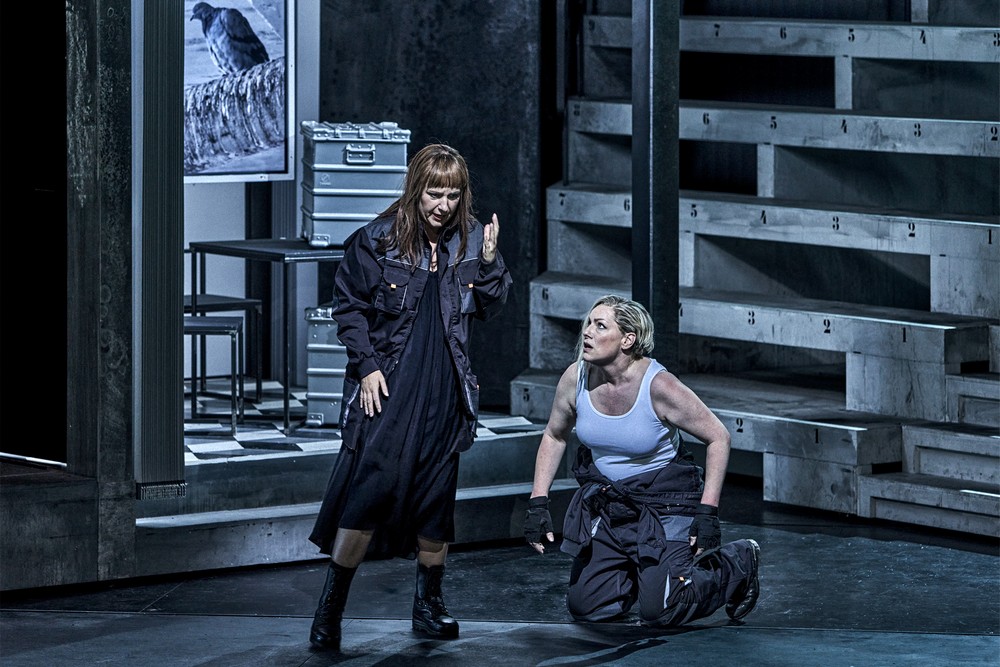
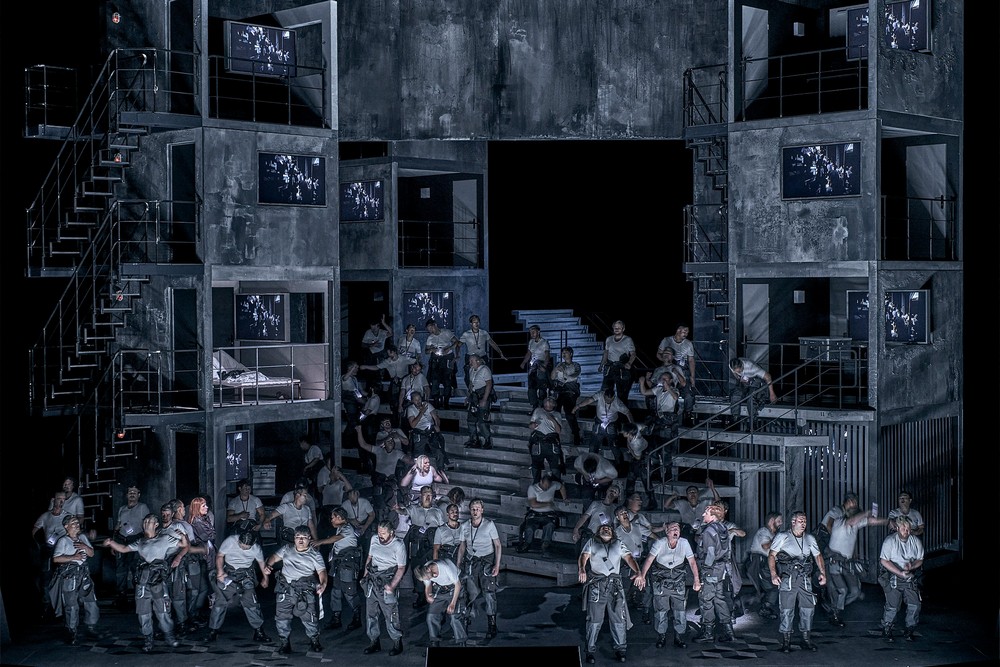
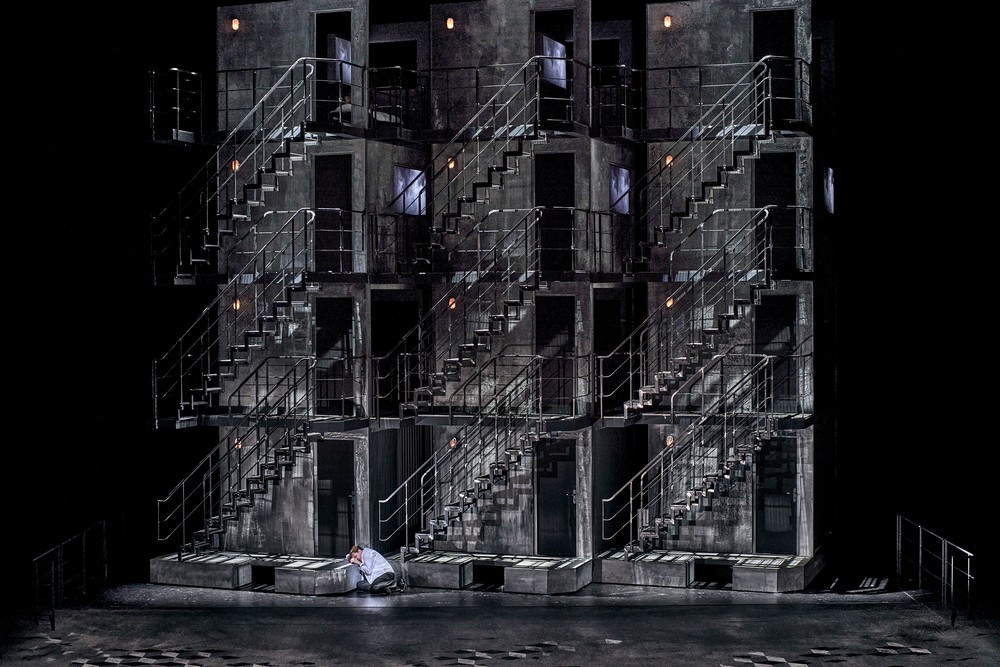
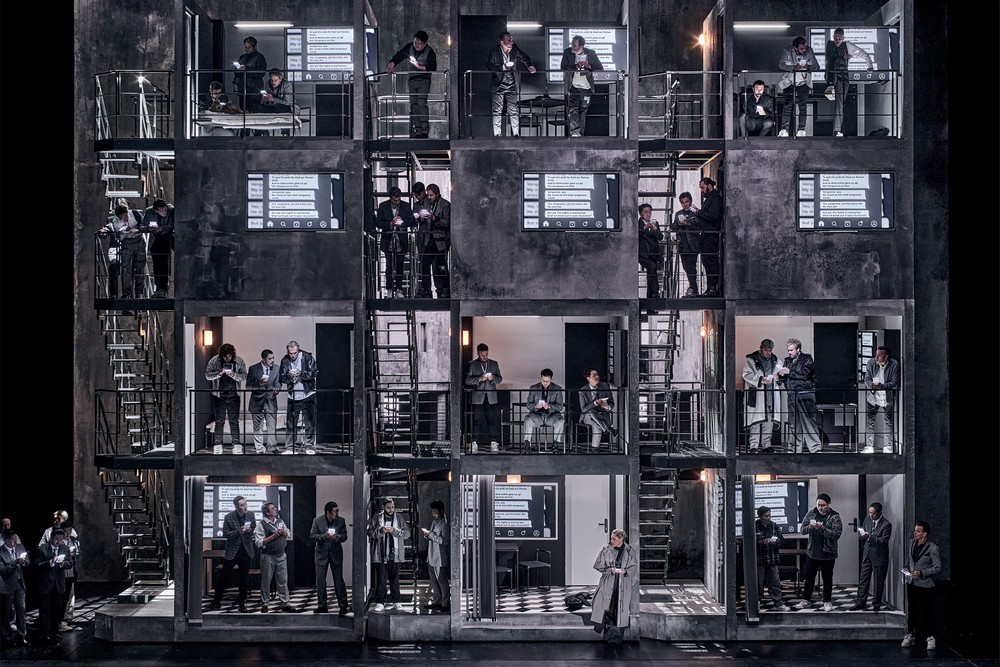
A slowly opening curtain reveals three occupied, sparsely furnished cube-like rooms, accompanied by the first strains of the opera’s pivotal melody. We find a ten-year-old-boy playing with a grey and white abstract Lego-like construction; a woman in shadow as distanced from a table set with plates and glasses; and a professor-like man pacing back and forth, book in hand. The first impact suggests the loneliness of living in a desolate, unemotional world, and thus the music here takes on an aura of unhappiness, whereas Wagner intended nobility of spirit as Rienzi will eventually pray to his God to save the Roman people before his final downfall. As the Overture continues, we are faced with a scenario that defends the director’s interpretation of the opera itself – the Tribune of the plebs resembling the populist President, Donald Trump, however distant from the original Roman leader or Wagner’s text creating him. The boy, if we stretch our imaginations, may perhaps be Rienzi’s younger brother or the fruit of an invented incestuous union between Rienzi and his sister Irene; his illness suggests tuberculosis, which literally brings the two to scream. Rienzi himself is taking notes from Werkformen deutscher Kunst, a 1926 philosophical study dealing with public appreciation of Art by museum director Max Sauerbrandt, a champion of German Expressionism, a freethinker who was isolated by the National Socialists. While true that our Rienzi onstage today would be in favor of enlightening his people, a subtle point is missed by the spectator, though hinted at: the future Tribune is a bit of an egoist as he sits the sick boy on his knee and continues studying. Soon, Irene enters, and seems to be correcting something Rienzi has scribbled, gesturing with powerful fist thrusts, spurring her brother on to be even stronger in his beliefs. They embrace and then begin to kiss. As a grand finale to Wagner’s bombastic musical march, the three cubicles rise up, revealing a stack of another nine, twelve in all – almost each one containing a person busied with a mobile hand in hand. Outside their single, squared windows, pigeons land, perch, fly about loftily. And of these pigeons? AI Overview always warns us that it may commit errors, yet states that the birds “ … project an inescapable, ominous refrain of ‘it will never happen again,’ a haunting warning of impending doom, representing the inevitable decay and extinction of political hope, familial affection, and Rienzi’s corrupting dream of absolute power.” Yet, the images of them flying as the heroic march blares seems the opposite … an image of freedom, hope, harbingers of good cheer, or even escape. Take it as you wish – we understood that this was going to be a long evening, sprinkled with forced messages and incoherencies.
Ordinary Grandeur
In a way, this production can only carry itself off with the élan and aplomb of 19th century French Grand Opera, true to its intended form, regardless of all the pitfalls of its own making. The use of technology for the theater was consistent with that technology which surrounds us in our everyday lives, in every way, all in itself somewhat humdrum. With the visual emphasis on that which splashes across our television screens, all is tinged with an elaborated sense of déjà vu, and little surprises us or captures the imagination. All was immaculately detailed and uniform in context to be sure, but the result was that of an ordinary production. At times, images were striking, as when the trial scene mimicking the courtroom goes stark black and white above the heads of all present, or a sunrise as an atmospheric sensation created when the soothing voice of the Peace Envoy arrives.
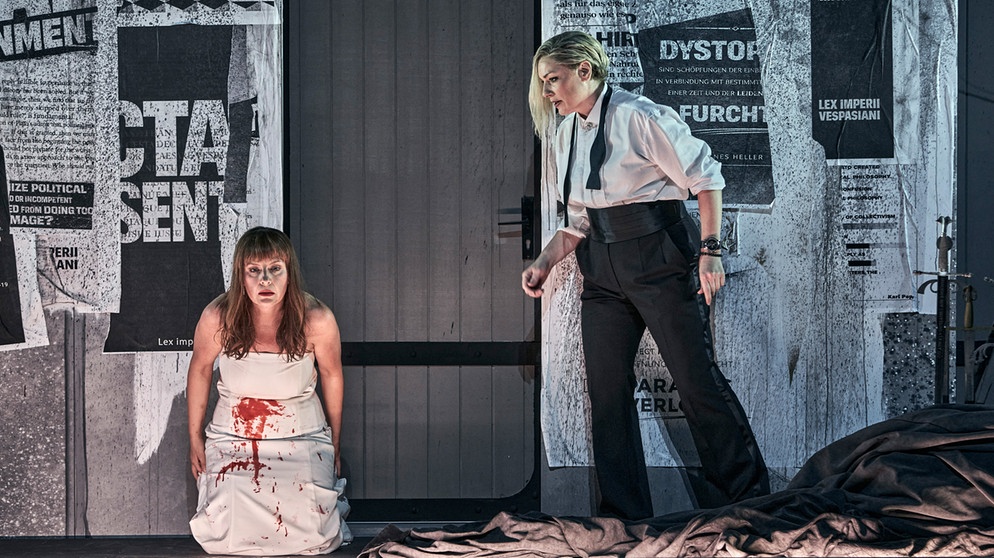
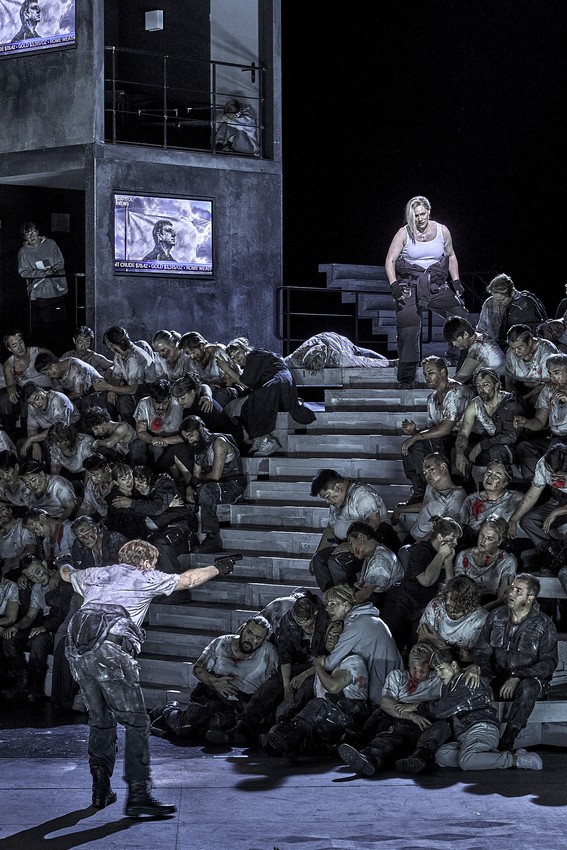
Electronic means dictate the ongoings right from the start. Orsini, Rienzi’s political rival, is in the act to kidnapping Irene, who, however, watches all his moves from her cell phone as the warring factions of Orsini and Colonna fight with their mobiles in hand. As the bickering goes on, a ‘Live from the Capitol’ heading blasts across TV screens from everywhere, while the first of many rousing choruses erupts. Though many would classify these as Meyerbeerian in substance, some indeed do hear Verdi in all his full-fledged patriotism: that of Nabucco of 1842, Rienzi’s premiere date. This is fine but is not to be a representation of History in the making. Another Tv News blurb tell us that Colonna was acquitted of a hit and run episode a few days previous, as if we didn’t know that those with power rarely pay. As Rienzi tells the populace that the trumpet will sound to advise them it is time to defend the city, a soccer match takes possession of the screens. The Italianate duet between Irene and Adriano is charming and characterizes Wagner’s love of Bellini’s melodies. The trumpet sounds, and the citizens regroup in a church, or so it was to be; we now have presidential-debate voting machines, all before a giant screen indicating ‘Favorability Poll.’ Certainly, having sacred organ music to accompany our voting is a plus in any society, at any time. I never saw so many people so happy to vote! Interesting, but overused, the mass image of the citizens clapping in slow-motion rejoicefully for Rienzi’s victory. Honestly, Act One was an Evening News Show, and in truth, the opera lost itself as the stage action and tensions amongst the characters becoming cardboard-cutouts, representing Andy Warhol’s theory of 24 hours of temporary fame or notoriety.
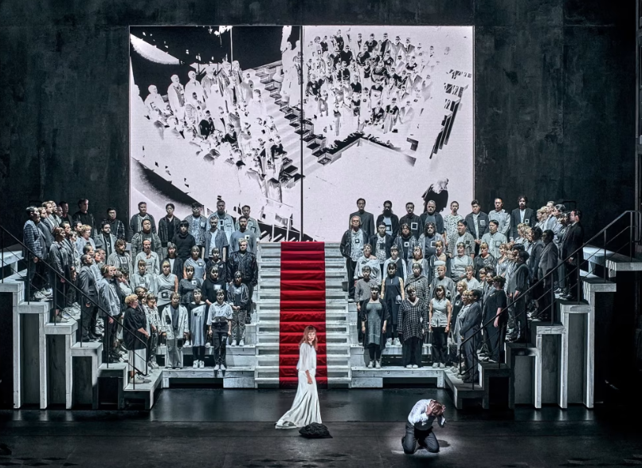
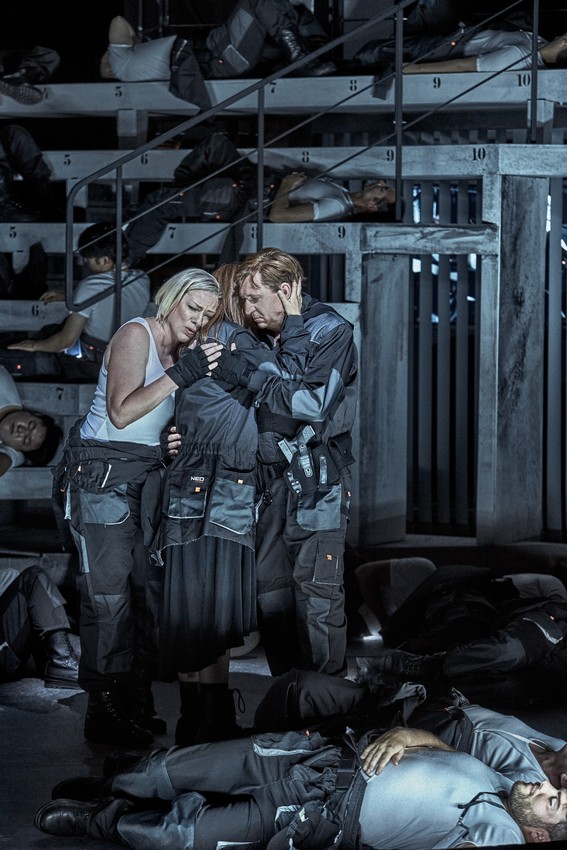
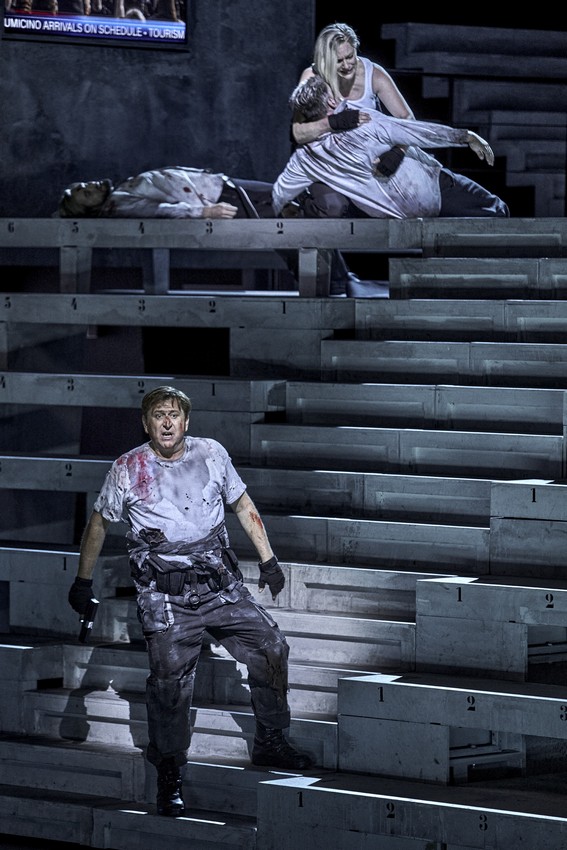
The Second Act followed immediately with no break, and the huge screen flew upwards to reveal the same slow-motion clapping citizens seated upon a white bleacher-like section; frankly not one of the most attractive scenic elements, as it also will be over-used until the end of the opera, where it is out of place. Its sole purpose was to house the vast chorus center-stage, neatly arranging them unobtrusively it must be said. As to the length of Act One and Act Two joined for a total of two hours, there is little else to do if the Ballet is to included which it was here. Originally, a wise move by Wagner, opposed as he would be in being forced to insert a ballet into the Third Act of his Tannhauser 16 years later in Paris, which he spitefully did, but at the beginning of the First Act, causing a riot out of which grew his hate for Meyerbeer and his gang. Yet, to paint History rightfully, we must recall that Meyerbeer also helped Wagner produce his operas in Dresden.
Wagnerian Pirouettes
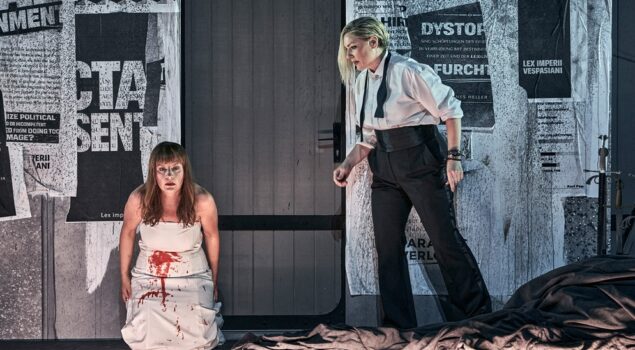
The Ballet that Wagner chose to include in the Second Act was to be woven into the plot, reflecting the political tensions and social themes inherent in the libretto of Rienzi. It represents the original tale of Lucretia by Livy and Ovid, dating back to the ancient Rome of 509 B.C., and is linked to Orsini’s attempt to assault and kidnap Rienzi’s sister, Irene, just as the opera begins, though the music is purely ceremonial. We may ask if Wagner desired a contrast to his tightly political drama. In one way or another, every other Wagner opera offers a shift in time or space, making theatrical sense. Without the Ballet, the order of the Acts would remain the same, and nothing of the structure of the evening would suffer. And yet, we here must support a rollicking, totally kitsch-filled tribute to Wagner himself as presented through takeoffs of all his operas. The public (the chorus) attending the-performance-within-the-performance is also mocked. Spanning nearly 15 minutes, a small Bayreuth-fashioned theater pops up, and we witness a burlesque travesty which might have been called Wagneriana. We must recall that the original version of the Ballet lasted over 40 minutes, yet in listening to it, it makes more sense and blends its dance-like eloquence with the other parts of the Rienzi score, as too with those Beethovenian outbursts; it carries Wagner’s stamp, and relates to his early orchestral pieces, symphonic variations and inventions one upon the other. It is not all so sprightly as it was here in this Bayreuth premiere. How would we love to see one facing the challenge of performing it fully one day! But be careful: Act One and Two combined would then last two hours and 25 minutes! One must admit that other solutions to staging this scene would not be easy to invent. Too many factors are involved, many depending upon the actual staging itself. Yet, a more stylistic or somehow novel version would lead to a measured rendition of Wagner’s visions. This abundantly television-computer-influenced presentation could only have produced this potpourri of fleeting snapshots of Wagner’s complete oeuvre.
Curtain up! A live, small golden statuette Wagner donning technicolor blinking shoes, arms raised while conducting, pirouettes onto the stage, and checks through his score as one Wagnerian personage after another appears. The fun for us is in easily identifying who they are, but their actions are glib, predictable, and only slightly humorous; indeed, it seems that the real audience lost focus on them as soon as they were identified. For example, Tristan and Isolde drank their love potions from their cups, Mime banged upon an anvil, Freia carried a basket of golden apples, and Hans Sachs whacked a shoe sole. Senta wandered the stage with a picture frame hand in search of her Dutchman. The chorus-audience donned AR glasses for Parsifal, while others rushed to the urinals and drank beer during the intermissions. A politically correct cleaning lady passed by smoking while pushing a colorful trolly of mops and detergents. The shtick did become more involved: we saw Beckmesser and Walther fist-fighting, and a waking, over-ripe Brünnhilde pleading to be kissed. Amfortas sports his spear anew, and a technically-slow ‘poor fool’ Parsifal is given the Grail cup, requiring Kundry to tell him over and over again that it needs to be switched on. However amusing it all may have seemed to some, one could not help feeling that this two-dimensional vaudeville detached itself from the opera and its sentiments. Also, recent slap-sticking Tannhäuser and Die Meistersinger productions (both excellent in many ways) give hint that future renderings of these operas might aim to include episodes of trivial comedy whenever possible. In truth, though, either the opera can sustain humor or not; and Rienzi can not.
Redoubling Noble Enactments
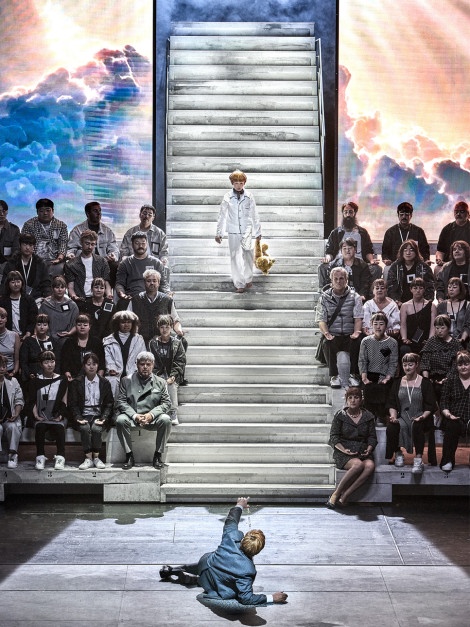
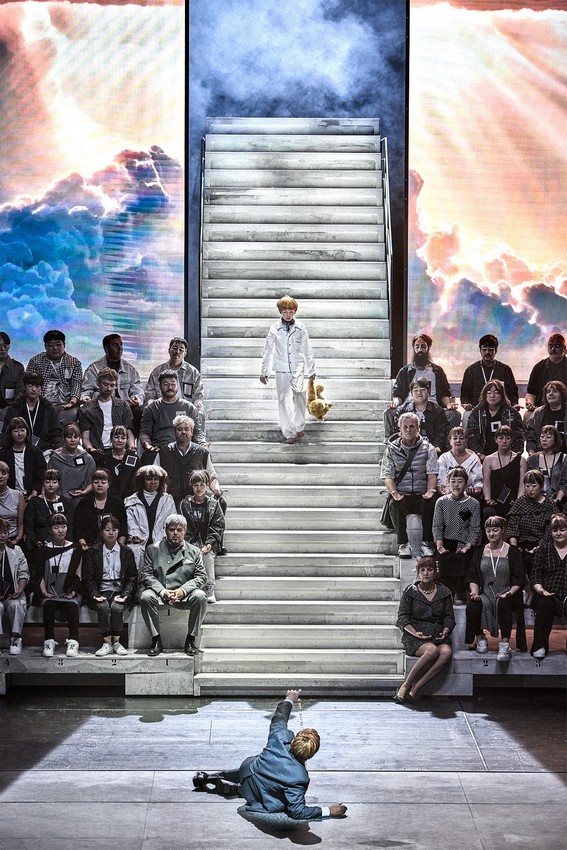
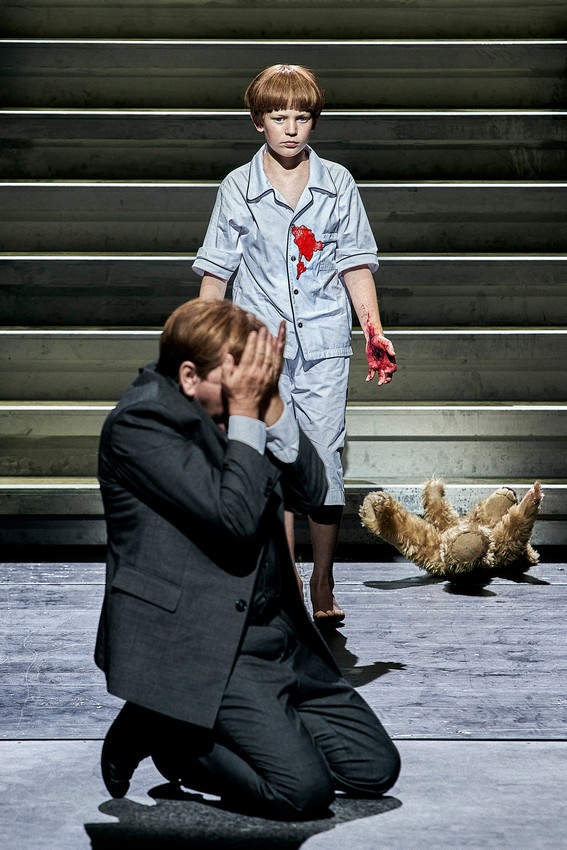
There are moments of great beauty in the score, and the staging did at times capture all wonderfully. Yet, the use of repetition, of falling back on gestures and actions in different moments and situations is not quite the same as counting on a psychological, hidden or modulated leitmotif, and did weaken many effects as such. In Rienzi especially, a historical opera, time marches on as events seal the destinies of many, thus the greatest fault is to impede this flow by physically revisiting a non-related event or profiting from a winning moment. We may examine a moment of citizens’ joy, as well as the figure of Rienzi’s boy brother as they appear at the beginning of Act Two, here attached to Act On. In the moving orchestral introduction, Wagner paints the panorama of the hills of Rome in all their grandeur, accompanying a moment of political tranquility after Rienzi’s election victory. Here, a seated chorus of citizens wave their arms in slow-motion (already seen), yet their smiles, expressive faces and outbursts of joyful liberation are in real time. Rienzi, we may note, in shaking hands with almost everyone as politicians do, ignores Orsini’s outstretched hand of congratulations. The joy of the masses is transmuted onto a background sky wherein a brilliant sun is breaking through storm clouds, reminding one perhaps of Easter Sunday and the Resurrection of Christ; the inspirational off-stage chorus of Peace Envoys certainly captures this sentiment – “Romans, hear the tidings of gracious peace!” In purely cinematic fashion, Rienzi climbs the stairs as if gliding through the sky towards two floating red doors indicating a double exit. The doors open, we see Rienzi’s deceased little brother, teddy bear and all collapsed upon the stairway. The angelic voice of a Peace Envoy, joined by the seated female chorus, hails the peace all Rome now enjoys.
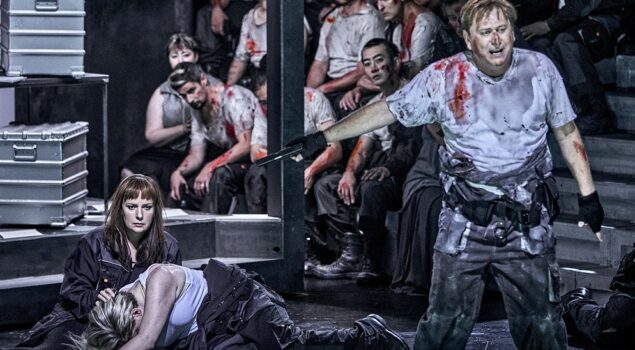
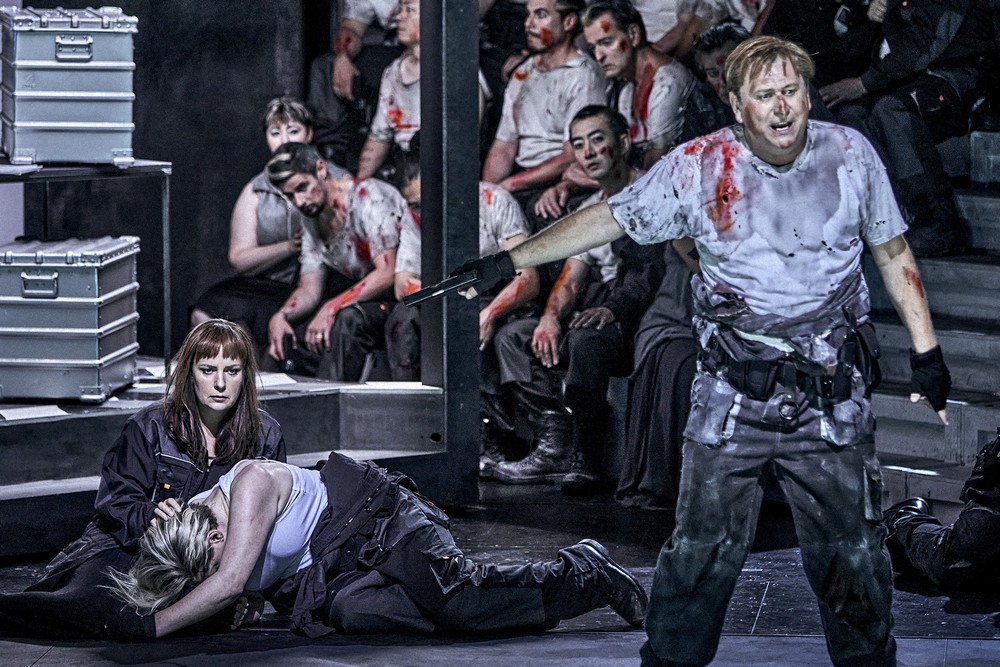
The boy walks to the bottom of the stairs, and we see that his hands bear the stigma of Christ; he is now a hauntingly surreal harbinger of peace. A striking image, a coup de théâtre for sure, yet not without consequences. Rienzi stumbles, faints, almost in shock; he must accommodate this vision, accepting the miracle of his brother-in-Christ. However wonderful the scene took form, it was forced, pure effect, not the opera as written. It took away the importance of the citizens as rejoicing the return of democracy to their land as Wagner’s chorus rises to great heights, and without the help of mysticism or miracles, though in a following scene monks do mention that an avenging angel will await Rienzi as an act of excommunication from the Church. It is a horrifically moving scene with Rienzi rolling about on the floor with Raimondo (the Pope’s legate) closing in, the citizens dogmatically ever-applauding in slow motion as seen upon a large black and white screen. One of the best visual moments of the evening. When Rienzi joins the chorus, giving praise to God, the violins soar as sustained by redemptive music resembling The Flying Dutchman. He faints, and his brother, who had already fainted, rises up and climbs to the top stairs, teddy bear in hand to return to eternal sleep. Rienzi wakes as a descending curtain hides the stairs. There is no space here to cite other deviations, some valid, some not. The point is that these directors seized the ‘Peace Envoy’ scene to create moving theater for the sake of theater. This was not exactly regietheater as it did not violate Wagner’s intentions as the end of the opera does – it simply created another scene following personal tastes while glorifying glorious music through imagery of pure effect. As with the Ballet, and the pantomimed Overture, all was out of place, and attempted to serve not this ‘historic’ version of Wagner’s early opera, but to present it in a contemporary, yet removed way. This was the fault of this staging.
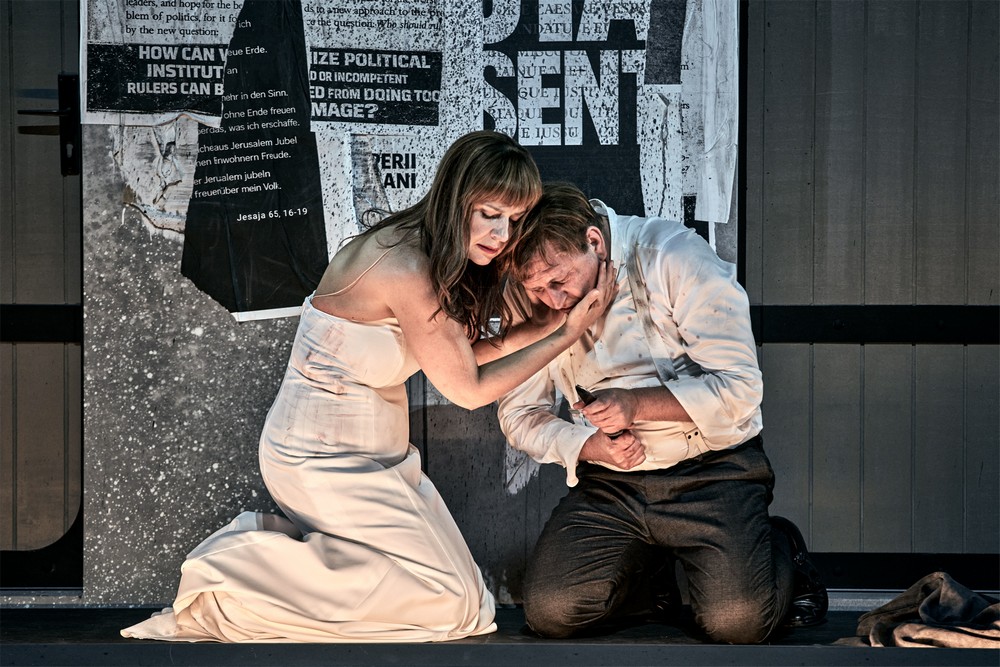
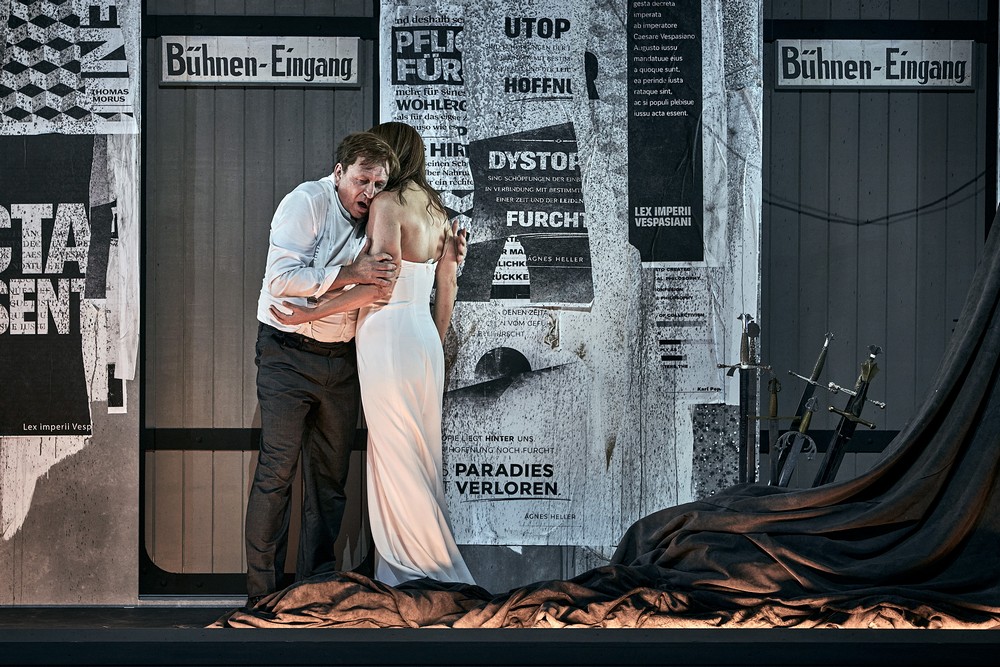
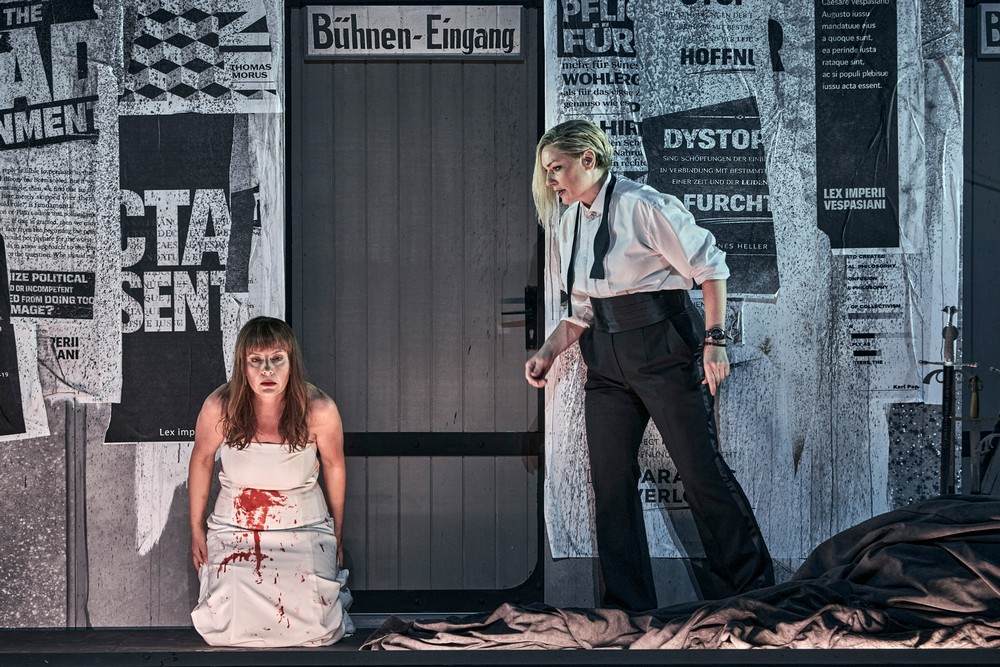
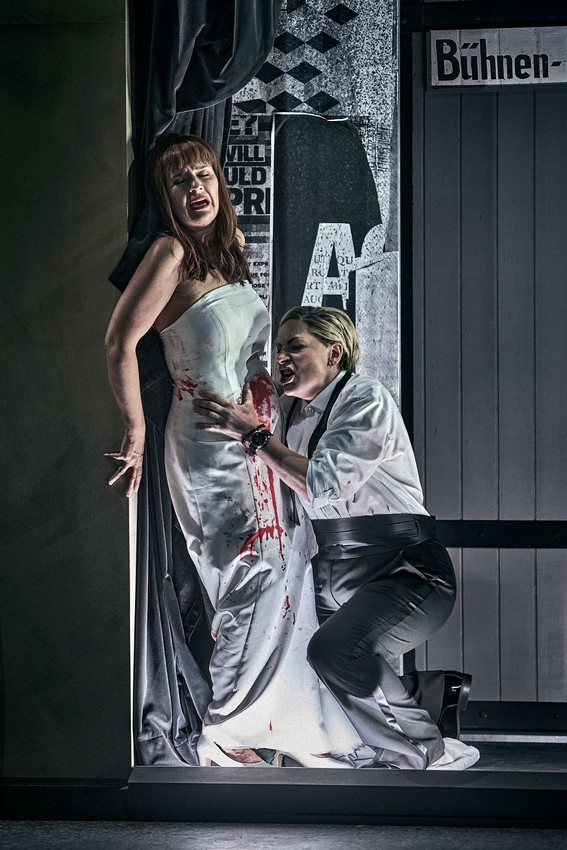
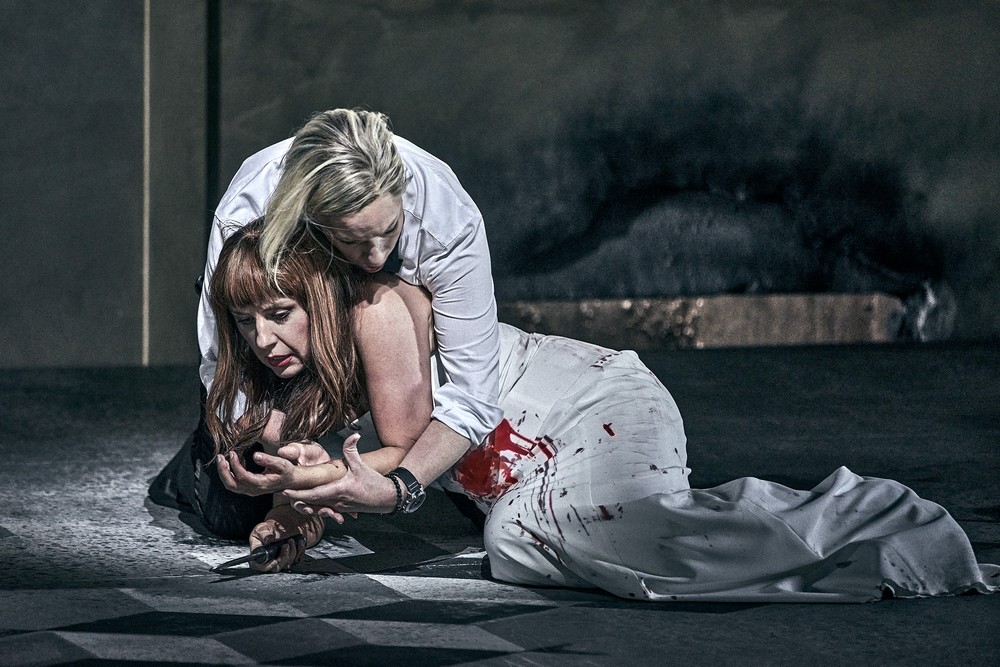
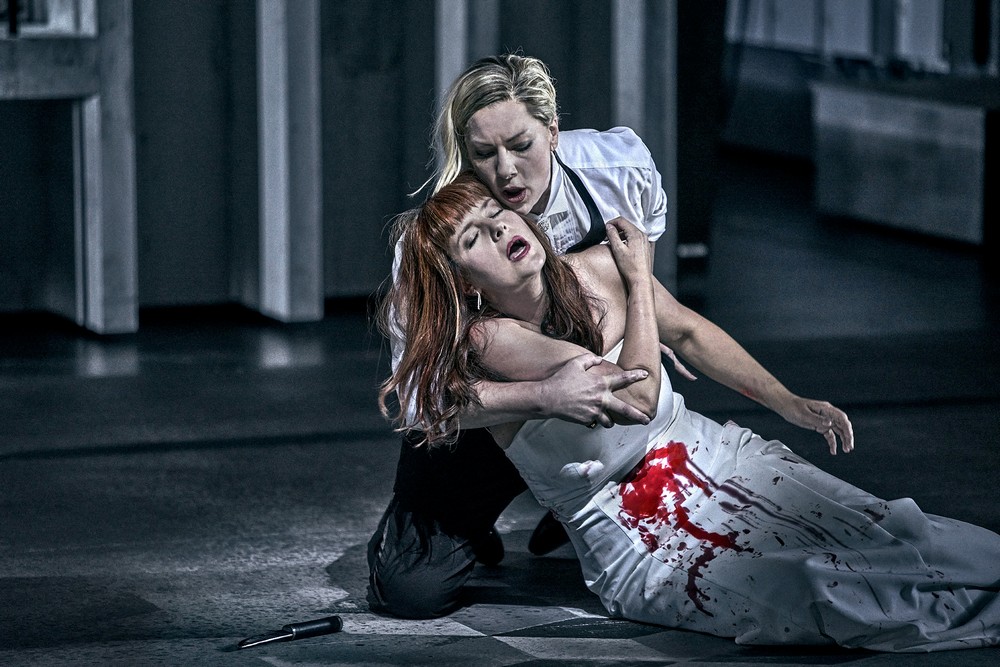
The last scene, as created by Wagner and the opera in itself, is in some ways a Götterdämmerung in miniature: a temple is set on fire to make room for a new social order while society’s Gods burn as punishment, including the sacrifice of others. Rienzi rushes into a collapsing building to avoid being stoned by his one-time citizen supporters. Irene refuses human love and follows him, leaving just enough time for Adriano to rush into the building to as the building in a gesture to save them both. Instead, a series of plot reversals are invented by the directors, ignoring the drama at hand through a bizarre, complete reversal and distortion of plot. Tragic. Irene honors her complex, idealist brother for helping her overcome her weaknesses regarding her allegiance to the state of Rome, declaring her wish to die alongside him, but instead stabs the Tribune in an erratic demonstration of free-will. He falls, only to rise again to applaud almost sarcastically as his sister refuses the pleas of Adrian to follow him. Irene cuts her veins, and faints as Rienzi climbs the stairs as a curtain flies up, revealing higher steps whereupon a video mannequin walks into the distance, his back to Rienzi. The bleacher-seated chorus sinks into the ground as Rienzi collapses on the stairs where his younger brother died. But wait, The suicidal Irene wakes bemused, as if from a sweet dream and begins to rise with Adriano near as the curtain falls. One sensed a bit or restlessness in the theater, as if wondering what was going on. We may ask if that mannequin leading Rienzi can be n God indeed, or the avenging angel, or perhaps even Nietzsche’s Zarathustra. At this point in Bayreuth’s staging, we may even think of Rienzi, Irene and Adriano as Pirandellian in their existential search for objective truths, having led themselves to confusion and madness. In a modernistic way, Symbolism, Surrealism or the Theater of The Absurd offer no answers.
Gesamtkunstsänger
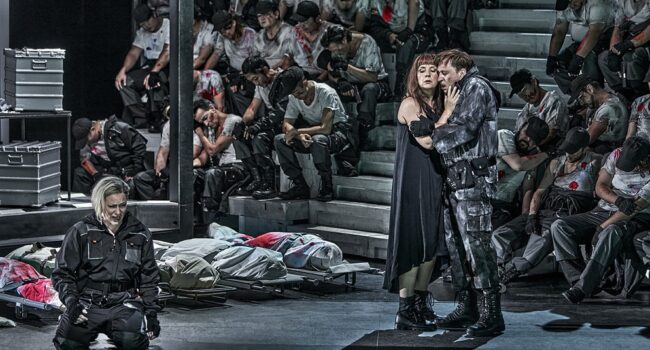
The opera was extremely well-cast at every turn, gifting us great Wagnerian singers of ‘total artistic commitment and accomplishment.’ They bore the brunt at times due to the liberties and weaknesses of the staging as they were often left to their own to fill in motivations and move about convincingly. The continued minute ‘silent film’ gestures wore thin, and much of their expressions were lost in arriving to the spectator. Rienzi fared well by never over-acting, as did Adriano also. Irene, onstage almost constantly, mimicked her interior emotions, uncertainties and muffled protests, communicating often with anyone standing near, or even to herself. The Act One almost belcanto love duet between Adriano and Irene was stodgily staged upon a street.
Andreas Schager as Rienzi was absolutely magnificent and achieved perhaps his greatest Bayreuth performance triumph. He was on stage almost continually, wearing the shoes of a modern-day politician at first seeking then wielding power, yet having his energy sucked from him by the very citizens he wished to guide. The role is treacherous, all-consuming, yet Schager left no stone unturned and moved about with restless energy. His heldentenor was ever-ringing, backed by stamina and endurance. His interpretation of the desolate prayer near the end of the opera summed up the recesses of his interpretative intensity. He ‘was’ Rienzi, a charismatic idealist, able politician and tragic archetype.
As his sister Irene, Gabriela Scherer’s lirico spinto soprano captured her vulnerable innocence, yet maintained every bit of Wagnerian tessitura and force. The emotional range allowed her phrasing and exchanges to obtain their deepest meaning. Though her role contains no arias per se, she partakes in several pivotal and prominent duets, trios, and ensemble numbers, consistently moving us. By the way, role-wise, she was not the weaker of the Renzi-Irene-Adriano trio. Jennifer Holloway’s Adriano impressively filled the extremely-wide pants of this production’s ambiguous, and thus weakened trouser role, yet the staging and singing of her 9-minute monumental aria, “Gerechter Gott” brought us one of the evening’s high-lights:
Rienzi, Irene and she bear witness to the defeat of the Roman Army who, by simple shaking, fall dead in their midst. The Aria is in an A-A-B classical form, rare indeed for Wagner, with a pure Italianate da capo of a beautiful melody to good not to repeat. She is brought back to reality by her agitated B section “Where am I? Where was I?” (“Wo bin ich? Ha, wo war ich jetzt?”) As she finishes, the soldiers respond to the leitmotif trumpet calls and church bells as new armed forces don battle gear to a rousing patriotic hymn. A wonderful solution, stirring, as was the music, and further proof that there opera is in no way an immature effort.
The remaining cast perform was truly excellent. We have Rienzi’s political rivals – the bass Andreas Bauer Kanabas as the bossy mafioso Colonna and the baritone Michael Nagy, slick, petty and wretched as Orsini. The other characters slink about the stage as in real life, witnessing to the political goings-on less than operatic protagonists, part of the mechanisms determining history. Vitalij Kowaljow was a cold-hearted, sure of himself Cardinal Raimondo, legate of the antipope distanced and in Avignon, while Martin Koch was the prominent Roman citizen Baroncelli and Michael Kupfer-Radecky as Ceccho del Vecchio, a plebian leader. Victoria Randem’s voice was the most moving off-stage heavenly Messenger of Peace, while also doubling as a ubiquitous on-the-scene reporter.
And now, full credit not only to Nathalie Stutzmann’s orchestral interpretation of the score, but also to her sense of Wagnerian drama. This is rare. Be it a personal reaction, or an accumulation of attending live Wagner performances, all sounded just right. The emotional predicaments of the characters mixed with the Bayreuth acoustics and reached us in dramatic fashion, and the desire to bring Wagner’s sentiments to us seemed unintrusive. The duets and ensemble pieces were not only creatively balanced, but subtly changing as emotions roamed. The choruses were as energetic or calming as needed. One may have thought that this was because they were listening to the opera for the first time, or with a relative acquaintance. Perhaps, but it was not that. The force of the dramatic episodes were carefully shaped, and also kept pace with Time sweeping on, especially as tinged with History’s own momentum. In essence, it all seemed that Stutzmann did indeed make it all appear easy.
The Bayreuth Orchestra and Chorus, ever-present, brought off more than was required of them. Honorable mention to Thomas Eitler-de-Lint, the Chorus Leader. As also to the lighting designer Bernd Gallasch, video creator of moving skies Leonard Koch, and the dramaturg Markus Kiesel for his extensive contribution regarding this Bayreuth version of the libretto. The stage directors were also the costumers and scenographers.
Bayreuth’s Last Premiere
As Wagner himself stated, Rienzi was “… a step on the way to something higher and more profound.” May the effects of this production, and all following productions, follow suit. For now, suffice it to say that this special year has passed. The souvenir shops sold “I was there” T-shirts in honor of the Rienzi premiere and the 150th anniversary Ring. May Rienzi find its rightful place upon the Festspielhaus stage in the future, that timeless space whereupon it seems Wagner himself continues to reproduce miracles. Another T-shirt: “I was there… again!”

I have been listening this opera on the radio being very interested because i believed it was the first time to be given at Bayreuth.I hoped to hear finally the opera for the first time in his totality. Because it is always performed with lots of cuts.But unfortonately Bayreuth did the same al all the others : in this case it was the fourth act to disappear completely!