
THE FLYING DUTCHMAN
Waves of Success upon A Desolate Shore
Bon Voyage to Bayreuth’s Der fliegende Holländer
“Only the strong know love; only love can fathom beauty;
only beauty can fashion art.”
Richard Wagner, Art and Revolution
The Flying Dutchman
Richard Wagner’s early folk-legend opera of The Flying Dutchman (Der fliegende Holländer) has its roots in a seemingly thousand origins, each one opening up to a myriad of cross-references and interpretations. May it supposedly be then that any stage director approaching the composer’s popular, first full-fledged Romantic opera claims carte-blanche in finding yet another version, a way of expressing a traditional tale in an innovative way. Yet, through a series of purportedly ‘original’ efforts in these recent years, the Bayreuth habitue has been led astray through representations under the ‘Regietheater’ regime, mistakenly compared to the era of Weiland Wagner who broke tradition in a noble way, embracing Adolph Appia’s principles of subtly-shaded ambiance to create mood, having the psychological effects of dramatic events reach us through somewhat abstract visual suggestion. This final run of Dmitri Tcherniakov’s takeoff at the Bayreuth Festival this year again seemed to have been unrecognizable, deluding as on previous evenings since 2021, distancing itself even more from its premiere in Dresden 183 years ago.
The tale was originally set down in Heinrich Heine’s satirical novel, The Memoirs of the Herrn von Schnabelewopski, telling of its protagonist witnessing a staged version of the mythical tale in Amsterdam, which actually never took place. To this, Romantic elements were added to the concept that the Dutchman could attempt to release himself from the bonds of his curse upon docking once every seven years in search of his redemption through the love of an eternally-faithful woman. As fate would have it, Wagner was to read Heine’s ‘Dutchman’ novel in 1838, then E. T. A. Hoffmann’s haunting story, The Mines of Falun, in 1842. He sketched a libretto for this for another composer, but the Paris Opera declined the project. Within a year, Wagner returned to his sea-faring libretto of a year before and composed The Flying Dutchman which was to run only four times as the Dresden audience found it too moody and atmospheric, they being somewhat insensitive to the symphonic weaving of leitmotivs and the text’s psychological implications. The Dutchman legend, true, is extremely theatrical in a literary way, and thus Wagner’s characters may seem removed, archetypal, as if existing upon the pages of a bed-side tale, ghosts are they as if imprisoned in a supernatural realm. However, the psychology of the elements of Nature in Wagner’s music were to influence many artists, among them the dramaturg August Strindberg, who created a single, Tuner-inspired painting in 1892, Storm along Cliffs: The Flying Dutchman, a masterpiece of sorts depicting the high seas in revolt, wherein he identified himself with the turmoil, restlessness and emotional inner chaos representing the Sea Captain’s solitude.
Unrelenting Dramaturgy
As Wagner wished the Premiere to be performed in one Act alone so as to capture the intensity of the action, we have the first time in operatic history that this need arose. Wagner was caught up not only within the rage of Nature’s elements, but also with the necessity for Man to resolve a Romantic crisis as related to love’s constancy. In a certain sense, the Dutchman’s crisis of symbolically freeing himself from loneliness, desperation and over-powering forces are ours, too. The momentum which the plot and music assume is rare, unwavering in joining reality with the phantasmagorical, human desire with emotional obsessiveness. Episodes seem unreal, but as in life, do take their course. All begins when the merchant Daland’s ship is approached by that of the Dutchman’s with its ghostly crew. Bourgeois values come into play, and the Dutchman’s riches attract Daland, who goes so far as to immediately promise his daughter’s hand in marriage. Soon after, the Dutchman enters the house of his betrothed, Senta, and we should sense the atmosphere as blurred, dream-like. Of importance, there is a large, dominating portrait of a mysterious mariner, perhaps the Dutchman, but surely his spirit. One thinks of the ‘Antonia’ episode in Offenbach’s opera, The Tales of Hoffmann. Here, the painting dominates Senta’s every-day life and becomes intertwined with her destiny. She herself sings the ballad of the Dutchman’s plight and declares that it will be her to save him through her faithfulness in love, though not realizing what this decision may cost her if broken. Her affections for the huntsman Erik wane. The villager’s celebrate the return of their sailors and wish to share their joy with the Dutchman’s crew, but they only tell of the harsh reality of their Captain’s tragic wanderings. Senta arrives, and the Dutchman warns her of the dangers in taking the vow to follow him, yet it is of no avail, and as the Dutchman’s ship departs, Senta throws herself into the sea, “True unto death!”
“To see things differently…”
In dealing with this subject, the Russian stage director Dmitri Tcherniakov just happens to see things differently and goes about changing everything that takes place in Wagner’s opera. It has been written of this director that he tends to base his stagings on the psychology of the characters, which is fine, but also that he does away with the very plot of the opera itself, which often is not so fine. Not relying on a change of epoch alone, with resultant scenic elements and dress, nor on an individualistic interpretation of the text’s meanings, Tcherniakov delves deep into their theatrical composure as seen, but through an entirely different light.
The libretto has here been ignored, tampered with and distorted.
The attraction of adding a ‘pantomime’ to embellish the Overture so as to perhaps illuminate us escapes control. Sadly, the eight and a half minutes of music as staged here border on the appalling. Mind you, there was a certain amount of public success accorded to this interpretation, be it so for an opera few of us recognized.
The Seas of Ostracization
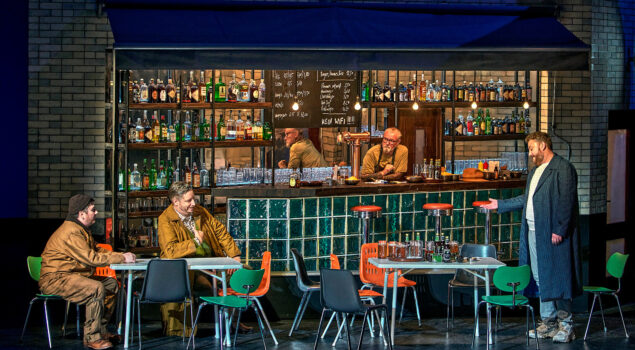
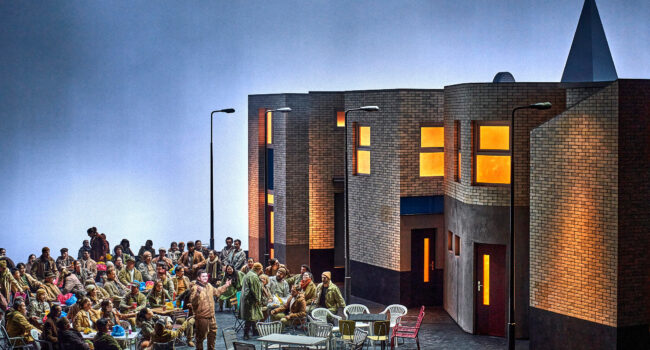
Not knowing of an opera beforehand may be a gift here. A Netflix-like episode seems enjoyingly readable from the spectator’s seat in the Festspielhaus, yet for connoisseurs things have gone awry. The Overture will tell us that this is a ‘revenge’ opera, ‘alla Rigoletto,’ where all goes wrong. Society is involved in the mechanisms of irrational attempts at justice, but as ever true through moral degeneration and corruption, it does not know all the facts. Think of the repercussions as found in Peter Grimes, The Visit of The Old Lady and Wozzeck. In an ocean-less, small-town square, perhaps Riga, we here have cube houses with their interiors lit yellow-orangey; there is something reminiscent of Jean-Michel Folon’s world of disorientation and rigid confinement, the alleyway’s between the buildings threatening as labyrinths. It seems to be a small, industrialized land-locked village, but the concrete, low wall barrier upstage does give the idea of a proximity to a stretch of sea just beyond and, for atmosphere, of a horizon flowing into the distance. Or is this just wishful thinking? There is no one about, but soon a mother with her young boy will arrive, then a man, then villagers bringing folding IKEA chairs and tables on and off stage. The mother, as we will soon understand, is a street prostitute, kissing a client passionately precisely as the theme of Senta’s love-redemption sounds, only soon to be rejected not only by men, but also by the villagers. Shattered, she hangs herself, dangling from a window just above where her son is sitting. During the entire Overture, villagers come in and out, as if in an Alain Resnais film. The boy’s ‘Traumatic Memory Imprinting’ catches the facial features of someone we will meet later on in the opera: a then-young Daland, the merchant, and Senta’s soon-to-be father. The mother? No worries. Tcherniakov has turned Senta’s governess, Mary, into his wife.
Victims of Society
This established, we do indeed have required justifications for all that occurs as the opera proceeds. The Dutchman is not in Daland’s town by chance, but with his ‘mafia’ associates bent on revenging his mother’s death, and he has now spotted his culprit. The entire First Act moves on, the staging adjusting the sung libretto’s actions as need be. Rether clumsy is the ubiquitous presence of Daland’s Helmsman, awkwardly eavesdropping, dozing off drunkenly, then falling clown-like off his chair. His part is enlarged here, but not at all interesting nor justified. Daland himself is a bit of a town boss and showoff, offering drinks to just about everyone; his friendliness in truth is his desire to control everything for his commercial interests. For the Dutchman’s monologue, Daland invites him to sit aside in confidence, which he does, refusing an offer to drink. The dialogue between the two is not one of Wagner’s most inspired as it is somewhat trite, and almost superficial wherein the dramatic turns nonsensical: the Dutchman, out of the blue, asks Daland if he has a daughter, and Daland, sniffing out money and treasures, readily gives up his daughter’s hand.
Clumsy handling
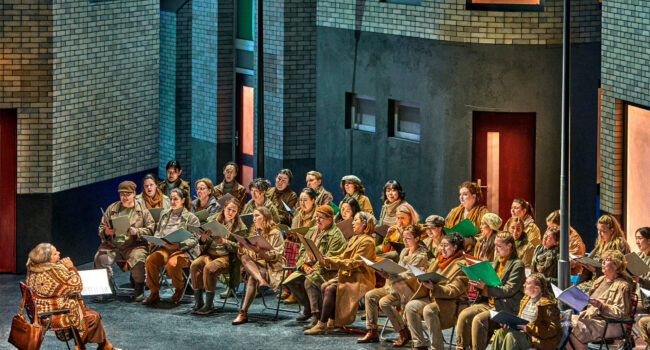
The Second Act offers no surprises and deludes principally for the staging of Senta’s Aria. It is she who tells Mary that she will sing the Dutchman’s Ballad, true, yet with motives so far removed from Wagner that all makes little sense, however so one wishes to follow her tale logically. Worst of all, is the clumsy handling of the once mysterious portrait of the Dutchman now reduced to a 5 x 7 inch black and white photo. The ‘Spinning Wheel Ladies’ are drab in their somewhat East European refugee clothing, brown and grey, almost being absorbed into the walls of the buildings. Mary clings desperately to a coffee mug for almost all the scene, and the Ladies sit with their ‘spinning chorus’ scores in hand. Senta, an odd figure, impertinent, mischievous, a tantrum-ridden brat, begins her playing-around antics. She conducts the ladies musically silly-mannered for a bit, then in a tempestive manner rushes to Mary’s bag to pull out the Dutchman’s photo just in time to intonate the counter-melody theme of redemption for the first time. Mary reveals that Senta is always seated in front of that picture, transfixed, but Senta disagrees as she brazenly smokes like a teeny-bopper, throwing her cigarette packet up in the air seven times. She will now sing the Dutchman’s Ballad that Mary refused to out of fear. She sits for two verses, waving the photo about ceaselessly. Seemingly without reason, in a violent volte-face, Senta stoically declares eternal love to the cursed, wayward Sea Captain, but here somewhat as if doing us all a favor. Squatting center stage, she blows smoke-rings as a sign of boredom as Erik arrives, only to then refuse his advances.
Consequences of the Clairvoyant
The ensuing eleven-minute scene between Senta and Erik is of great importance and actually contains moments wherein Tcherniakov allows Wagner to lead us into their hearts and minds. We understand the reality of their lives as if we are entwined with the ominous presence of the mythical Dutchman. A responsible daughter, Senta must go to greet her father Daland as his ship arrives, yet she skips about as she tells Erik that she is but a child who sings the Ballad without knowing what she is singing. This reveals that she has been looking at that portrait since childhood, and thus that 5 x 7 photo substitute does not in any way illuminate us as to her relationship with the portrait. She is prone to let her sentiments bring her to truth within herself, something her mercenary father would never let her do. Erik sees all this and is a mirror of Wagner’s involvement in depicting the realities of his character’s lives and motivations. Erik the hunter is outside that small-minded circle within the city’s walls and knows that Senta truly does not care about him. Thus, he envisions a ‘nightmare’ wherein he sees Daland offering Senta up to a stranger, and Senta sailing away with him, the Dutchman, whom she had never seen before. This bring to us the sense of the Romantic, the supernatural in the myth, and Wagner’s attraction to the ideal of ever-faithful love.
A claustrophobic dining room
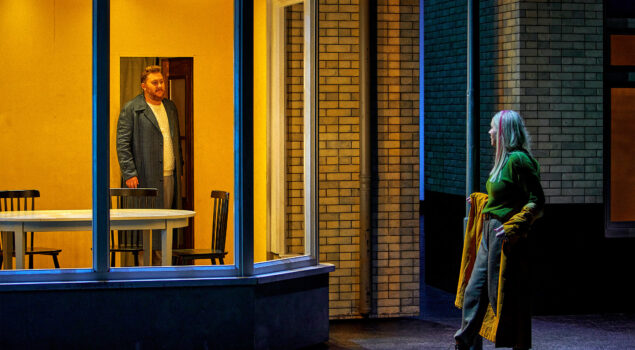
The contrast to all this is the dinner scene with the Dutchman, Daland, Mary and Senta. Within a claustrophobic dining room at Daland’s home pressing against a large bay window, the marriage is to be sounded out. Ingmar Bergman’s Scenes from a Marriage comes to mind, wherein frustrations boil over. Mary bites her nails in continuation, as Daland’s falseness is held under smooth control. The Dutchman is concentrating on the eventual moment of vengeance, but too is attracted to Senta, who in her turn feigns attraction in the hope of escaping her dreary life by marrying him. All is too complicated, with too many conflicting side motives to satisfy the plot as Tcherniakov had already lain out.
Shocking the greatest fans of Regietheater
The Third Act was the worst of all, and only bizarre happenings can resolve Tcherniakov’s deconstructionist ground-plan. In the square, the tensions between the thirteen mafia ‘hitmen’ of the Dutchman and the villagers reach their peak. The time has come to act, and the Dutchman shoots two of them, just as Senta arrives. Upon an empty stage of tables and chairs, Erik sings his heart out in a wonderful aria inspired by Bellini, already set out in an almost identical melody by Daland in Act One – “I saw my house on the shore, and thought to embrace Senta, my child!” The Dutchman by chance returns before the aria finishes, and in misunderstanding Senta’s involvement with Erik, claims that all is lost for him. The mafia ghost-sailors burn the town down, and we wonder if Senta will still attempt to save the Dutchman. And now, a rapid barrage of stage movements ensue, shocking even the greatest fans of Regietheater. Mary, Senta’s mother or not, enters with a rifle and shoots the Dutchman in the back. Senta carefully takes the rifle from the shocked and shaking woman’s hands, and sits her down, only to burst out in acrid laughter. The final tableaux has Senta seated, ‘true unto death’ with an ever-baffled Erik behind her. The villagers, they themselves victims of their own closed-mindedness, have fled. Wagner, too, has abandoned the square, and might be imagined as sailing upon the high seas, rising to the heavens with Senta and her beloved Dutchman, all to the music of another opera. This Act was the undoing of the director as the absurdities of a forced-upon-us revenge plot crumbles, the Dutchman’s curse returns, and human fragilities crumble.
The Music of Uncanny Love
Wagnerian love themes as ever-haunting, uncanny presences must come through the music and singing in any Dutchman performance. As it does so in this production, one must be careful not to mistake a staged interpretation with a singer’s vocal involvement and characterization. This phenomenon is more frequent today as performances paint pictorial pictures that remove as psychologically as spectators. Yes, the Dutchman’s monologue in Act One may remain the exact same musically, yet the effect cannot take hold if our visual perspectives interfere with what must have come from Wagner’s ‘mind’s eye.’ Thus, an imagined Sea Captain estranged from his crew, only to appear from his cabin in the depths of the ship’s bosom, standing above them as would an obsessed, deranged Achab from Moby Dick cannot be associated with a silent, suspicious foreigner in a local pub, a factory-worker clad foreman seated among us, smoking excessively and drinking beer. This Dutchman is strangely removed, isolated in his thoughts, frozen in Time. Can we know that he is planning revenge against Daland, and the entire city for that matter? Can his words of desperation in facing his tormented life be felt there in a pub as if on an isolated shore? At any rate, Nicholas Brownlee was a most convincing damned mariner, and his bass-baritone instrument contained all needed to assume the role of a penitent man yearning for salvation. The nuances of his thoughts when interacting with others were balanced musically in a sophisticated manner, at times harsh, then pleading desperately, then assuming as air of mystery. A rather great voice, a waver here and there, yet a magnificent theatrical interpretation.
As much as the Dutchman is the odd man out, Daland is the center hub of a complex petit-bourgeois wheel, churning to its own destruction. As so, we accept the stiffness of his mechanical movements as he commands nearly everyone in his small town, influencing their destinies through his petty gestures of generosity, as when offering a round of drinks to all in the pub. If he comes off as boring, non-imposing and a bit insipid, that is because this is his nature. Mika Kares is an almost perfect Captain Deland, a bass-baritone as excellent a Hagen as you will find at Bayreuth this year also. His timbre rolls piano, making all mellow, controlled as the complacent man he is. If he seems to be annoyingly over-acting, spelling every thought out through gestures, this must be attributed to the staging. His wife Mary and daughter Senta rigorously fall under his domestic rule, the source of their frustrations. Apart from what should happen as sailing upon distant seas, this has all the makings of a domestic, Ibsen-like tragedy, though this does not always come out in in Tcherniakov’s staging. Yet, rightly so, Nadime Weissman’s Mary appears vacuous, out of place, ever agitated, a bit schizoid, and with a distanced relationship with her daughter. Her weighty voice and edgy flexibility symbolized perhaps her stern will to control Senta. Her role was amplified here, and all her physical and psychological exchanges with Daland were indicative of their hidden guilt bubbling to the surface.
The biggest star of the production
The hyper-active personality of Senta as interpreted by the Lithuanian soprano Asmik Grigorian was totally convincing in an unconvincing way. Heartfelt was every gesture and sung line, believable for their forceful, out of control mannerisms that were simply over-played. The director asked of her to act eccentrically, in many ways superficially modern to the point of becoming a wild-child cliché. She is one of today’s kooky anti-heroes, showy, attention-starved, and erratic in knowing what she wants from life. Yet, all was played to the hilt, and with much ‘élan’ as needed. Her range was solid, and vocal presence very Wagnerian, over-powering at times. Her success was totally deserved, especially so for giving vital life to her character, be here superficial in its excesses. Tcherniakov has made her the biggest star of the production, yet the opera itself does not cry out for a prima donna of these sorts.
Her hapless suitor, the hunter Erik, is on stage more often than not, lurking in the background all too often. Benjamin Bruns’s more than distinct, voluminous voice reveals impressive expressiveness. His duet with Senta in Act Two and Aria in Act Three were well-handled, though with evidence of having to push for the expressive high notes, perhaps not indicating stress, but rather susceptible to the shadings of register changes within a resonating text. His acting is a bit lack-luster, but this is also due to the staging. His hand remain in his pockets for long stretches, and he assumed stock operatic poses all too often. The Helmsman Kieran Carrel received more stage time in this production, almost becoming Daland’s side-kick, a sort of Sancho Panza or Leporello. Many unwarranted intricacies between them physically were too minimal, and thus lost, as when Daland excludes him from the bar table conference with the Dutchman, yet he is questioned constantly as Daland sounds out the Dutchman’s deal: your daughter in exchange for my ship’s treasures. Then too, the beer-loving seaman responsible for keeping the ship on course must, yes, fall off his chair while singing his ditty, drunk. He slept through the Dutchman’s aria and was forced to react to too much of the stage action, and thus all comes off as false. The voice is robust, bright, with wavering in intonation at times.
Wagner’s Rhythms in Every Syllable
The Lithuanian conductor Oksana Lyniv drew considerable praise from all, and the energy and power of the score were indeed effectively highlighted. Yet, the Overture itself felt rushed, over-detailed and somewhat bombastic, as if trying too hard, whereas this gem of symphonic poetry calls for a more nuanced interpretation, a to-and-fro as a wanton sea of a wanton ship captain. One slight reservation regarding her pacing and dynamics was verified in a Facebook video she made while rehearsing at Bayreuth. She stated that she is convinced that Wagner saw his music only as part of something greater, adding that nothing in his scores “exists for the sound of beauty alone, beauty alone … every syllable must express meaning … “ She asked the strings “to keep the character evenly paced in fortissimo, but to dynamically remain in piano.” This, if we understood the comments, indicates the Maestro’s attention to the music’s precision, cut and dry, but may reveal a certain rigidness, discontinuity, an over-focalization in breathing along with the very drama she refers to, not permitting her to accomplish what she set out to. Forceful and moving, as the score itself is, one senses that Wagner’s emotions must overcome precision in some measure. The ‘Redemption’ coda that closes the opera was musically projected with the emotions of a letting go, a release from life’s bonds as in the ending of Mahler’s 9th, thus Lyniv brought us the sense of Wagner’s Romantic necessity, wherein “only love can fathom beauty.”
The Festspielorchestra and Festspielchor flowed along effortlessly with the tide, bringing Wagner’s legend to the forefront. Maestro Thomas Eitler-de Lint’s choral forces were truly inspired here. Elena Zaytseva’s costumes were elegant in their simplicity, neutral as if to avoid making comments about the villagers drab life. Gleb Filshtinsky’s lighting of the pastel skies and housing blocks was elegantly handled, and ever-suggestive.
An Indifferent Redemption
After four years in Bayreuth’s repertoire, plus this insertion into the anniversary Festival, Tcherniakov’s Dutchman will set sail forever on a one-way journey. While it is true that the public’s favorable response will always remain a mystery for some, we can only believe that it was the music itself, the singing, and lifting spirits within this Romantic score that held sway. All told, enlightened originality is truly one thing, distortion of uniqueness is another. Bon voyage to a non-existent ship and its transformed passengers, and a warm embrace to that Senta prototype of an Isolde or Brünnhilde never seen. And a Happy 150th Birthday to all ever-involved in preserving Wagner’s dream.