Lucia di Lammermoor
Yannis Kokkos’ Uncanny Pictorialism
A poetic Lucia di Lammermoor at La Scala
“The mirrors which receive the reflection of all successive objects
are framed of hard materials like glass or steel;
the softer substances, when they receive an image, retain it undefaced.”
Lucia, Chapter 21
The Bride of Lammermoor, Sir Walter Scott
“The madman is a dreamer awake.”
Sigmund Freud, “The Interpretation of Dreams”
Opera, and Those Things of The Past
In November of 1834, Donizetti was commissioned to write an opera for the Neapolitan ‘San Carlo Opera’ to debut in July, eight months later, being offered what today would amount to €550,000. The reigning laws dictated that the theater was to provide him with a libretto at least four months prior to the opening night, censors approving. It was now May, and as there was no librettist yet nominated, Donizetti himself proposed the 34-year-old Salvatore Cammarano, and by July, six weeks later, the opera was completed, though the debut was moved to September. Vesuvius was about to erupt, as was an epidemic of cholera, the unpaid cast refused to rehearse. Even the glass harmonica specialist who was to play for Lucia’s ‘Mad Scene’ walked out over a financial dispute, forcing Donizetti to re-write the part for flute.
Even today, mounting any opera will always present seemingly insurmountable obstacles. Yet, for many, the true precarious elements that threaten opera-theater in our society are the constant maneuvers of stage directors in their oft-vain attempts to re-interpret the messages inherent in the original creator’s intentions. Worse, so many productions resemble one another, and as all sense of originality fades, we often can guess the direction the stage action is going, even anticipating our letdown of how noted scenes will be played out. Let us use this refined, classically-proportioned La Scala version of Donizetti’s Lucia di Lammermoor as a case in point regarding the state of the Art. This was the 2023 production, intended to open the 2020-2021 season, but postponed due to a flare up of Covid infections among the chorus.
At times, we may now finally tell ourselves that operatic tropes and plots do belong to today, do indeed in theatrical ways relate to the values and perplexities of our society, and in so doing, leave lasting effects in a unique way through the language of music. Physical operatic representations will always become a matter of discussion and often of disapproval, yet they are also meant to be deeply moving experiences, leaving traces of high emotional content upon our psyches. Sounds and images are opera’s landscapes, and have been so for over four hundred years, a testimony to our civilization and artistic achievement. And yet, the art form is experiencing deep crises in that its forward marching progress has been stymied, brought to a halt even by those very same chosen to be our guides.
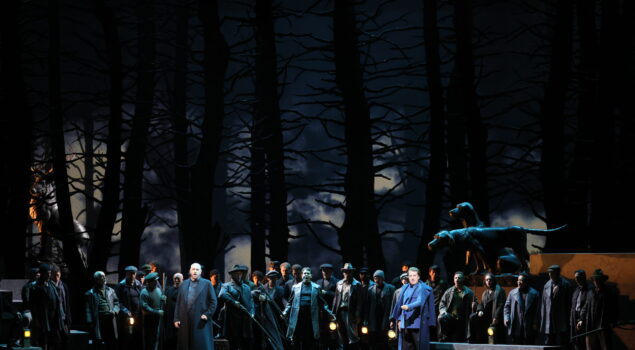
Almost no new important works have been written since Alban Berg’s 1925 Wozzeck, that atonal portrait of our distorted world. Worse, the beauties of our past that have always been brought to us have all-too-often disappeared, manipulated through misrepresentations in the name of innovation and modernism. We leave the opera house spiritually dissatisfied, asking ourselves why the visions of today’s directors and their supporters seem to negate the work being treated. Here, Stage Director Yannis Kokkos remains faithful to the opera’s origins, yet creates his own poetically intimate version through movement, scenic elements and costuming; a delicately sophisticated amalgam that through the choice of essentials allows the spectator to experience the event seemingly unguided, unperturbed, allowing the drama to come to them almost in a freely personal way. Kokkos himself stated that in experiencing Donizetti’s Lucia “… we must feel what belongs to our world today as it derives from come from a world gone by, one which we can visualize without seeking too great a sense for history.” The beauties of this production are that we find much that is modern within a classical framework, albeit tapestry-like in breathing the air of Sir Walter Scott’s famed novel, The Bride of Lammermoor, which even today moves us through its over-whelming sense of tragedy.
The Scenery is The Thing to Catch The Conscience of Our Being
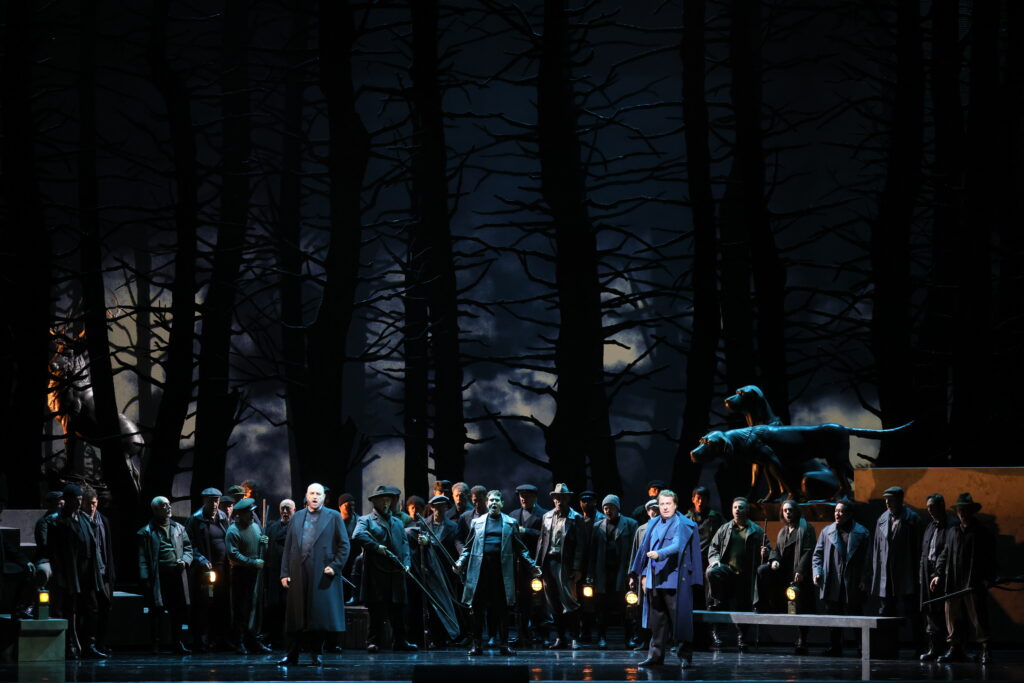
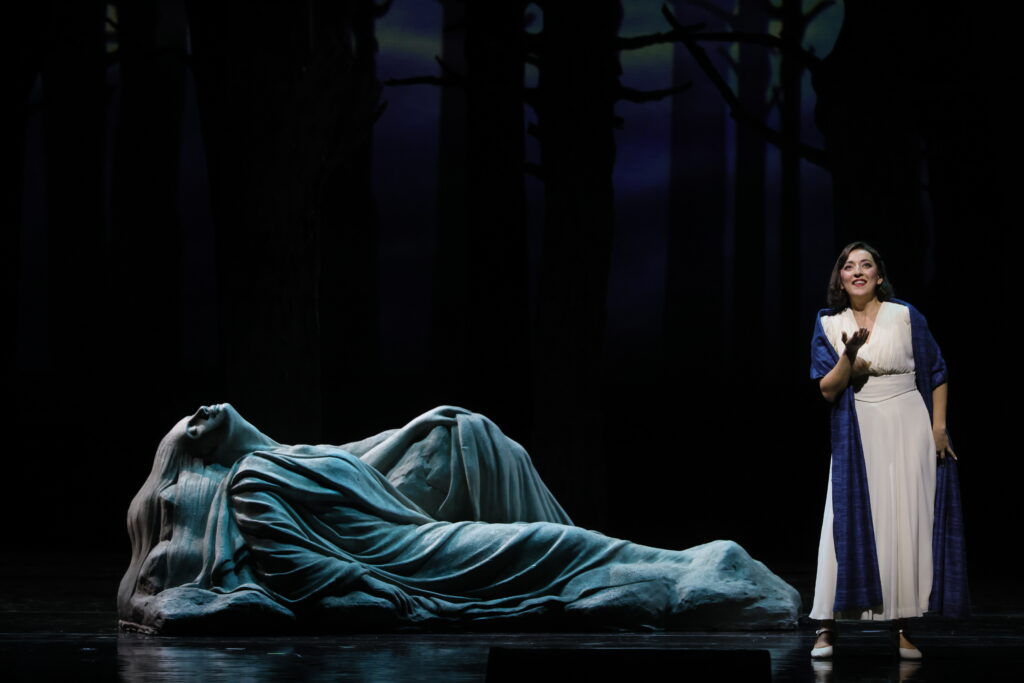
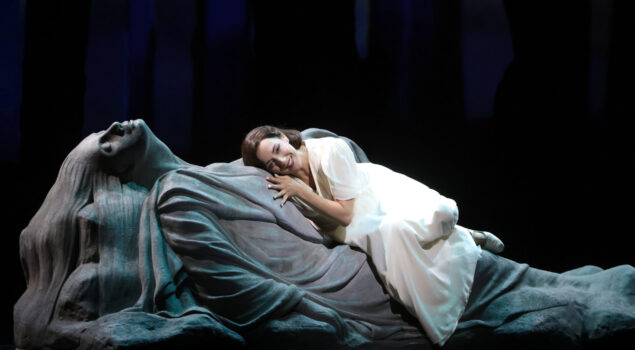
In essence, Yannis Kokkos is one of today’s true theater scenographers, and we must recall his 1986 Pelléas et Mélisande at La Scala which also required a most delicate treatment of pure ambiance, an accomplishment here repeated with Lucia. There, too, was a scene in a garden with a menacing, almost bottomless well; now in Lucia, Act 2 in a nearby park, Kokkos places a stone sculpture of a sleeping woman beneath a shroud, probably a premonition for death (as Kokkos told us), yet perhaps a symbol of peace found in eternal rest. Might it be that iconic artifact of a 5,000-year-old prehistoric clay figurine discovered in Malta, a representation of an ancient mother-priestess, a mysteriously somber, dreamlike, or tomb-like statue. Oddly, Lucia herself seems to give it little importance, laying upon it almost sacrilegiously.
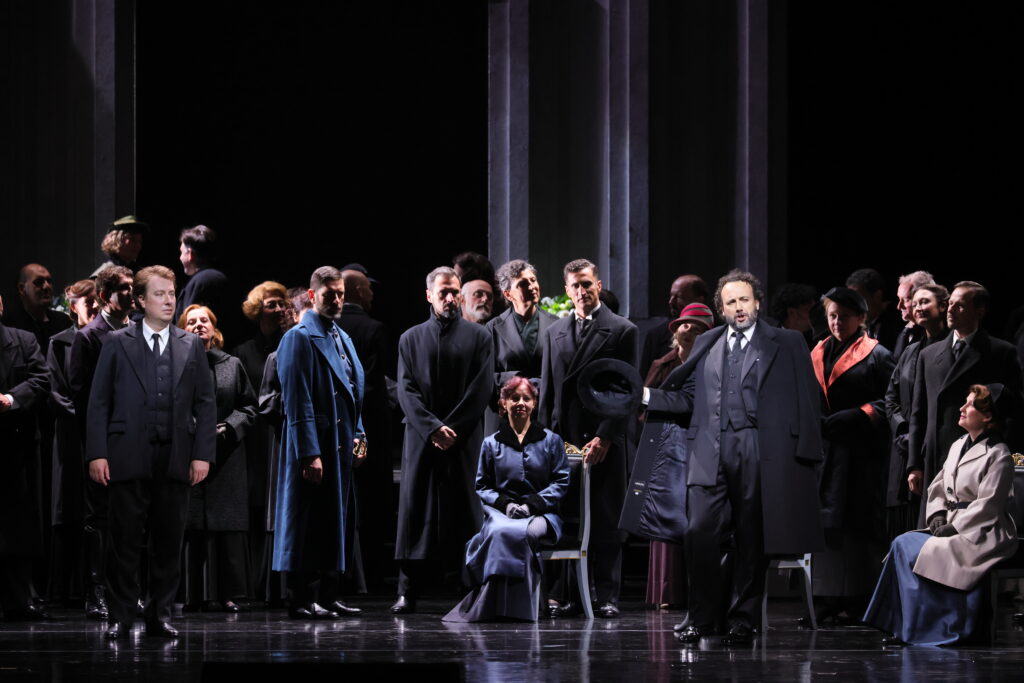
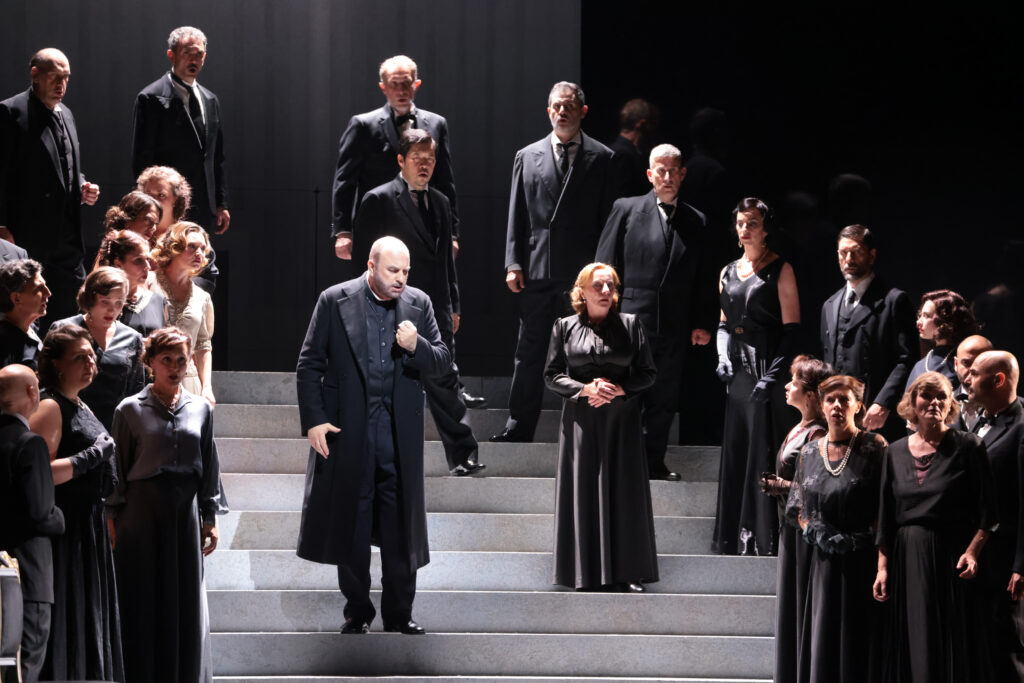
The entire production, sets, costumes, and lighting sustains the undertones of Gothic tragedy, and not just Lucia’s ‘Mad Scene.’ The limits of reality are reached in the most subtle of ways, substituting the perplexities of dungeons, madhouses, caverns, or labyrinths with apparent every-day spatial–temporal dimensions. As with Scott’s mechanics of ambiguity, Kokkos balances the rationality of Enlightenment belief with Gothic superstition, while attempting to establish a certain fluidity in the passing from one scene to another in an effort to effect open scene changes visually, holding tight to the flow of narration. Moving all the action to the 1920’s underlines the epoch’s exaggerated involvement with financial gain, yet we may ask if Kokkos wishes to surpass Romanticism by hinting at Naturalism, portraying the human drama of existence.
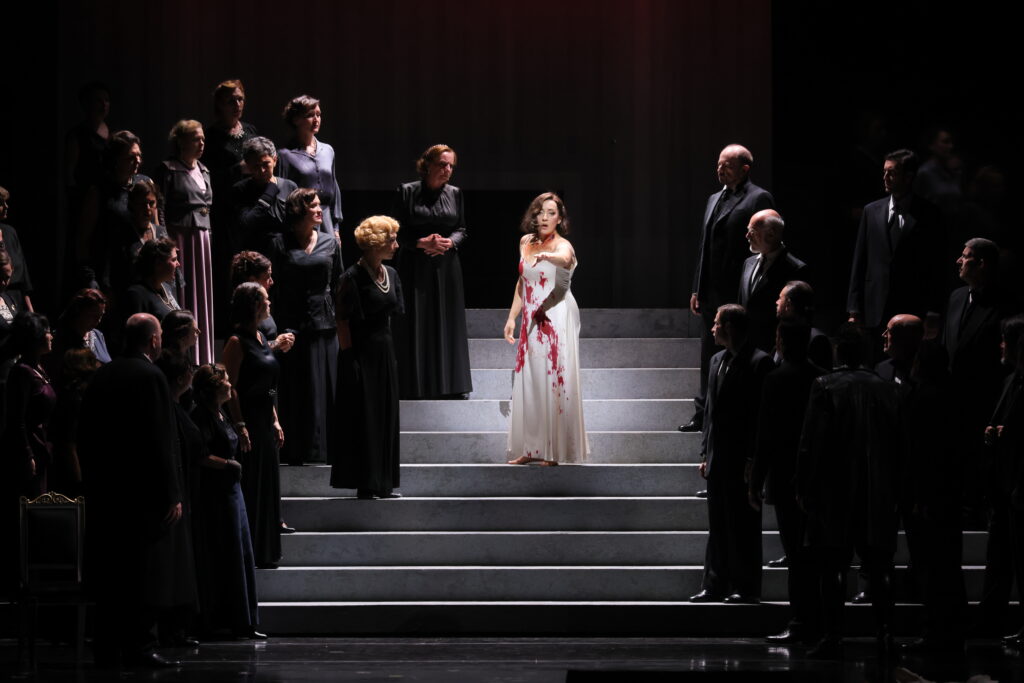
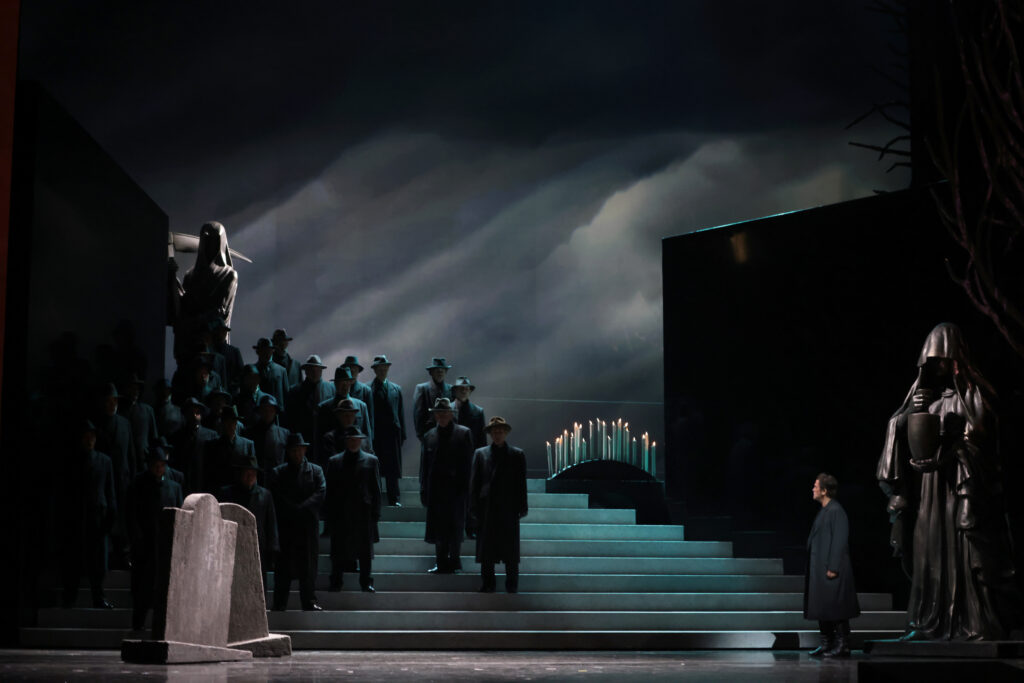
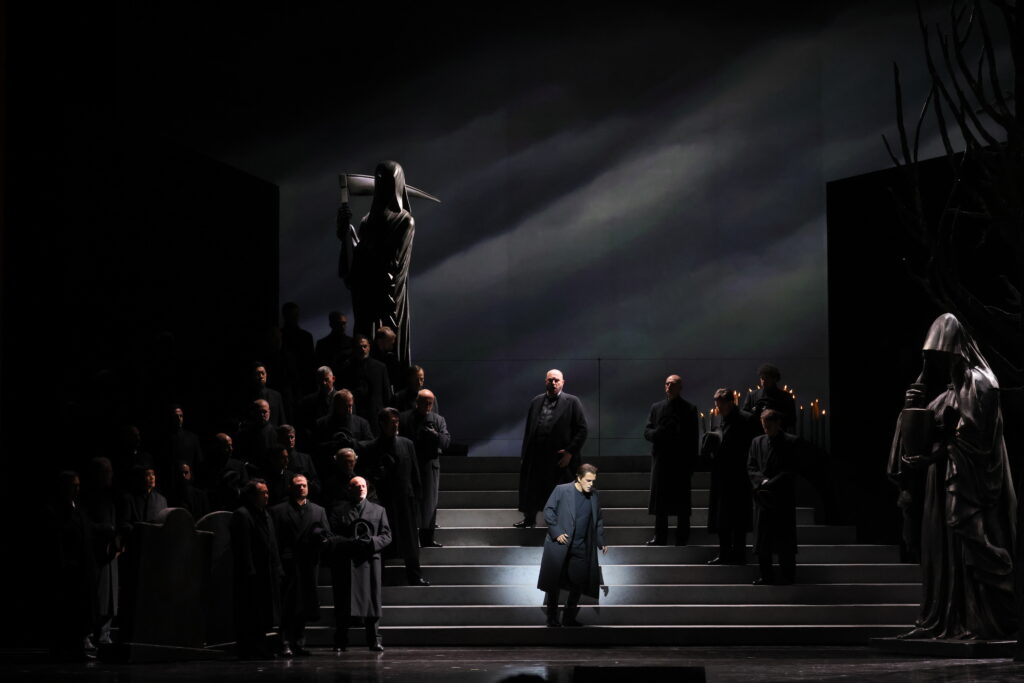
Scenically, we may observe the brutal sacrifice of Lucia though the metaphor of the ‘hunt’, a deer fleeing retriever hounds as represented by bronze statues upon the grounds and rooms of the castle, as also in a tapestry of those very dogs closing in on the prey, lit in red for Lucia’s scene of folly. Then, too, those glassy walls during the wedding scene reflecting the guests as in a mirror, doubling the effect of their cold observance of Lucia’s playing out her pathetic ‘blood wedding’ ceremony. Red is the color of the wallpaper for the castle room in which Lucia confronts the anger of her brother, Enrico. Notable are the storm images of Nature in revolt that depict the imaginary Wolferag Tower scene of Act 3, wherein Edgar and Enrico will challenge each other to a duel. Effective video images of rebellious clouds, lightning bolts flashing also within the theater, and two wall partitions in the shape of lightning itself all unite to bring out every bit of what is chilling and sinister when musical contrasts prevail. The scene brought the horrors reminiscent of the silent film era, perfectly blending with images of high Romanticism. The cemetery scene is truly evocative in representing the Gothic idea of death, exploring as it does indeterminate nature of human mortality and its relationship to the supernatural. Upon the seemingly unrecognizable same steps of the scene before, we have a mini-altar of candle flames, two imposing statues of death (one hooded, the other the reaper with scythe turned to us frighteningly). There is a winter, leafless tree, almost existential as if from Waiting for Godot, whose branches of shadow will cruelly reach out to a dying Edgar as twilight falls. In all, Kokkos has created an atmosphere not of death, but of Time standing still, observing the human folly of denying life’s end.
Scenic Pictorialism, Emotional Tableaux
The weight of the fabric that dresses this production appears at times as would a transparent ‘tableau vivant,’ yet without the common gauzy-effects, fake smoke and phosphorescent lighting. One thinks of those first photographs of Pictorialism (1885-1915), quasi-Impressionistic in their rounded softness, emulating the bygone by romanticizing pastoral landscapes. As related to Lucia di Lammermoor, there is something of the aesthetic in connecting photographs and madness with their manipulations to convey abstract human emotions. All this Kokkos does, but reproducing all in a realistic manner: cold, harsh lighting, then stern, angular objects in the ambiance, and almost always refined movement from the singers, even in animated situations.
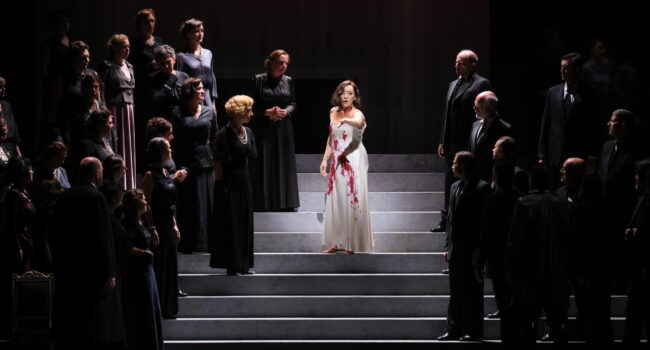
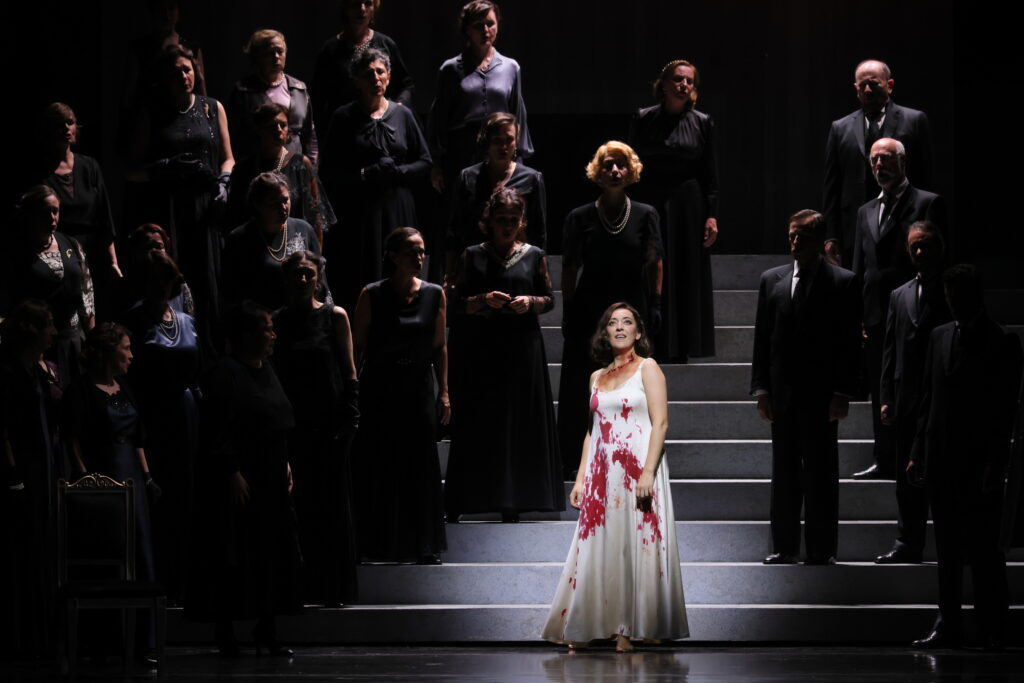
The staging of the chorus was truly noteworthy for two main reasons: it avoided the standard, annoying technique of having them react immediately to the words of a main character, wherein they must appear to be surprised, shocked or outraged, and communicate their emotions by whispering to one another in a gossipy manner, yet never convincing us that they are emotionally involved; it positioned them ‘en masse’, yet having them move almost imperceptibly, this itself representing their emotional reactions to the unfolding drama, and too, a simple action (the men’s chorus in the last scene removing their Borsellino hats as we watched Edgardo die). In all, it is the opportunity for the audience to study the faces, the natural gestures, even the breathing of each person coming to grips with Lucia’s folly. They, too, were the ‘observers’, in themselves, ‘mirrors,’ as it should be in every theatrical performance.
The behavior of the protagonists was equally believable, and though, yes, it IS opera, gone were the stock gestures, those of a singer ‘singing’. This is rare, and if at times nothing strikingly impelling was going on, the music and unravelling emotions of the characters kept our attention. It is enough to watch how Lucia moves in her ‘Mad Scene.’ Some of us may have seen many versions of this, but one thing is sure – if the interpretation and staging choose a mistaken path, there is no exit, and what is either too ordinary or too far from the drama becomes unmoving. Trauma has caused Lucia to escape into herself, and although possessing a fragile psychological disposition, she does not resort to a persecution complex, paranoia, or jealousy in her delusions. Her resources are surprising, and her creative imagination dictates a more-words-than-action mechanism, grandiose, nihilistic to be sure, and thus her pathetic living out a marriage to her true love, Edgardo. She somewhat defensively alters her own behavior, relying upon a supposed elevated status or special powers, refusing the emotions of self-blame, severe guilt, self-accusation, and even the anxiety of believing that the world is ending. In many ways, all madness is a deceptive game in a Pirandellian sense, played out in a teasing, half-hidden ‘guess who’ mode. For this, we (as the wedding guest chorus) should approach her. Kokkos captures all this, and we understand that Lucia’s collapse at the end is nothing more than the true collapse of her mind. Here, she launches quirky looks, skips girlishly to the empty chair where her ‘groom’ is waiting, removes her corset to return to an innocent love. The wall tapestry of the hunt glows a warm red, and the walls close in on us as her music twists and turns. Kokkos asks Lucia to find her way out of her maze, avoiding to look outwards to a cruel world, yet also looking inwards in a somewhat poetic manner. Donizetti does his job as psychoanalyst through the rhythms and dynamic markings of the score, which should undergo further study. The death of Edgar was almost believable, justly under-played as he lightly stabs himself. His will to die, the decision to go through with it, as well as the agony manifested within his soul while following the shadows of a tree’s branches into darkness, was all quite moving. Uncanniness has its own unexpected beauties.
Music & Its Styles
Conducting Lucia di Lammermoor in a free, easy way seems adapt, so allowing the music to speak for itself, as it always does with ‘bel canto.’ One should find little diversity, then, as to choice of ‘tempi’, breadth, intensity, and linear sinuosity. Overall, Speranza Scappucci’s interpretation was a particularly moving one. Yet, at times, the oppressive atmosphere of the Gothic tale, the sense of a distant Highlands governing family strife, as well as the intimate emotions of the characters were missing. It seems that all was too exacting, constant, rigid. And, too, what might physically appear as total involvement within the flow of the music in seeking transparency and precision at every turn, resulted in an over-abundance of measured concentration and the application of tonal force in contrast to beauty and gentleness. At times, Donizetti allows us to approach Bellini, who extended the melodic line through delicate yearning or melancholy. To say, there is less leeway as to timing when coming to the ‘bel canto’ aria: almost every live or recorded version of Lucia’s Mad Scene, from her pronouncing “Ardon gl’incensi” to the recalled melodic repetition of the love duet lasts 4:30 minutes, whereas the “A te o cara” aria with chorus from Bellini’s I Puritani runs from 5:35 to 6:49 minutes. Personal choices of conductors down through history? Yes. Yet it is not the timing, but the shaping of phrases and the balance between the timbre of the instruments, this comes through the sentiments of who guides the orchestra. All must flow freely; too much control, anticipated ‘fermate’ and familiarity in flow distract from the natural restlessness evocated. This is verified by Scappucci’s overly energetic gestures upon the podium, those abrupt crouches to obtain a ppp. Unneeded, and distracting; fine for a Bruckner or Mahler symphony. Her handling of the Glass Harmonica was a creatively poised one, delicate as if holding a butterfly in hand. She also used the ‘glasses’ throughout, avoiding the use of flutes for the ‘staccato’ notes that accompany Lucia’s laments.
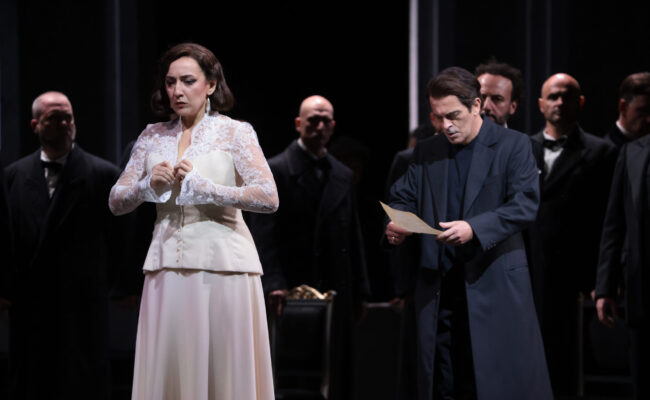
The three main personages were truly excellent, while the others were rather good. As Lucia, Rosa Feola lived fully through the gamut of emotions. She made use of every nuance in Kokkos’ staging, and every one of her appearances led logically to her sad demise. At every turn, vocally and theatrically, Feola’s Lucia remains a fragile figure, a victim of the manipulations of others causing her to doubt her lover’s fidelity. The Brünnhilde of Götterdämmerung comes to mind; both will sacrifice their lives through delusion. Observing Feola was a moving experience, made richer through the musical dissolution of her consciousness. The top notes were more than there, and delivered almost naturally, and in character with the crazed sad, desperate demise. An absolutely wonderful Lucia. Piero Pretti was a more than credible Edgardo, perhaps most of all for his non-exaggerated operatic characterization. His gestures were almost always natural, and his interior sufferings and delusions remained ever involving. The voice was extremely right for this role, and nothing was lacking; just think, we have heard Edgardo’s from Spanish lightness to Italian dramatic over-compensating strengths. Pretti well-interpreted the role’s subtleties, blossoming from a passionate, youthful lover to an aristocratic lord seeking vengeance. The final scene was robustly executed, mellifluous and yet acutely dramatic. He stabbed himself and died with feeble elegance if that is what must be said. In all, an elegant ‘bel canto’ performance. He and Feola made a good pair, proving that yes, once in a while, God creates us, then joins us together successfully.
The remaining performers were truly in form upon the stage, dramatically making sense, proving that Cammarano’s libretto does indeed probe the emotions and capture the Romanticism of every episode. All were well-cast. In a way, the baritone and bass voices (Enrico – Boris Pinkhasovich, Lucia’s brother and Raimondo – Michele Pertusi, Lucia’s tutor) were deft in carrying the action along, while the tenors and mezzo-soprano (Normanno, Enrico’s captain of the guards – Paolo Antognetti, and Arturo, Lucia’s groom – Leonardo Cortellazzi, and Alisa, Lucia’s handmaid – Hyeonsol Park) appeared more than justly upon this Romantic tapestry of a stage. The energy of portraying their roles, absorbed in living their situations, had them win the day. To mention, the negative energy and powerful emotions of Enrico in his scenes with Lucia. The chorus was intriguing to watch in their elegant 1920’s dress, so well vocally prepared by Alberto Malazzi. Let us not fail to honor La Scala’s harp soloist (Luisa Prandina) and Glass-harmonicist Friedrich Heinrich Kern.
The lighting by Vinicio Chieli nobly draped the elegant set of Kokkos; the background videos of Eric Duranteau created rare, subtle atmosphere. In the absence of Yannis Kokkos, the 2023 production was recreated admirably and in grand style by Marco Monzini, never an easy feat.