
La Scala’s Far West ‘Carmen’
La Scala’s inefficacious, fake Far West ‘Carmen’
“At first sight she did not attract me, and I returned to my work;
but she, according to the habit of women and cats, who do not come
when you call them, but come when you refrain from calling them –
she halted in front of me and spoke to me.”
Don José – Prosper Mérimée, Carmen
“I am speaking of the way life makes love the center of everything,
which looks for all satisfaction in loving and being loved.”
Sigmund Freud, Society & Its Discontents
Where is The Flower, Where is The Opera?
While it is true that the action of Carmen is somewhat easy to follow and understand, and hence its great popularity, we have often come to sense disappointment in witnessing it on stage. The opera itself seems to encourage unneeded directorial juggling as to Time and Space slots and often pushes for increased justification of the central protagonists’ motivations through repetition. Should instead it be played out in a simple, direct and yet non-traditional manner, with enticing, evocative scenery and colorful costumes, thus allowing us on our own to pick up on the double entendres and intuit the repressed inner workings of the characters’ minds … all for the better. Regie-theater without the ‘theater’ may be on the way out, what with its encouraging radical changes in epoch, plot, and visual settings. Asking the performers to carry out actions that seem to make sense only to the stage director does indeed hamper the production as it is only through genuine feelings that the performer can reach out over that immense sea before them called the public.
This is the case with Damiano Michieletto’s stage direction and Paolo Fantin’s scenic structures, attempting to bear the weight of confronting problematic, current-day realities and preoccupations lurking in the background – the phenomena of violence against women, feminism, and social disorder, yet doing so through glib, somewhat half-hearted representations of the opera’s drama itself. During a performance of this nature, where the attempt may even have been to reduce, to simplify all to its essential meanings, we can only hope all will find its just, pre-ordained ‘dénouement’ in the manner in which Don José must tragically snuff out Carmen’s life in a fit of jealousy. Thus, whether we will have either a traditional Carmen or a pseudo-modern concoction, all must bring a distorted, frustrating and seemingly senseless love relationship to its destructive end as Bizet and his librettists indicated. Michieletto has stated that his Milan-London-Madrid co-production was to strip the physical ambiance to its essentials so as to leave an abundance of wide-open space upon the stage wherein he would be free to concentrate on the characters. A Minimalist ambiance was indeed, but the character development aspect was almost non-existent. Nearly every solution or off-the-mark innovation seemingly failed to captivate us as there was little sympathy for the personages as perceived, and they were surprisingly almost always projected through excessively old-fashioned stock mimic gesturing. This was especially so for the chorus who were never present in their prescribed roles, and were often asked to carry out bizarre, invented scenarios, unrelated to the main flow of action and with total regard to the words they were singing. In Carmen, they are essential characters inserted within the plot and must remain so. A Socially Historic Opera ahead of Its Times.
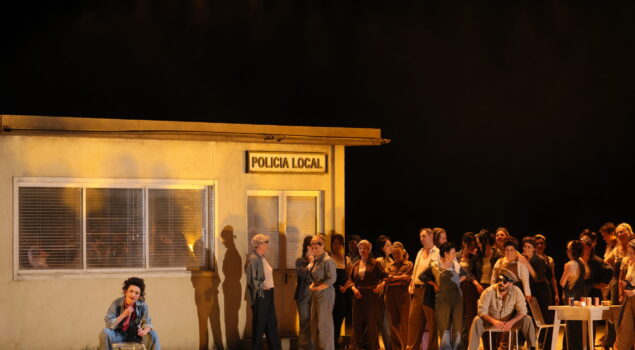
The opera was originally conceived in the Opera Comique form, a mixture of theater with opera (a ‘musical’ by today’s standards, we may think) created to accompany the festivities of street fairs. A partial listing of the Opera Comique’s first presentations is awe-inspiring: Jean-Jacques Rousseau’s Le devin du village, Bizet’s Carmen, Offenbach’s The Tales of Hoffmann, Massenet’s Manon, Berlioz’s Le Damnation de Faust, and Debussy’s Pelléas et Mélisande, right down to Poulenc’s 1949 La voix humaine. To note, many of these works were noticeably ahead of their times, presenting identifiable arche-type characters who became the inspirations for literary movements through psycho-philosophical examination. All of the character’s actions can be traced to those hidden recesses of the mind wherein dwell the uncanny, aberrant encounters approaching the supernatural. Yet, in Carmen, all is rather down to earth, and we sense Romanticism in its origins, with Naturalism and Verism at the door.
Carmen, therefore, is a starkly realistic tale of human weakness, immorality, wickedness, and irrationality. Set in the Spain of the 1830’s, wherein conservative, all-powerful Absolutism was about to face emerging liberal movements pushing for more social freedom through constitutional amendments which would afford them extended civil rights. Any production of Bizet’s opera should in some way reflect this spirit, perhaps even viewing the smugglers as a metaphor for the secret society preparing their battle towards liberty. As a contrast to Catholic, despotic, monarchical power, one could only envision a free-wheeling, undisciplined, restless rebel-rouser of a social heroine – yes, Carmen. Her apparent instabilities might be psychologically revealed as attempts not to destroy herself or others, but as a vain sacrifice to yield herself up to destiny, and to die with honor as a substitute for a life struggling against Fate itself.
A Tarot Card, Vengeful Mother and Anachronistic Revisitations
At the end of the Italian National TV Broadcast of this production, the director Michieletto himself talks to us above the applause. What he says uncovers in essence his failure to capture the spirit of the principle characters, and reveals what we already know, reiterating the fact that Carmen is brutally assassinated by an impulsive, uncontrollable Don José, a violent person by nature as Bizet captures him. His social upbringings, Carmen’s too, limit their capacities to love, thus they flee from attachment, from the securities of family life. Michieletto, to the letter, follows Mérimée: Don Jose’s mother lives for him to return and marry Micaëla, this in contrast to Carmen’s desire for anarchy and all-empowering liberty. Yet the staging goes too far in equating the musical Fate motif with the mother of Don Josè, an almost Sicilian, black dressed lady-in-mourning who will appear five times throughout the opera, bizarrely incongruous. Here, then, that overly protective Mediterranean all-Mother is turned into a suffocating theatrical presence, whose ineffective multiple appearances never actually change the course of action. And yet, there she is, center-stage during the Overture, the curtain rising to show her shuffling cards menacingly. Then again, after the ‘Habanera’, she approaches Carmen face to face, card held high, which the gypsy herself will snatch away and throw frustratingly to the ground; this is all invented to again forcefully dramatize that telling moment when the Fate motif possesses the orchestra. But this is not the original scene! Here, a dialogue is mysteriously and sadly cut, one which demonstrates love’s superficial games wherein Don José chooses to ignore Carmen in a purposely blasé manner, showing us yet another aspect of his character. This causes Carmen to brazenly approach him in anger, throwing that famed flower from her hair into his face. Then, after the chorus’ exit on their La liberté!, we now discover the dark lady rising from a chair, walking to the Carmen to throw that flower with impudence at her feet. Of course, for the Act 3 mountain scene and the tarot card readings with Mércedès, Frasquita and Carmen, the mommy must be there to pick up the card of Death, and exit, though as a phantasmagoric apparition unseen by the two hussies. And she cannot miss being there for the end of the opera, as Carmen lay strangled beneath a shocked Don Josè, wherein she throws her trump tarot card of Destiny towards the by-now lifeless libertine.
A brushstroke of anachronism
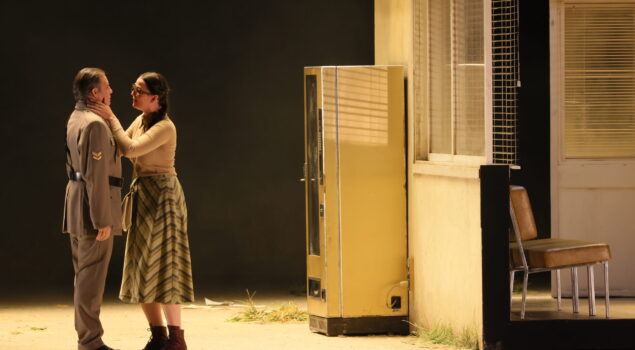
Whirling about all this tussock grass as dust in the desert was a picture frame of the show itself. Michieletto’s major thematic setting was to bring us a Carmen through with a brushstroke of anachronism – all is supposedly set in the late 1960’s. Attempting to recreate the post-Franco era is a common director’s move, but here rendered trite if the intent was to portray a society liberating itself from years of dictatorship. Turning the opera into the battle between a licentious, sexy, anarchical Carmen and a ubiquitous, over-powering, revengeful mother leads nowhere as she is a victim of her imagery alone. And if Carmen is to be the representation of a modern, sexually liberated woman, as are Frasquita and Mércedès, much more needs to be conveyed. It was not enough having Carmen waltz about the stage in what may be classified as a bouncy, licentious strut for the entire opera, nor asking her two sidekicks to dance away the nights emptying bottles of liquor. More than escaping from post-Fascism, it appears they are all approaching Neo-Decadence. It is coincidence that Michieletto attempts to highlight Carmen’s loneliness, though all is not so clearly evident. The research of Sigmund Freud comes to mind, wherein the rebellious Gypsy could have sailed upon the unconscious waters of repression and trauma, doing so as recognition of her sense of guilt; her life is consumed by her need to balance the forces of Eros and Thanatos, both within herself as an enemy of civilization.
Paris, Texas … And Its Routines
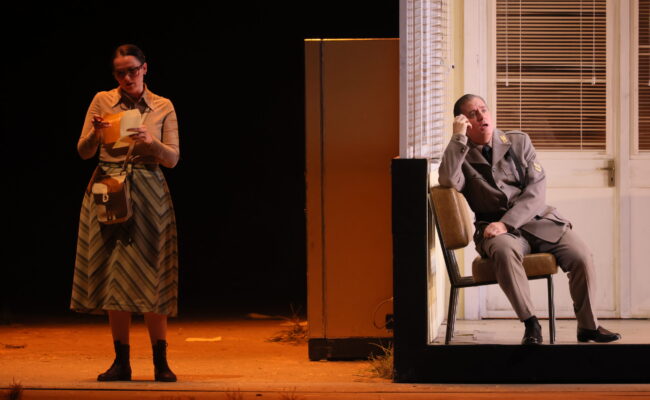
All the action “takes place inside containers in a desolate Far West, synthesizing situations,” the director goes on to tell us. Yet, as related to the actual use of theatrical space, we observe that almost all the arias and ensembles dogmatically take place ½ inside, ½ outside those rooms. The scenery of Paolo Fantin, inseparable associate of Michieletto for all his productions, unique in the annals of opera production, does not capture the imagination. Four basic scenes with four rectangular, somewhat prefabricated buildings; yes, as those seen along the highways near any isolated Los Angeles community, distanced from other structures, almost suggesting a landscape of loneliness alla Edward Hopper. A large, suspended tilted grid of exactly 100 holes projecting light beams remains fixed as if to represent a broiling sun, but will turn eerily greenish as it touches the stage floor for Carmen’s death scene. Every single room unit is Ikea-like, and set upon a revolving stage, certainly serving to bring us into and out of the structure. Act I is a single-unit Police Station, with a soda-machine vendor on its side, and a few plastic chairs and a table placed within a tussock grass desert; inside we have a desk, padded chair and two waiting room seats hugging one wall, the other taken up with aluminum venetian blinds which will be played with excessively, but there are no file-cabinets as used in any police station to store the documents Don José pecks out on his manual Remington typewriter; we do seem to be in an auto-insurance office. Perhaps this sparseness may have been intended as the ideal space to analyze the characters as if under a magnifying glass, all in a truly existential way. Act II, at Lillas Pastia’s Tavern, is no longer a dimly lit smuggler’s den, but now a bawdy nightclub, first seen from outside – a bare wall, a door, a chair, and a slice of purple light along the roof; inside, a sparsely furnished garish disco with shiny dancefloor, red walls, small round table with liquor bottles, and little else. The whole Act follows Michieletto’s staging rules for the established musical pieces: ½ sung in and then ½ out, all becoming truly monotonous, predictable. Thus, it is so for Carmen’s exuberant ‘Les tringles des sistres tintaient,’ Escamillo’s brilliant ‘Votre toast,’ and the intriguing quintet ‘Nous avons vous en tète une affaire.’
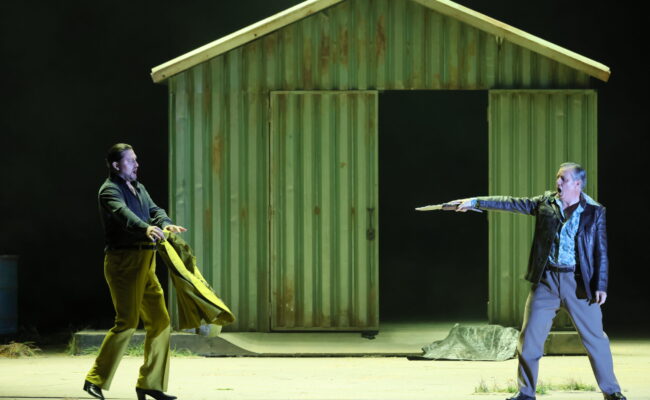
Micaëla extracts a machine gun
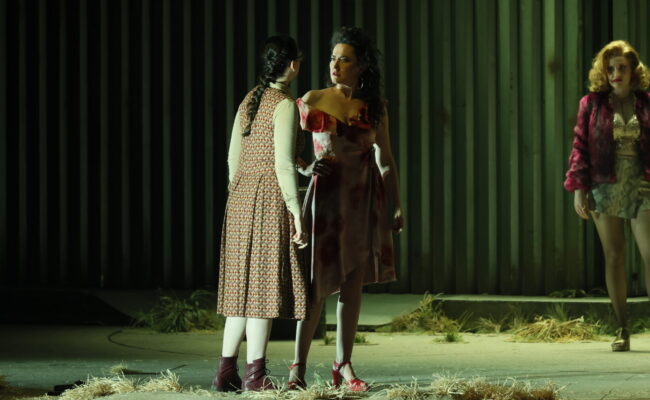
Act 3 is in so many ways always a difficult one to stage, requiring that the tensions and exalted crowd scenes are carried off with great effect as representing a smuggler’s hideout in the high mountains. Here, we see a simple metal shack, and a barrel outside on which tarot cards will be dealt out. A white pick-up truck with headlights blaring into the public’s eyes steals the show as the Act begins. This is the most Far West scene; very American in that all have guns or rifles – Don Josè, Carmen, even Micaëla who, once inside the shack, uncovers a wooden box of contraband objects to extract a machine gun, soon to fly out into the crown as if ready to mow everyone down, so losing her docile ways. Act 4, be it the Plaza de Toros de La Maestranza in Seville or not, is here reduced to a single cement block building, with one door. It will revolve to bring us into Escamillo’s dressing room – a chair, sofa, mirror, revealing the bullfighter, his dresser and Carmen. The piazza is densely populated with those about to enter the arena for the bullfight, along with those pesty urchins from Act I; everyone has a souvenir photo of the heroic toreador. In a truly weird moment, Michieletto has the kids rush into the dressing room, submerging Escamillo in pleading for his autograph. The whole stage is rocked by Bizet’s vibrant music, as nearly the entire cast in and out of the room jumps about exuberantly. Yet, we should have sensed that solemn atmosphere within the room, requiring perfection in the toreador’s donning heavily embroidered golden threads, that sparkling ‘Traje de luces’ (suit of lights). There might have been shamanistic votives, candles, an altar with photos of various saints, all hopefully protecting the bullfighter as he will very soon risk death. Would he ever allow the distraction of thirty autograph-hungry children?
Whither & Wherefore
Wherever the director wishes to lead us by this European production of Carmen, one thing remains evident: the action of the scenes left basically untouched to play themselves out are most effective and moving, while Michieletto’s ‘invented’ realities, so often contrary to the words being pronounced, not only make little sense, but substitute the essence of the opera in itself with unconvincing episodes. Within the psychological subtleties of the music lie the dramatic intuitions of Bizet and his librettists. Take the scene where Carmen uses melody and castanets, dancing to convince Don José to abandon the military and follow her into a life of crime. Emblematic of the gypsy life, here the music is a simple series of persuasive, rhymical “la la la la la, la la la la” syllables, danced in a baiting manner. Then, the sound of a bugle from the nearby barracks calls the soldiers back in retreat, almost the same tune, but with ‘staccato’ and not ‘legato’ notes. José is overcome with a sense of duty, but Carmen cleverly insists, wrapping the chant in hypnotic eroticism. Their shadows move across the wall, and theirs are truly ghostly, surreal presences, wandering as if lost, never quite uniting. Carmen repeatedly tugs on the waist strings of her dress, cautiously watching Don José’s reactions; a deft touch. As simple and clearly motivated this scene was, questionably ineffective is the manner in which the ‘Flower Song’ was staged, wherein Don José should tell Carmen directly how when in prison he kept the red acacia. Yet, there is no flower at all. Here, he sings to himself, somewhat weirdly as the aria becomes almost confessional, an introspective memoir. As he finishes, he goes inside Lilla Pastia’s to find a seated, immobile Carmen deeply moved in thought. A touching moment, as she has come to understand what it means to be loved. We think of Violetta in La Traviata, also moved by these strange, poignant emotions; they both tragically negate the sway of love’s power.
Fiddling around with Image Semantics
“If it ain’t broke, don’t fix it!” goes the old adage. But this has deeper meanings as related to the physical mechanisms of the Theater, wherein we learn that it is just wrong to modify, transform, or distort what is part of the original structure. This production of Carmen is excessive in its inherent strivings to illuminate what does not exist. Just think, Micaëla is a total nerd, from beginning to end. How can we accept Micheletto’s version of this sweet, devotional, sacrificial good soul? She always appears dressed as an elementary school teacher, a half-nun, lost, confused, pathetic; her bravery and belief in unreality is stoic. Carmen’s tarot-reading scene is moving here as it too remains simply blocked out. Here the effects of one in isolation, facing herself upon a grand stage are evident. Any scenery may be adapted, but the use of shadows to accompany this music is fundamental. “In vain to avoid bitter responses, in vain will you shuffle,” she sings under-breath in a gravelly voice, and any of us who have been touched by destiny’s heavy hand will here shutter! It seems to be one of the best moments in this staging, but then, oh no!, Mommy arrives and Carmen seems to sing to her, as if she does indeed sense her presence. In another scene, the letter from this over-protective mom of Don Josè is brought by Micaëla for him to read alone, but José here moves his lips in silence as an audio recording bring us the mother’s words – all too echoey, as if read in an empty gym. Thus, the lady in black has returned, but this time unseen.
The use of the chorus borders on the absurd. In their first appearance in Act I in a popular square, the men do sing of observing the common people passing by, they representing life itself in motion, the beauty of the everyday. There should be an old jealous husband with his young wife flittering about as a butterfly, perhaps seeking attention from younger men. Everything in this First Act is related to love, flirting, seeking, dreaming. Here, instead, is an ‘invented’ wedding preparation going on. The men and women of the chorus are involved in this and pay no heed to the text they are singing. A man in red shirt is dressed, given a tie, a bouquet of flowers, and is propped up as to have courage in proposing to his wife-to-be. She, too, is egged on by all the women factory workers who should instead be intoxicated by the clouds of smoke that bind them to their daily activity of rolling cigarettes, yet they now must move about through unwanted fussiness. The children are treated even worse, as stereotype Neapolitan ‘scugnizzi’ (cunning urchins), lively and streetwise, bred by necessity to survive life’s hardships. Instead, they are directed as a Broadway-musical ensemble, stomping through routine dances. They break open a soda vending machine, explode firecrackers, then draw out play pistols, all drawing attention to themselves, something that which cleaver little thieves would not do. In Bizet’s reality, their music is a march, and they should wish to join in with the changing of the police station guard, or so they sing. Michieletto instead referred to them as the symbol of “humanity sweating.”
Basically speaking, the orchestra, conductor, singers and chorus did manage to bring us enough of Bizet’s Carmen. Maestro Myung-Whun Chung, La Scala’s new Musical Director so praised for his Verdi, Debussy, Brahams and Messiaen, brought us a fresh, brisk, symphonically moving flow of melody. At times, one may have sensed that there was a ‘holding back’ in volume and as if under-playing for fear of exaggerating. The ‘Flower Song’ was here 40 seconds longer than Chung’s recent Korean semi-staged version, but that makes little difference; all the phrasings of a delicate bouquet of emotion blossomed, and there was a surprising, caressing unwritten string ‘glissando’ on “… oui, te revoir!” (“… to see you again!”). The Entr’acte to Act 3 was unrushed, and the balancing of the harp accompaniment to the flute, clarinet and English horn brought delicate memories of a Mozart ‘Serenade’. Maestro Chung’s trademark of non-excessiveness held sway here; this was a refined Bizet in the French style to be sure.
The singers were all rather adapt for their roles, given the fact that they were not well-represented in the staging, and all were in some way mono-dimensional: Carmen strutting and waiting around too long at times; Don José wringing his hands in agitation both when either violent or overcome with emotion; Micaëla was trapped into playing a product of her provincial upbringing, emotionless and without pulse, even when asked to point her machine gun at others in frustration; Frasquita and Mércedès eternally flippant in uncaring about anyone else interrupting their superficial sense of fun-only lives.
Clémentine Margaine’s Carmen was a polished, well-studied musical portrait. Special were the moments when her lower register became husky, indicating her battle with inner forces; her tarot card-reading scene was overwhelmingly penetrating. The Don José of Vittorio Grigolo was a vocally calculated palette of colors, and his voice held our attention for the entire opera. The ‘Flower Aria’ was pure feeling, he breathing his emotions. His is a poetic presence on stage, an ideal Werther as we have seen; one can only suggest pantomime lessons to control the excessive hand-gesturing.
Giorgio Manoshvili kind of fit the role of the ostentatious bullfighter Escamillo, his voice projecting what was needed, yet there was a sense of our desiring just a bit more as to energy and emphatic declaration. Natalia Tanasii sang Micaëla well, and though a pathetic, weak character in the drama (added by the librettists, as she does not appear in the Mérimée novel), she has enough to sing during the evening. The phrasing and emotions were well-shaped. Frasquita (Sarah Dufresne) and Mercédès (Marine Chagnon) were gave excellent vocal characterizations and made a deserving trio along with Carmen. Their acting and natural attractiveness got lost in Michieletto’s antics. Well carried off in every way were the ‘compromario’ roles: Zuniga (Xheldo Hyseni), Moralès (Simone Del Savio), Le Dancaïre (Pierre Doyen) and Le Remendado (Loïc Felix). Some believe that the ‘dark lady’, Don José’s mother (a silent role) deserved mention in the printed program. La Scala’s Chorus (directed by Alberto Malazzi), Children’s Chorus (directed by Brunella Clerici) and Orchestra all remained peerless.
Michieletto’s perennial crew offers the scenery of Paolo Fantin, the multiple costumes of Carla Tetti, and lighting by Alessandro Carletti. All followed the director’s plans, and thus we should not find fault for the irregularities: the lighting could not be more than self-contained as the enormous over-head grid panel washed out any subtleties, the costumes reflecting or not the 1960’s were not evocative nor truly modernistic, only a touch of déjà vu resembling many of today’s regie-theater productions.

[…] Mailand La Scala’s Far West ‘Carmen’ https://www.operagazet.com/la-scalas-far-west-carmen/ […]