MACBETH
Liège, September 18
A spectacular nightmare
At the Liège Opera, Verdi’s Macbeth, as directed by Stefano Poda, takes us on a descent into the underworld, into hell itself. It plunges us into a spectacular nightmare.
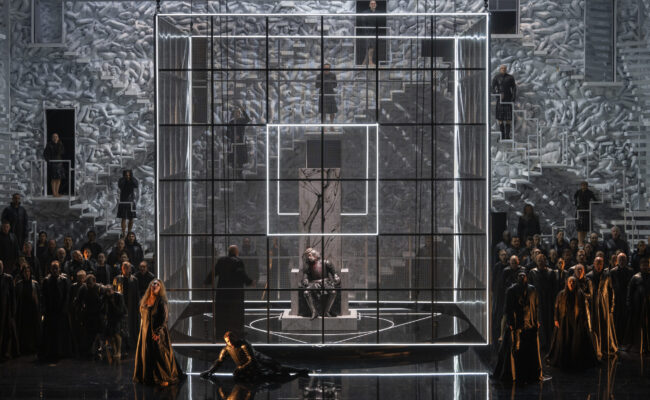
The set design, which he devised himself, immediately confronts us with a strange space, featuring immense vertical white walls, with a few openings, and different levels connected by external staircases. But what strikes one, on closer inspection, is that the walls of this space are, to quote Poda, ‘an accumulation of human bodies, piled up, frozen in the drama of their deaths, like the petrified bodies of Pompeii’. Those who will stir here have come to join all those who, before them, will have experienced such terrible realities.
Premonitory nightmare
We are no longer in the realistic realm of action and its appearances; we are in a premonitory nightmare.
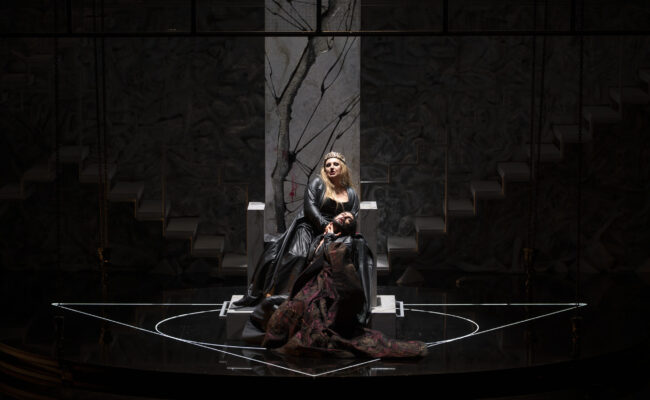
And that is why, in a dimly lit space streaked with beautiful lights (also by Stefano Poda), characters in strange, dark leather ‘Gothic’-style outfits (the costumes are also by Stefano Poda) thrash about, entangling one another in a strange race towards the abyss. This is the race of Macbeth and his wife, whose dream of power has very quickly morphed into this irresistible apocalypse. There will also be figures suspended, trapdoors in the stage, a giant game of Mikado, and a huge metal cage rising and falling, imprisoning the characters. There will be, amidst a deeply intense physical excitement, numerous choreographed sequences (all conceived by Stefano Poda).
It is clear that Stefano Poda is the demiurge behind this production. For, as he himself puts it: ‘Theatre can be a total art form, and I have never been able to isolate the various disciplines from one another’.
Sound and fury
This, in this instance, could well be fitting to capture this world ‘of sound and fury’ – as Macbeth himself describes it. It is true that the whole thing is highly spectacular and that there is always something happening on stage. Yes, but…
For me, this resulted in a sense of overload, a distraction from what really matters – from what is actually ‘unfolding’ and, above all, being sung. To give a small example: why were those men in thongs there to introduce the musically so crucial aria from *La Sonnambula*? The dance episodes struck me as long, almost self-contained interludes. What I was seeing prevented me from truly hearing what Verdi had intended to convey in his significant orchestral passages.
One consequence of this was that I felt as though I were watching a succession of sequences rather than being increasingly engulfed by the fatal consequences of the two protagonists’ initial choice, in their terrible descent into their own personal hell.
Ewa Plonka, an imposing Lady Macbeth
Yes, of course, it is ‘lively’, but for me, this Verdi is much more than just a ‘thrilling story’.
And in this sort of setting, it is the orchestra – the Opera’s orchestra conducted by Giampaolo Bisanti – that suffers: the eye is so captivated by the hustle and bustle that we hear, for example, the clacking of the dancers’ heels more clearly than the musical passages played by the orchestra.
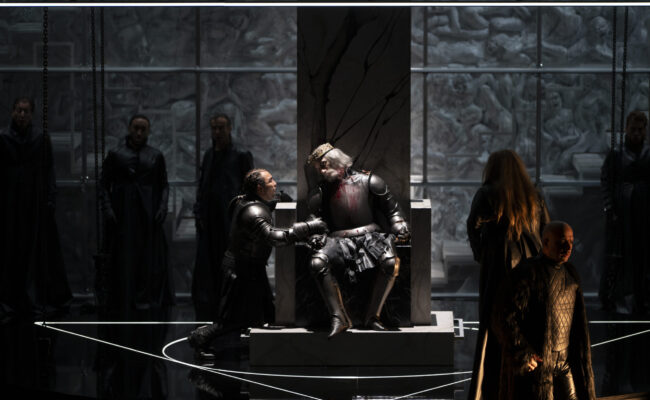
The soloists and the chorus, however, make themselves heard – and heard clearly. I must emphasize the suitability and quality of the cast: Ewa Plonka is an imposing Lady Macbeth in her song of greed, fulfilment and despair; Luca Micheletti brings a wealth of beautiful nuances to his Macbeth; Gianluca Buratto is utterly convincing as Banco – what a vocal presence. I also greatly enjoyed Matteo Desole’s Macduff and Lorenzo Martelli’s Malcolm. They are joined by Alexandra Grigorias as one of Lady Macbeth’s attendants, Luca Dall’Amico as a doctor, Bruno Silva Resende as an assassin, Bernard Aty Monga Ngoy as one of Macbeth’s servants, and Marc Tissons as a herald.
Stéphane Gilbart