
P A R S I F A L
A Pure Fool in A New Age of Images
Bayreuth’s Augmented-Reality Parsifal Dissolves
When a dreamer can reconstruct the world from an object that he transforms magically through his care of it, we become convinced that everything in the life of a poet is germinal. Gaston Bachelard, The Poetics of Space
The technological mechanisms sewn within an AI image will ever be born ofsophisticated techniques, often bringing to a spectator the reality of his own unknown mental images. Anonymous
Augmented Reality
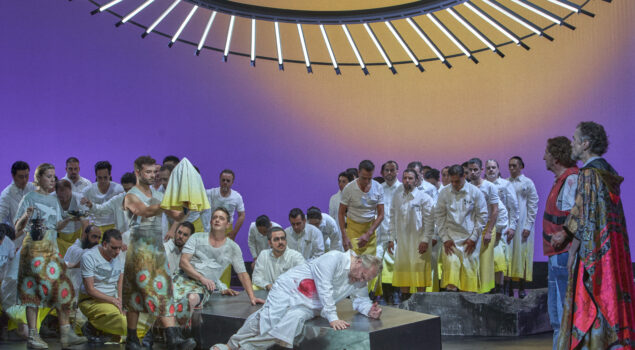
When it was announced that the 2023 Bayreuth production of Parsifal would be one of Augmented Reality (AR) to be viewed through special black glasses hooked into a central system attached to seats in the last rows of the Festspielhaus, a sense of something historical in the making came about. Through these magical lenses, one was supposedly being prepared to be transported into other realities through 3-D graphic images, videos and data as projected onto our real world within a theatrical event. Reality itself was to be ‘augmented,’ and this most transcendent of all Wagner’s operas was perhaps the ideal one for such a metaphoric shifting to that domain of the Grail, wherein “Time becomes Space.” Indeed, this may have seemed like the opera of all operas whose two great transformation scenes would be superbly handled through floating objects, passing forests and temple walls, all within AR’s limitless range. And yet, it was not to be so as our concentration wandered due to an over-abundance of images, especially when we were faced with iconically-crafted hallucinatory, distorted digital creatures, recalling in some ways ‘The Garden of Earthly Delights’ triptych of Hieronymus Bosch; here, however, with scores of discarded white plastic bags drifting through a sea of space, or death-warmed-over skeletons peering at us. One may have predicted that an orange and blue psychedelic milieu would have been chosen to depict Klingsor’s Castle and surroundings. We know of Wagner’s great disappointment regarding how these scenes were handled at the world premiere in Bayreuth in 1882, and yet we have been won over by the creative ingenuity and aesthetic mastery of stage directors who, with non-sophisticated means, swept us along mesmerized as accompanied by Wagner’s truly magnificent, over-whelming metamorphic and at times cataclysmic score.
On The Road to Wisdom
Through the music and drama of this, his last opera, Wagner gave birth to the idea of having his Bayreuth theater itself evolve into a visually spatial realm, transforming its communal properties into an almost individualized sacred place wherein one’s ideals for salvation are sealed through bonds of empathy in indirectly recognizing and experiencing the sufferings of others. Thus, for the spectator, it was a chance to partake in ceremonies resembling a Mass at times, as also to identify through ritual with a misplaced Christ-like figure overcoming himself through innocence and unselfishness, though all the while moving about in a world tainted by all that was dogmatic and laden with new values of a spirituality-crushing industrial materialism. It was simply Wagner’s return to religious symbols and artefacts, through which Art would rescue us by resolving one of life’s most beguiling enigmas through simple actions: the battle between good and evil so very often within oneself as a disintegrative force. Hence Wagner’s life-time thought-processes were to follow, tracing Buddhism through its aspects of appearance, and of illusion. Here, it is the mythical Parsifal figure, far from his position as one of King Arthur’s Knights of the Round Table, who has no idea at all of his destiny as rooted in his incongruous ‘pure fool’ attributes. Wagner himself mistook the name for its Arabic traits of a ‘fool’ with ‘pure intentions’, whereas instead it truly derives from ‘pierce the valley’ of French medieval novels, meaning ‘to break through walls, overcoming obstacles.’
This takes on greater importance today in a world wherein imagery surrounds us as never before in history, thus any representation of Parsifal is wont to almost surrealistically gather up all that is symbolic within the legends of Wagner’s creations. Let us think of the baffling mid-fifteenth century ‘The Lady and The Unicorn’ tapestries in Paris, enigmatic as to content, yet certainly representing our five senses. In Parsifal, it is that sensation of ‘touch’ that predominates as it relates to pain and healing as caused by human weakness though a dropping of one’s moral guard: Amfortas’ lack of restraint in falling to the sensual temptations of the Flower Maidens; Kundry’s seductive kiss which backfires and thus brings Parsifal to an awareness so as to feel compassion for Amfortas; the contact with the sacred spear’s tip to close the Grail chieftain’s wound. In a certain sense, it is that gash what drives the opera to its denouement, a symbol of what is unresolved through an enduring illness. Why then, in this production, are we asked to watch a live, endless and somewhat gory video of unsuccessful surgical operations to close Amfortas’ wound, gratuitously deployed to save the swan shot down by Parsifal.
Parsifal
A Palimpsest of The Soul
As with the early beginnings of many great artists, those themes that appealed to their sensibilities were to linger as to so become their major life statement. This was ever-so-true with Wagner, and the fact that he called his Parsifal “A festival play for the consecration of a stage” certainly bears out the complicated journey he embarked on, only to arrive at a point where he even surpassed himself, going beyond that end of the road. Thus, the stage of his Festspielhaus was to act as a springboard to those higher spiritual dimensions, the timeless surreal landscapes of our unconscious drives. It is not difficult to understand why the composer banned the opera from being performed elsewhere, and for 32 years he had his way, though he had died in Venice half a year after the Bayreuth premiere in 1862. In essence, Wagner’s ideal was in having his theater united with society, playing a cultural role that would ever-thrive far away from the industrialized cities he considered toxic. His sentiments towards religion mirror those of many of us today, and with Parsifal, he had hoped to spiritually bolster waning religious zeal with Art, even advocating pilgrimages to Bayreuth to attend performances of Parsifal in evoking a sense of their own redemptions through his music. What is essential is that the spectator’s will is engaged, and that the mysterious Grail embodies Nature itself, manipulating his sentiments through the ‘magic’ of music. Might we not forget that Wagner wafted from Christianity to Buddhism as we see through various compositions: the cantata, Love Feast of The Apostles cantata (1843), whose choral structures were to influence mystical scenes in Parsifal. Then, of course, the knightly Lohengrin (1848), followed by his prose draft and outlines for Die Sieger (1858), an Indian tale of aesthetic love, leading the knight Parsifal to the heights of spirituality by way of action and merit. In Wagner’s time, these contacts and influences were transposed into the imagery perceived by us through the music and creation of theatrical space. This enrichment of sensibility allows Wagner’s sound-board to encompass distances within Time itself, and all that that seemed to be abstract are however common spiritual sensations within us. Through these, we may reach great heights if we are willing to accept the challenges to follow our instincts into uncharted waters; think of the two transformation scenes that could accompany us both times into the realm of the Grail.
Peering into Our Own World
Attending Bayreuth performances of this AR Parsifal then and now (2003, 2006) and the 2026 AI Ring cycle, the Festspielhaus habitué began to assess the effects of these visual technologies. They either digitally over-laid our real-world surroundings with a myriad of floating 3-D objects and images, leaving us to connect their meanings, or instead generated projected images onto the stage as if through a visual filter, a cataract so to say, recalling past Bayreuth productions as well as worldly events reflecting our conversations occurring in those times, and thus provoking one into making his own associations. Let us state that for all the intricate qualities of these experiments, nothing truly innovative was accomplished outside diversity. The presence of today’s computer imagery lingered above and about us, interwoven into a live performance, yet leaving us with all the work to do in order to ‘travel’ into other dimensions. Through their visual effects, we were simply peering into our own worlds as represented through that mythical ‘third wall’ framed by a proscenium arch. This is not a criticism or font of disappointment, but instead an indication that we are awaiting more to transport us beyond the reality of other worlds, or perhaps simply into other realms of consciousness bordering on dreams or spiritual revelations. How were we supposed to react to this AR trip into the land of the Grail, seen now without the use of the image-projecting glasses?
The Mystical Veiled
The staging of Jay Scheib and his crew from the Massachusetts Institute of Technology (M.I.T.) for this supposedly avant-garde production was sadly not inspiring, as has been observed during repeated performances over these four years. Seeing the production with and without the optical AR glasses brought one to the opinion that the main flaws became more obvious without the presence of the floating images which made for distraction. The main problem is that the show was over-directed, and in seeking alternatives only managed to distance itself from the simplicity of the legend. Wagner, if we note, concentrated his sentiments into the first 8½ minutes of the Prelude, his musical language transporting us to the higher sentiments, towards an almost suspended existence. All is in A-flat major, the key of religious solemnity, and the first three leitmotifs of the Grail’s substance prepare us for entry into a purely spiritual, seemingly suspended realm. Among Wagner’s greatest creations, any interpretation as to intensity of volume and pacing must represent the conductor’s visions of this sacred realm, and the inner tensions to resolve the sense of guilt and doom therewithin. We must note that this entire orchestral portrait relies on Time itself, or its absence thereof. It may range from 10½ to 16 ½ minutes, notable differences so unique that they tell of the powers of sonic profundity achieved in order to represent the themes of the Love feast (the Last Supper), the Grail embodied, and the motif of Faith; the ‘collective unconscious’ of every spectator is involved in this beginning of a solemn ritual, the dimensions of which may begin to imagine the colors in an almost synesthetic aura of light.
The totally unneeded ‘show-within-a show’
Again, a stage director felt the need to ‘orchestrate’ in pantomime form a musical piece written to precede the opera, but not with the composer’s purpose of setting a mood, creating an atmosphere, and also preparing the spectator to assimilate tonal colors and perhaps hints of arias to come. We know very well of those great Preludes or Overtures that made history, of which many were written the day before the premiere! Why it has almost become a duty to stage a totally unneeded ‘show-within-a show’ is beyond comprehension. The vast majority of these charades are flops, inane attempts at ‘illuminating’ us about who knows what, or even to what we already know. All Jay Schieb has accomplished here with his creation of a ‘doppelgänger’ of Kundry having soft sex with Gurnemanz, the Grail’s moral anchor, rolling about like two teeny-boppers is ridiculous. Worse still, she will remain through the opera, a silent role, until joining hands with him again at opera’s end.
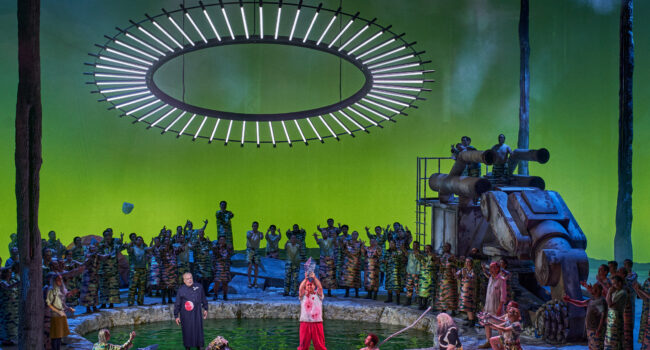
Through the opera, we encounter many odd solutions as far as this mise-en-scène scene is concerned. It is difficult to estimate how much the abundance of the floating AR images made the performance worse. It is sad to say (as we did after the 2023 premiere) that this attempt to integrate technology was less innovative than hoped for. It is interesting to report that many stated that these electronic feats might serve for a future Ring staging. Lo and behold, we did have a 150th Anniversary Tetralogy to this end, perhaps more intriguing now, yet almost unanimously despised. A small circle of us did defend the ‘experiment’ as bringing us Wagner in a novel way, playing on the psychology of symbols, filling the ambiance with historical and most abstract imagery. Scheib, on his own, was not able to convince us of his many messaged attempts which, in altering much of what Wagner has given us, led us astray, and did not follow through with Parsifal’s own steps towards renewing the world (as in Greek Tragedy) through the magic of Nature and the Good Friday Spell. The ending here has the Grail become a greenish chunk of lithium, a valuable mineral for the production of today’s ‘ecological’ car batteries. An idea, perhaps, but instead Parsifal smashes it to bits, and we wonder if he intends to tells us that the future is Grail-less, anticipating the messages of the anti-Christ in Nietzsche’s Also spoke Zarathustra. The final tableaux in itself was of interest, though sadly it was totally out of harmony with Wagner’s revelatory music. As if a snapshot of a ritual Nativity set of sorts, artifacts carefully placed about, the final tableaux seemed as a child of pure Theatricalism’s double role: that of artificial anti-Naturalistic mannerism through unnecessary dramatics, and that of rejecting the realism of esoteric spirituality. Yes, because after the Grail is smashed and the Magic Spear set down, Parsifal steps into a pool of polluted water with Kundry, she looking out to us as he glares towards the sun, or perhaps up to an ever-lasting Grail of light bulbs indicating a tomorrow. Today’s non-religious world captured in essence then? All appeared beautifully ritualistic to be sure, but that perhaps was due to Wagner’s music alone.
The eternal Hand Video Camera
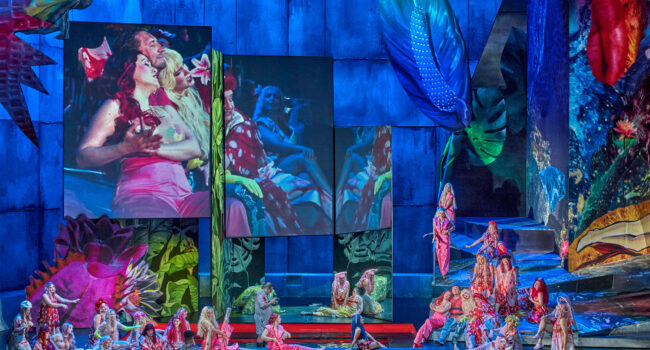
Among other questionable moments of this Parsifal, we have the use of a hand-held video camera, its operator following the Kundry double-figure as she sensuously hunts down Gurnemanz, used again in the psychedelic Act Two Flower Maidens seduction scene, on both occasions splashing their facial expressions across a giant upstage movie screen reminiscent of a 1960 drive-in movie lot. This occurs also in Klingsor’s Act Two ‘Garden of Temptations’ wherein close-ups of Parsifal in a spa pool are flooded with pretty maidens, all starring in a Hollywood film to come. Then, too, there is the moment that the evil Klingsor should throw the sacred spear at Parsifal maliciously; here, bizarrely, the devil simply saunters to him, stabbing at the ground near his feet, upon which Parsifal grabs the relic and pushes Klingsor down onto a convenient mattress where Kundry was sleeping. Comical, and sad. Here is where, indeed, some AR know-how might have resolved a perennial staging problem. The first transformation scene, when Gurnemanz leads Parsifal into the inner sanctum of the Grail Brotherhood itself, is disappointingly unmoving as all that happens is that giant halo of whitish fluorescent light bulbs is pulleyed over-head.
The final scene is a series of cherries on the cake, beginning with Parsifal’s “Den heil’gen Speer – ich bring’ihn euch zurück!” (“The holy lance – I bring back unto you!”) Kundry brings in the Tabernacle-covered Grail stone, and now the Mass will be celebrated. Lifting it to the heavens, Parsifal, in control, denounces “Open the shrine!”, only to smash it to bits to the astonishment of all (even some in the audience). The lance put to the floor, Parsifal wandered into the cesspool, “Remember me” tee-shirt and all, rising his arms towards in exhalation. Kundry is beckoned, and she wades knee-deep towards Parsifal as the moving final chorus resounds through the entire theater. Kundry n. 2 rises, and goes to hug Gurnemanz, yet the ring halo of light bulbs descends. Through all these distracting, not clearly motivated or moving actions, Wagner’s music soars as spiritually sound as the Grail, and thus indestructible.
Parsifal
Soft pacing, musically caressed
This time around, the fourth year of performances, Maestro Pablo Heras-Casado seems to have settled into his interpretation of the score, quite a natural process. The 3-hour-55-minute 2023 DGG cd, as too of a live broadcast, was now clocked in as 4-hours, just about identical. In essence, his reading of the score was investigative and always pliable as he transported the orchestra across the tonal plains of the Grail land. The sense of the orchestra’s breathing ever true to sensitive pacing was accompanied by a sense of lightness, more clarity than buoyancy, the instruments inter-locking in unison in perceptive manner. Thus then, not always Teutonic in presence, yet the stretches of spiritual crisis within all the characters was at times less expressive than desired, never over-burdened to be sure. What might have been uplifting, as redemption itself, at times escaped him. The stretches of symphonic exposition, the marches, scenes of diverse realities were elegantly portrayed, if at times all-too-refined. The chorus was as fine as it ever was, yet something took away from their verve, perhaps the staging itself. did not move them The second ‘transformation’ scene, being Titurel’s funeral march, from Gurnemanz’s “Mittlag” to the entrance of the chorus, was a bit as that of conductors like Boulez who, in never over-stepping bounds, remain seemingly a bit removed from the theatrical essences of all. The tension created by Wagner is tremendous, and it must be maintained – vibrato, painful, salvation-seeking and dissonant all in one. Here, all was slightly pedestrian, ‘cantabile,’ the timpani somewhat innocuous, the raspy brass less irritating. In all, the steps of the imagined pall-bearers must bear the weight of the saddened within a world of lost faith. The Chorus and their Chorus Master, Thomas Eitler-de Lint can only be complimented for leading the inhabitants of the mystical fairy-land of knights into such emotionally-involving pure sound.
Bayreuth is Wagner’s Monsalvat, and the artists who perform there seem to fill their roles with an added pinch of ‘chutzpah’ and do the composer no wrong, which, in reflecting, is quite a feat. True, the acoustics there are tailor-made so as to envelop their voices. Andreas Schager’s portrayal as Parsifal was again this year an amazing performance. He was outstanding also in the first-ever Rienzi. His is a remarkable, dutiful Wagner-tenor as we have heard many times in these recent years in Bayreuth. His acting is ever-forceful, full of energy, and his actual stage presence is noteworthy. Georg Zeppenfeld, a true Bayreuth staple (there were years when he sang three diverse roles), demonstrated all that was paternal about Gurnemanz when facing not only Parsifal, but also Amfortas, Kundry and the ubiquitous Kundry doppelgänger. Poor guy, however, as the music of the final scene lifted us up, he had to turn to stare belovedly into Kundry 2’s warm, yet blank face. He seemed a bit shocked, somewhat mystified, an awkward touch from the director Schieb in this rendition. The vocal presence, its delivery and mature dramatic interpretation have never abandoned his performances. The two great monologues were highlights of this AR version; his Act One narration of the history of the Grail and its present crisis: and in the Good Friday scene of Act Three, bringing us his optimism upon seeing Parsifal transformed, and perhaps the one who will save the Grail. He is so good at all he does related to Wagner that one may feel he ‘is’ the personage himself. Some prefer his Gurnemanz to any other role he assumes, yet his King Marke (Tristan und Isolde) and Han Sachs (Die Meistersinger) leave little to be desired. As the guardian of the Grail, the wounded, guilt-ridden Amfortas of Michael Volle was a strong portrayal of an embittered, frustrated knight, burdened by his failed leadership. Many of his interpretations reflect his great ability as a Lieder singer, and thus he relies here too on the stage in creating ‘movement’ through vocal inflection. The role is excessively dramatic, and the vocal lines harsh, yet for Volle, all is so controlled, balanced, that his inner thoughts surface. Let us not forget that he sang Wotan in this Ring 2026 run of performances. The role call for slightly different vocal characteristics during a single performance, but this presents no problem. Yes, his Amfortas is more than dramatic, acute and full of tension.
Parsifal
Jordan Shanahan was impressive as the fallen angel Klingsor, embittered enemy of the Grail. His imposing figure clothed in a pinkish suit dominated the space surrounding a Hell of his own making. His menacing long hair topped off by a devil’s horns all symbolized his evil intentions and power over the weak serving him. Vocally robust, yet without excessive force, his psychological portrayal of one of Wagner’s potent villains was memorable. The dramatic soprano Miina-Liisa Värelä made her Festspielhaus debut as Kundry, and she indeed appeared as the ambiguous seductress of complicated psychological depth. Her acting, through natural stage presence, brought nuance and interest to one of Wagner’s most demanding roles, vocally and dramatically, and her Second Act monologue captured the essence of her interior struggle of choosing between sin and redemption. In this version, she remains standing close to Parsifal in the end, looking out to us waywardly, again enigmatically; if it is a divine deliverance we will never know. A challenge won over, then, and not a small one at that. Remember that Maria Callas face it, recording and performing Kundry in 1950.
Vitalij Kowaljow as the ageing Titurel appeared ghostly, willowy, and was deeply moving in the First Act’s Grail scene; there was something of Christ about him. His nobility of presence and voice moved us as he had more to do in this production thanks to another unwarranted Scheib invention. Instead of singing from a removed chamber, Titurel wanders in, and to the shock of all, partakes in the Mass, drinking the blood of Christ. This is also invented because it is the pure light (be it Nirvana or not) emanating from the chalice that rejuvenates them, and his repeated pleas to them to “uncover the Grail” signal some of the most poignant moments in all. Here, he then wakes, but is now youthful, saved, making all that follows in Wagner’s opera useless as he and those present in the Grail must no longer await the pure fool’s return with the spear, having defeated the fallen angel, Klingsor, negating all that relates to Parsifal’s pilgrimage to challenge the forces of evil in order to win the spear with which he can heal Amfortas. Schieb perhaps forces the issue of demonstrating how religion can act as a drug, it being, of course, false spirituality. This scene, as Wagner wrote it, is pivotal as the very existence of the Grail itself hangs on the negative turn of events that is the drama’s story-line.
Mention goes to the Grail Knights, Daniel Jenz, Tijl Faveyts, and also to the esquires, Lavinia Dames, Natalia Skrycka, Manuel Günther, and Martin Koch. Of the six flower maidens, we discover the return of Victoria Randem, the Wood-bird in Siegfried, as also the Voice of the Messenger of Peace in Rienzi: Marie Henriette Reinhold, doubling also as the off-stage alto solo. The others were Catalina Bertucci, Lavinia Dames, Evelin Novak, Natalia Skrycka.
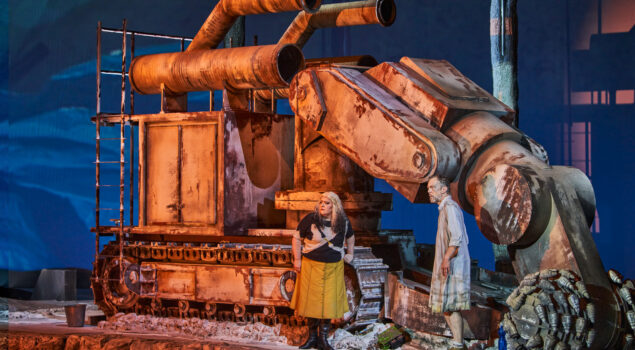
The technical crew included Mimi Lien for the scenography, Meentje Nielsen as the Costume designer, Rainer Casper for Lighting and Joshua Higgason for the Videos (no AR visions here). Marlene Schleicher researched the dramaturgical content. Giving physical presence to Scheib’s staging requirements, one must say these artists merit credit. The costumes were not at all appealing, and at times ridiculous, but let us leave it at that. Persifal’s “Remember Me” tee-shirt was not her idea, one would bet. The lighting was well-done, and in many ways, the scenery was captivating: the Grail of Act One with its metal, monolithic a post-Industrial Deconstructionist tower, Klingsor’s Act Two realm as a brick wall, with a rectangular opening to show the flames of hell was intriguing, and the industrialized territory of the Grail of Act Three were most interesting, what with that seemingly broken-down cobalt excavator resembling a tank with hand grenades for wheels, war-like. The center stage knee-deep pool of green water representing ecologic disaster.
Sad, though, that the ideas needed to bring this dystopic world of the future closer to us never materialized, as too the additions and modifications to Wagner’s intentions only drove us away.