Regietheater. Intellectual terror through compelling prescription.
Bismarck and the Opera
One of the most far-reaching laws of the Kulturkampf was the Jesuit Law of July 4, 1872: the Society of Jesus was banned, and the Jesuits were expelled from the German Empire. Why the Jesuits, of all groups?
Chancellor Otto von Bismarck and the liberal majority in parliament viewed the Society of Jesus (the official name of the Jesuit Order) as the ultimate symbol of “ultramontanism.” This was the movement within the Catholic Church that was blindly loyal to the pope (“beyond the mountains,” i.e., Rome) rather than to its own national government. Jesuits were known as highly educated intellectuals who wielded enormous influence, and they were regarded as a direct threat to the new German Empire.
These days, with the events of ’40–’45 in mind, we are no longer so keen on expelling racially or religiously defined groups from the country, even if our own culture is being threatened relatively suddenly and quite drastically. Resistance to demonstrably undesirable infiltration is timidly expressed, for fear of being labeled a neo-fascist, xenophobe, dinosaur, fascist, Alt-right, conspiracy theorist, racist, reactionary, or fossil. Nationalism -the ultimate unifying force based on shared identity, culture, and solidarity- has gotten a bad name.
It’s the society, stupid
In opera, one sees the same trend. Developments that, a priori, were welcomed by virtually no one, are taking root because no one dares to take up the Roundup for fear of exclusion from the high-and-mighty progressive circles who consider themselves the guardians of modern life.
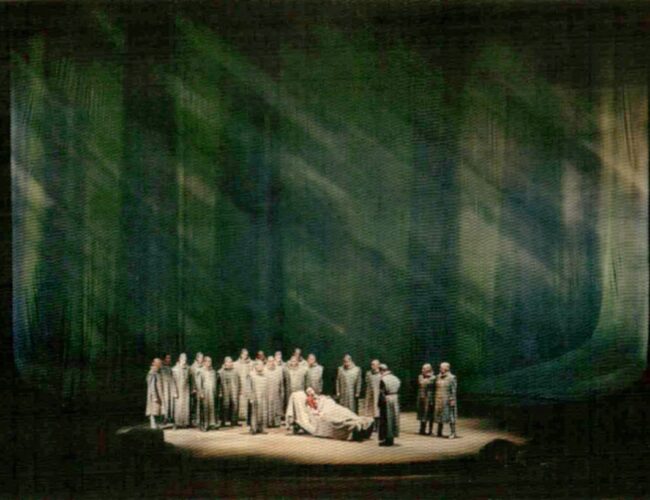
The dictatorship of the opera director has turned the opera world into an ideological and aesthetic battlefield, in which the score and the creator’s original intent have been systematically sacrificed on the altar of directorial narcissism for decades. What began in 1951 as an almost clinical aesthetic intervention by Wieland Wagner -who sought to liberate the Bayreuth Festival from its burdened traditions with his minimalist and stripped-down productions- degenerated in the 1970s into a destructive artistic totalitarianism: the uncompromising and radical Regietheater.
From that turning point in theater history onward, stage direction definitively and violently laid claim to the legacy of the classical masters. The historical setting was unceremoniously thrown out, and the libretto was relegated to a non-binding, optional text. Instead, political or psychological themes -purely and solely as the director saw and interpreted them through his or her own private vision- became the absolute and guiding dictates in the operas of Mozart, Wagner, and tutti quanti. The autonomy of the work of art was thereby rendered fluid; from then on, every masterpiece had to bow to the ideological whims of the man or woman in the director’s chair.
The Fury in the Auditorium: The Audience Demands Respect
However, from the very moment it was conceived, this theatrical tyranny met with legitimate, deep, and fierce anger. True opera lovers, who -rooted in a deep-seated tradition- placed far greater value on the artistic trinity of composer, librettist, and soloist, would not tolerate this usurpation of their beloved art form. They reacted furiously, booing loudly during the farcical premieres of that era. The general sentiment among the audience -and particularly among those who were wrongly labeled “purists”- was clear: people believed, not unreasonably, that the director should approach the score and libretto with the necessary respect. They had no use for narcissistic fantasies that were forcefully imposed on the audience and the performers.
It is therefore entirely logical that the term “Regietheater” was still generally regarded in the professional reviews and critiques of the 1970s as a purely negative slogan, a well-aimed aesthetic epithet, and a critical condemnation. It was a term used specifically to brand those productions in which the director elevated himself above the artwork in a far too dominant, dictatorial, and destructive manner. It was an open warning against the devaluation of music in favor of a particular ideology.
The Rebellion on Stage: Conductors and Singers Take Up Arms
But the rebellion and deep discontent certainly did not originate solely from the anonymous darkness of the theater auditorium. Behind the scenes and on the stage itself, massive and principled resistance also arose. Many conductors and singers -the true artisans tasked with bringing the music to life- vehemently and consistently opposed this disgraceful state of affairs. The reason for this was as clear as it was painful: the radical, often egomaniacal interventions of the first Hochstapler who came along, calling himself a director, constantly and directly clashed in practice with the internal musical logic, with the vocal technical requirements of the human body, and with the original, deep emotional charge of the composition. All too often, the singer was reduced to a lifeless puppet in a “conceptual” set that actively sabotaged the organic flow of the music. A word of caution: always be on your guard when the word “concept” comes up in the context of opera.
Consequently, the criticism from the absolute giants of the international music world has been unsparing over the years. They mercilessly pointed out the sore spot of the over-the-top “concept” staging.
When the audience has had enough…
- In 2022, Swiss conductor Philippe Jordan launched a scathing attack on the state of affairs in the international opera world. He bluntly called the artistic misstep a “fatal, wrong path” that is inevitably plunging the art form into the abyss.
- Maestro Christian Thielemann has repeatedly and forcefully warned that music must remain the absolute priority at all times and under all circumstances. He criticized directors who make the staging so unnecessarily complex, top-heavy, or downright absurd that it physically hinders the singers in their grueling vocal work, or that it fundamentally and irreparably ruins the acoustics of the stage.
- Nikolaus Harnoncourt, the legendary pioneer who spent his entire life tirelessly searching for the composer’s original intent and authentic sound world, expressed his deep and fundamental frustration with directors who shamefully abuse operas to satisfy their own egos. His position was crystal clear: a staging must, under all circumstances, serve the score, rather than mercilessly drowning out the music with irrelevant visual gags, cheap effects, or ridiculous anachronisms.
- Sir Simon Rattle drew the line even more sharply, if possible, and pinpointed the intellectual and musical poverty that underlies many modern productions. He subtly pointed out that many contemporary directors simply cannot even read the score. The logical and painful consequence of this is that these directors devise scenes that run diametrically opposed to and clash head-on with what is happening in the orchestra at that exact moment—a testament to a shocking, profound arrogance and a fundamental lack of craftsmanship.
The Intellectual Void of Conceptual Hijacking
Anyone who considers these arguments can reach only one inescapable conclusion: Regietheater has not liberated opera from its historical chains, but has brutally hijacked it. It is a testament to boundless intellectual and musical hubris to stage a work of art that one cannot even understand in the most fundamental, musical sense. When the visual gimmick becomes more important than musical phrasing, and when acoustics must give way to the megalomaniacal set design of a narrow-minded director who cannot read a single note, the boundaries of artistic freedom have long since been crossed. Opera is and remains an auditory universe; anyone who refuses to acknowledge this does not belong in the theater, but in a museum of misplaced ego-documents, where on Sunday afternoons the Waldorf School Concert and Circus Roncalli take turns performing.
A Capitalist Drama
Patrice Chéreau (Bayreuth, 1976) is the forefather of modern “Regietheater” scandals. His Ring from that era was rewritten as a capitalist drama set during the Industrial Revolution: Wotan in a Victorian costume and the Rhine Daughters as the inevitable prostitutes, gathered merrily around a hydroelectric dam. Hans Neuenfels transformed (Bayreuth, 2010) the medieval Brabant of Lohengrin into a sterile, dystopian laboratory filled with gigantic lab technicians and rats. The production is known in the opera world as the “rat Lohengrin.” For his Idomeneo (Frankfurt/London, 2020), Martin Kušej conjured up a real, gigantic, dead, bleeding shark on stage, surrounded (of course) by half-naked extras. Calixto Bieito, of course, cannot be left off this list. His legendary staging of Un Ballo in Maschera (Barcelona, 2000) opened with a scene in which gay members of parliament were sitting on the toilet defecating while reading the newspaper. The production was filled with explicit homosexual acts, murder, rape, and graphic violence. It earned him one of the loudest and longest booing sessions in opera history. We’ll also briefly mention, directed by Burkhard Kosminski, the Tannhäuser set in a Nazi concentration camp, in which a family was gassed in glass booths.
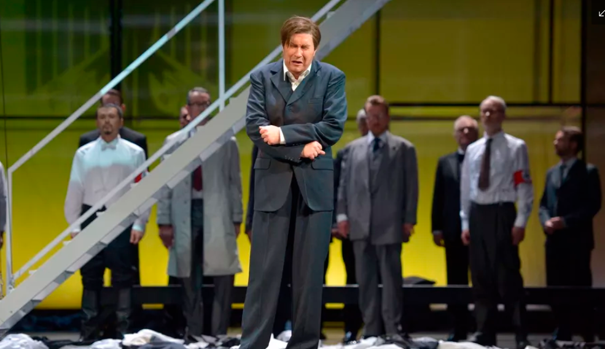
The Dutch National Opera
For decades, the Dutch National Opera (DNO) in Amsterdam has embraced “Regietheater” as its core artistic discipline: operas are consistently “updated,” that is, adapted to the modern era. From Artistic Director Pierre Audi to Artistic Director Sophie de Lint, the Amsterdam opera house has been a European stronghold for directors who deconstruct the historical context of the libretto and replace it with contemporary, “conceptual” frameworks. Our independent magazine Opera Gazet -no advertisements, no government funding- has always been the most vocal and principled critic of this approach.
The Dutch National Opera believes that an opera only truly connects with the audience when its universal themes -such as power, lust, jealousy, or existential crisis- are mirrored in contemporary society. This leads to radical interventions. In productions such as Puccini’s Turandot, directed by Barrie Kosky, all traditional Chinese sets and references were eliminated to make way for an abstract, “psychological” mirror palace. Not so long ago, the Dutch National Opera (DNO) overplayed its hand with the (internationally recognized as such) completely insane Fidelio by the Ukrainian guest director Andriy Zholdak:. https://www.operagazet.com/the-dutch-national-opera-and-its-institutional-failure/
Such a debacle would cost people their jobs in the business world, but failure is no cause for concern in subsidised institutions like the Dutch National Opera.
“Even a fool who keeps silent is considered wise; when he closes his lips, he is deemed intelligent.” Proverbs 17:28
Where other media opt for a “both-sides-of-the-story” or “nuanced” approach (sitting on the fence), the online opera magazine Opera Gazet takes an unequivocal, fierce stance against “staged theater.” We explicitly position ourselves as the voice of the sincere opera lover and wage a constant battle against “subsidized iconoclasm” . Our criticism of the Dutch National Opera’s policy is fundamental and rests on three pillars:
1 The inviolability of the source material: directors have a duty to respect the score and the historical staging as intended by the composer and librettist. The productions in Amsterdam are not infrequently the “narcissistic fantasies” of intellectually challenged individuals, detached from the authentic libretto – and thus from the authentic opera.
2 Visual distraction from the music: an excess of shocking (often distasteful), political, or anachronistic imagery prevents the audience from enjoying the music. The shoddy staging works against the score rather than serving it.
3 Alienation of the audience: Dutch National Opera has long since lost touch with its own knowledgeable audience by completely banishing opera “as is,” thereby alarmingly depriving the audience of access to its own musical and cultural roots.
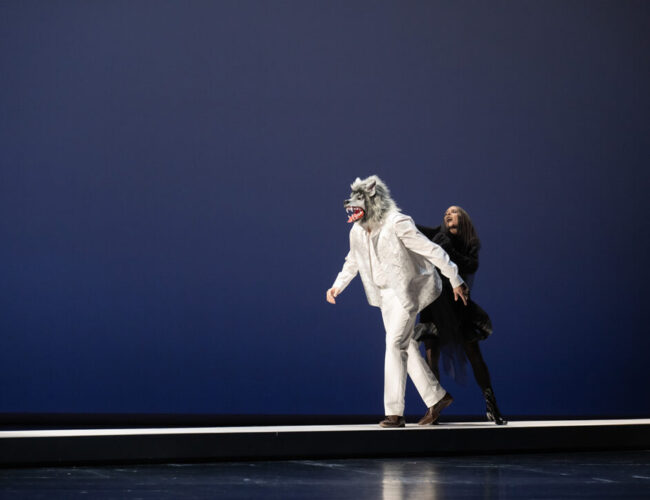
This fundamental conflict has led to a new ice age that continues to this day, with a drafty little shack (paid for by us) for Opera Gazet on the ice plain and a lavish palace -financed by taxpayers- for DNO, the latter complete with an exorbitantly expensive law firm. Tensions exist among the inhabitants of the ice plain. DNO is throwing all its resources into the battle; The Dutch National Opera is the only institution in the world that refuses to provide press facilities to the reviewers of Opera Gazet because of our unsparing criticism. We have not only become the loudest critics of “Regietheater” in Amsterdam, but also the symbol of resistance against an arrogant ideology of snobs for snobs.
We are often accused of exercising an “aesthetic-conservative” veto. For us, the concept of “Regietheater” is inherently flawed, and that conviction has nothing to do with being “conservative” but everything to do with exposing narrow-minded, snobbish nonsense. We view the libretto and the original historical setting as immutable laws. As soon as a haphazard director at DNO transposes an opera to the modern era, we brand the production as a failure.
We view misguided directors like Calixto Bieito or Dmitri Tcherniakov -regular guests at DNO- as intruders who hold the composer’s legacy hostage for their own political agenda. A fierce, polemical tone -a pointed rebuke of the new bourgeoisie- is particularly appropriate in this context.
Olivier Keegel